
The power semiconductor industry has traditionally been viewed as a mature market with relatively balanced supply and demand. However, market attention intensified after China announced an export ban in September 2025, prohibiting Nexperia from exporting power semiconductor products manufactured and packaged in China. As most of Nexperia's assembly and testing capacity is located in China, the restriction directly disrupted the global supply chain, significantly tightening market supply. As a result, the power semiconductor industry has gradually shifted from a mature market to one with clear structural growth potential.
What Are Power Semiconductors?
Power Semiconductors Are Primarily Used for High-Voltage, High-Current Control and Power Conversion
Semiconductor devices can generally be divided into active and passive components based on their functions and physical characteristics. Active components mainly include integrated circuits (ICs), discrete devices, and optoelectronic devices. Discrete devices are a key category of power semiconductors and can be further classified into diodes, transistors, and thyristors. These devices are designed to independently handle high voltages and high currents while performing power conversion and control functions.
Since they do not need to be integrated into complex IC logic circuits, power semiconductors have developed into an independent product category. Today, they are widely used across information and communication equipment, consumer electronics, automotive electronics, aerospace, industrial equipment, and medical devices, making them indispensable components for ensuring the stable operation of modern electronic systems.
| Device Category | Primary Function | Characteristics | Products |
|---|---|---|---|
| Diodes | Rectification / Protection | One-way current conduction | Rectifier Diodes |
| Small-Signal Transistors | Signal Amplification | Power < 1W | BJT |
| Power Transistors | Power Conversion / Switching | Power > 1W | MOSFET, IGBT |
| Thyristors | Current Switching / Voltage Regulation | Current Control | SCR, TRIAC |
Table 1. Comparison of Discrete Semiconductor Devices
Source: CTBC Securities
Diverse Product Categories and End Markets Result in a Highly Fragmented Industry
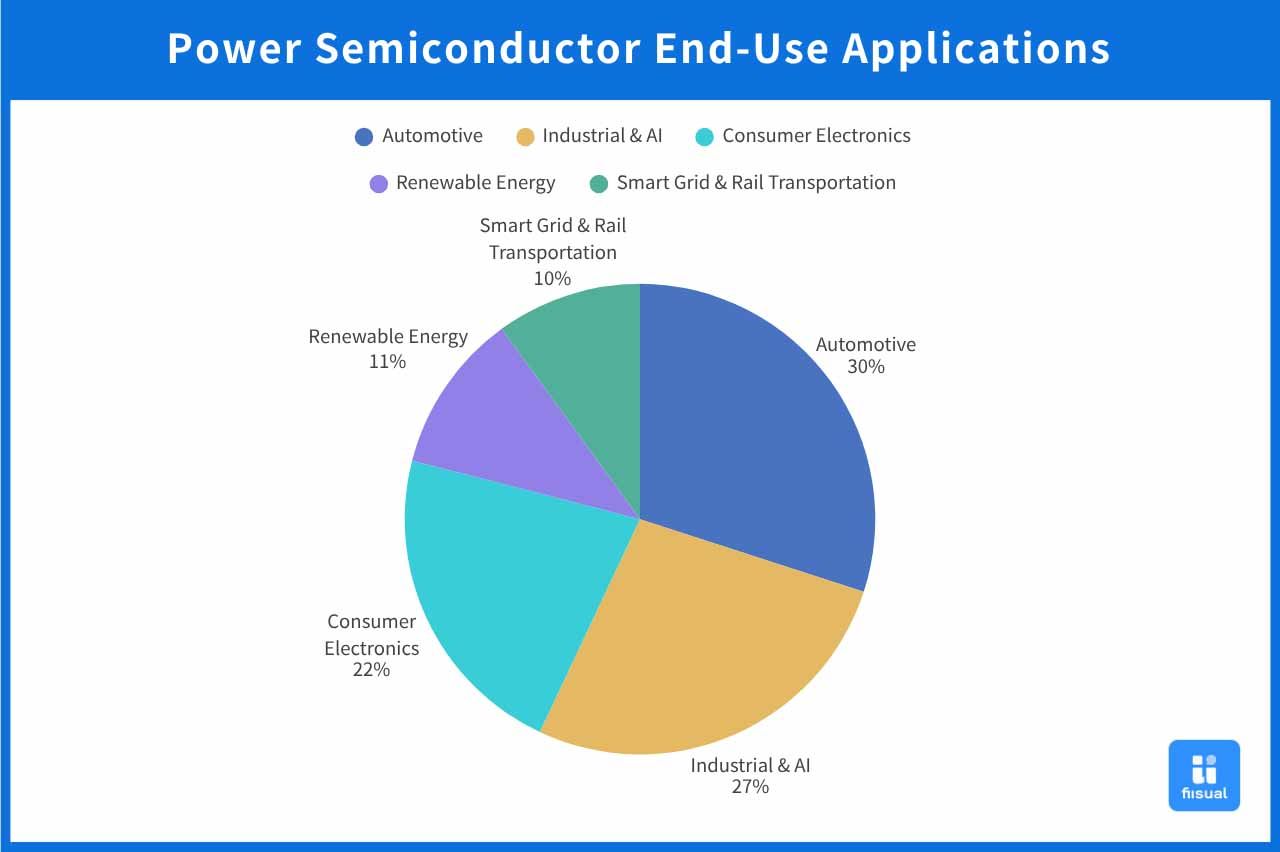
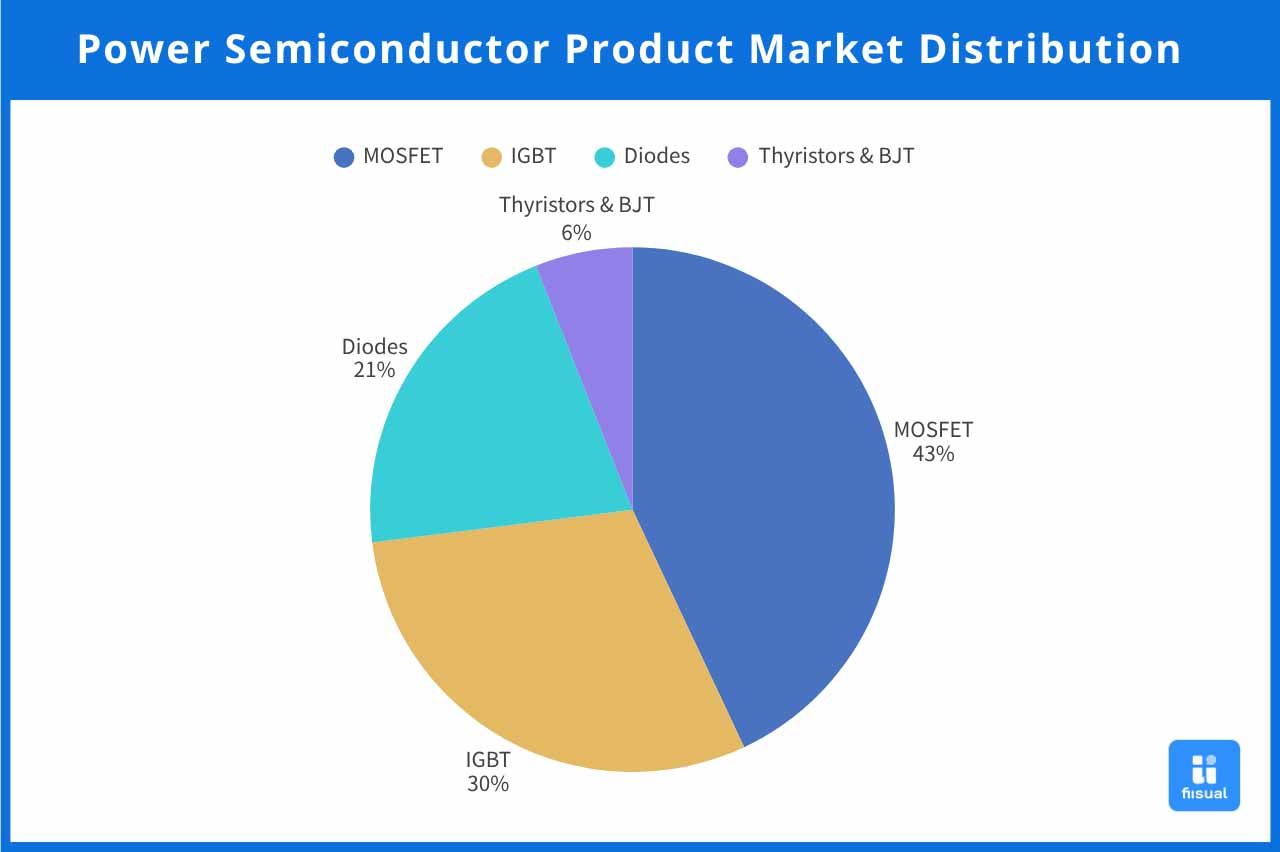
The power semiconductor market is highly fragmented due to its broad product portfolio and wide range of end-use applications.
Source: WiseWeb Research, HEC Research, Huaxin Securities, Forbond Securities
By end market, automotive is the largest segment, accounting for 30% of total demand. Industrial and AI applications follow at 27%, while consumer electronics and renewable energy account for 22% and 11%, respectively. The remaining share comes from applications such as smart grids and rail transportation.
Source: WiseWeb Research, HEC Research, Huaxin Securities, Forbond Securities
By product category, MOSFETs, IGBTs, and diodes account for 43%, 30%, and 21% of the market, respectively, benefiting from mature technology, strong cost competitiveness, and broad application coverage. The remainder consists of BJTs and thyristors. This highlights the industry's diversified product mix and application base, making it difficult for any single product or end market to dominate.
IDM Companies Dominate the Global Power Semiconductor Market
Given the highly diversified product portfolio and end markets, manufacturers typically specialize in different products and application areas based on their technological capabilities, product portfolios, and customer bases, resulting in a highly differentiated competitive landscape. Nevertheless, most leading companies operate under the Integrated Device Manufacturer (IDM) model, managing design, wafer fabrication, packaging, and testing in-house. This approach helps ensure manufacturing quality, provides greater flexibility in capacity allocation, and better satisfies customers' stringent requirements for long product lifecycles, high reliability, and consistent performance.

Source: WiseWeb Research, HEC Research, Huaxin Securities, Forbond Securities
Infineon leads the global market with a 13.5% share, followed by Texas Instruments at 8.5% and onsemi at 6.8%. All remaining suppliers collectively account for more than 80% of the market, reflecting the industry's relatively low concentration and highly fragmented competitive landscape.
Recovery in Automotive and Industrial Demand Supports Steady Market Growth
Source: IBF Securities
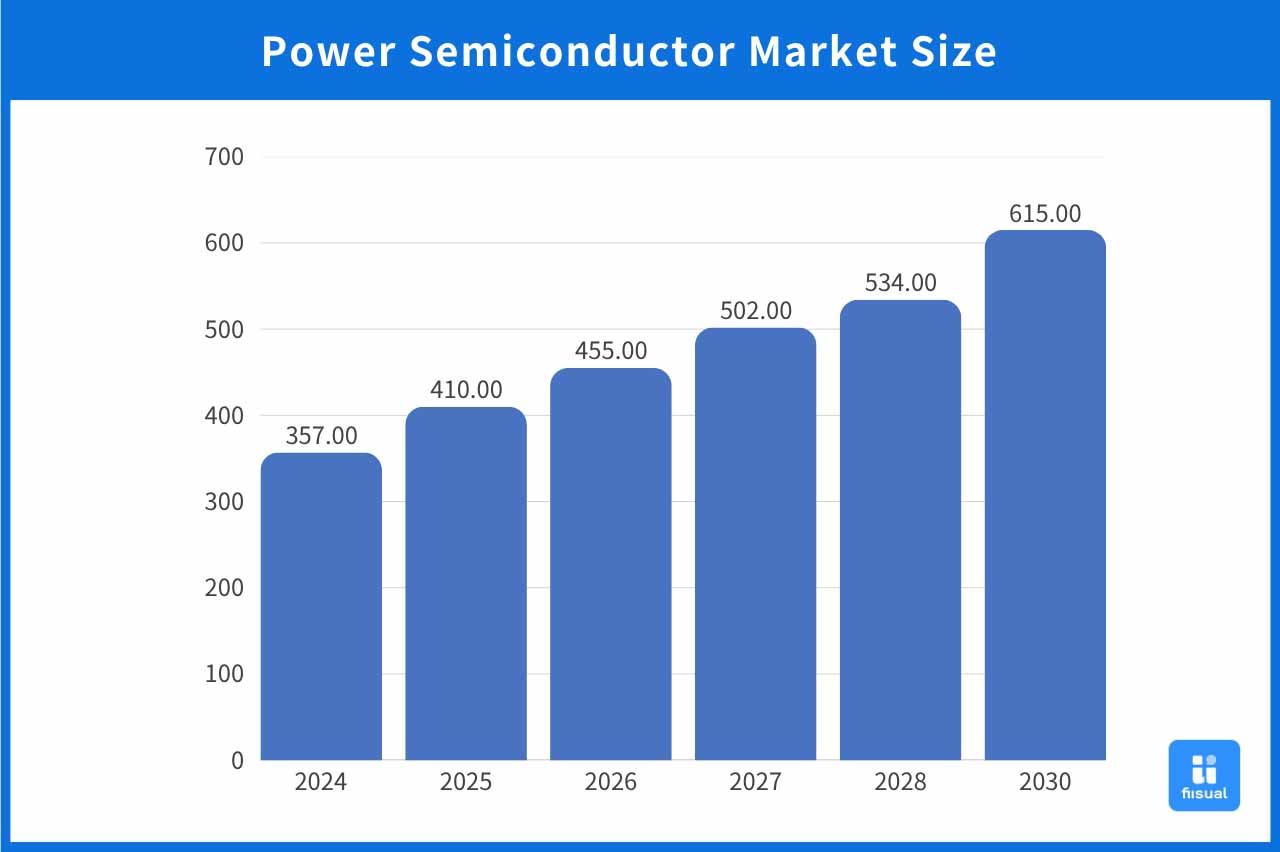
On the demand side, power semiconductors have historically been supported by traditional end markets such as automotive, industrial, and consumer electronics, with automotive and industrial applications together accounting for more than half of total demand, providing a relatively stable foundation for the industry. As inventory levels normalize and product specifications continue to improve, the global power semiconductor market is projected to grow at a compound annual growth rate (CAGR) of approximately 8%, increasing from US$35.7 billion in 2024 to US$61.5 billion by 2030.
The automotive market is gradually entering a restocking cycle as customer inventories return to healthy—or even below-normal—levels, leading to improving order momentum. Meanwhile, the ongoing trends toward vehicle electrification and software-defined vehicles are expected to sustain robust demand for automotive power devices, MCUs, and sensors. Industrial demand is also recovering, supported by normalized channel inventories, improving manufacturing activity, and increasing investment in automation and energy efficiency, all of which contribute to the steady expansion of the power semiconductor market.
AI Rack Upgrades Drive Higher Power Semiconductor Content
As AI computing demand continues to increase, rack power consumption and power delivery specifications are advancing accordingly. NVIDIA's next-generation Vera Rubin GPU is expected to increase its thermal design power (TDP) from approximately 1,400W to 2,300W. Maintaining the existing low-voltage power architecture would significantly increase transmission losses, copper usage, and cooling requirements, accelerating the adoption of high-voltage DC power architectures in AI servers and data centers.
Under the new high-voltage DC architecture, external AC power is first converted into 800V DC before being stepped down through hot-swap protection circuits, high- and medium-voltage intermediate bus converters, and point-of-load converters to the operating voltage required by AI processors. Power Supply Units (PSUs) and Battery Backup Units (BBUs), which serve as the primary power source and backup systems, require large numbers of power semiconductors for AC/DC conversion, charging and discharging control, and circuit protection. Power Delivery Boards and 48V Bus Converters handle power distribution and voltage conversion, making them key deployment points for power devices and protection components. GPU boards also rely heavily on power semiconductors for precise voltage regulation and overcurrent protection under high-current loads, while Smart NICs require dedicated power conversion and protection devices.
Overall, AI rack power density is expected to increase by roughly 15 to 25 times by 2027, driving significant increases in both power conversion stages and power phases. Demand for power management components is expected to grow by approximately two to three times, while accelerating the adoption of high-efficiency devices such as Super Junction MOSFETs and silicon carbide (SiC) power semiconductors. As rack power specifications continue to evolve, the value of power semiconductor content per rack is projected to increase dramatically from around US$2,500 in 2024 to approximately US$50,000 by 2027, providing a powerful structural growth driver for the industry.
AI Demand Creates Capacity Constraints, Shifting the Market Toward Sellers
As AI rack upgrades significantly increase power semiconductor usage per system, industry supply and demand are becoming increasingly tight. Because AI customers are willing to pay premium prices to secure supply, capacity allocation has begun to resemble the crowding-out effect previously seen in the memory and passive component industries, reducing supply available for other end markets.
Even with suppliers prioritizing capacity allocation, demand continues to exceed supply. Channel data indicates that Infineon's product prices have already begun to rise, while lead times have extended to between 12 and 52 weeks. Infineon implemented price increases of approximately 5% to 15% beginning on April 1 and plans another round of increases starting July 1, signaling the beginning of a new pricing cycle for the power semiconductor industry. Beyond rising raw material costs, the primary driver has been structurally tight supply caused by rapidly expanding AI data center demand. Certain high-end power devices have already entered allocation status, indicating that the market is gradually shifting toward a supplier-driven environment.
| Company | Effective Date | Products | Price Increase |
|---|---|---|---|
| Infineon | 2026/4/1 | Power switches, IGBTs | 5–15% |
| Infineon | 2026/7/1 | Automotive-grade and high-voltage modules | 10–20% |
| STMicroelectronics | 2026/4/26 | Power devices, MCUs | <15% |
| Texas Instruments | 2026/7/1 | Analog devices, Power Management ICs | 5–15% |
| Silan Microelectronics | 2026/3 | — | >10% |
Table 2. Selected Power Semiconductor Price Increases
Source: Company Websites
Customers Accelerate Diversification Away from China-Based Supply Chains, Creating Opportunities for Taiwanese Suppliers
Although the global power semiconductor market remains dominated by international companies, several Taiwanese manufacturers are well positioned to benefit from supply chain restructuring and order transfers. Beginning in October 2025, geopolitical developments weakened the supply stability of Nexperia's European and Chinese operations, raising concerns over shortages of MOSFETs and small-signal devices. Customers responded by increasing safety inventories and accelerating supplier diversification. Subsequently, Chinese IDM supplier Yangjie Technology was sanctioned by the U.S. and Europe in April 2026 after being accused of supplying more than 200 dual-use technologies to Russia during the Russia-Ukraine war, including products associated with drones and ammunition. This prompted many international customers to reassess their sourcing strategies, further accelerating supply chain diversification away from China. In automotive and industrial markets, where product qualification cycles are long and supplier switching costs are high, customers have become increasingly proactive in establishing alternative supply sources, creating clearer opportunities for Taiwanese suppliers through both higher penetration among existing design-in customers and faster adoption in new projects.
Key Taiwanese Companies
PANJIT International Inc. (2481.TW)
Founded in 1986, PANJIT is an IDM power semiconductor manufacturer with in-house chip design, wafer fabrication, packaging, testing, and global sales capabilities. The company's core products include diodes and MOSFETs, serving automotive electronics, AI servers, power supplies, industrial control, consumer electronics, and other applications.
The company's competitive advantages include its fully integrated manufacturing capabilities, comprehensive product portfolio spanning small-signal to medium- and high-voltage power devices, automotive-grade certifications, long-term customer relationships, and diversified manufacturing footprint across Taiwan, China, Vietnam, and the Philippines. These strengths enhance delivery reliability and production flexibility while positioning the company to benefit from global customers' multi-sourcing strategies and growing demand for non-China supply chains.
Looking ahead, key growth drivers include rising power density in AI servers, which is increasing both the specifications and content of power devices. PANJIT has already entered the supply chain of a major U.S. cloud service provider (CSP), with increasing shipments of medium- and high-voltage MOSFETs expected to raise AI-related revenue contribution and average selling prices. Its automotive business is also expected to benefit from increasing electric vehicle adoption and supply chain diversification. In addition, the company continues expanding packaging and testing capacity in Xuzhou, Vietnam, and the Philippines while improving its revenue scale and profitability through product price increases and a higher proportion of premium-margin products.
Advanced Power Electronics (APEC) (8261.TW)
APEC is a Taiwanese power semiconductor company specializing in medium- and high-voltage MOSFETs. Its products are primarily used in switching power supplies, DC fans, computing systems, and display applications, with switching power supplies and DC fans currently representing its largest revenue contributors.
The company's competitive strengths include an expanding portfolio of medium-voltage MOSFETs and early reservations of wafer capacity for high-voltage products, helping mitigate supply constraints. In addition, its DC fan products have entered the supply chains of Taiwan's two largest cooling fan manufacturers, providing a solid foundation for expanding its presence in the AI server market.
Future growth is expected to be driven by increasing AI server power consumption and cooling requirements, boosting demand for 80V medium-voltage MOSFETs, power supply products, and DC fan applications. Combined with rising market share in switching power supplies and DC fans, these factors are expected to support continued revenue growth. The company also plans to gradually pass through higher foundry and packaging material costs through price increases, further supporting profitability.
Conclusion
Overall, the power semiconductor industry is transitioning from a mature cyclical market to a structural growth story driven by AI computing, vehicle electrification, industrial automation, and global supply chain restructuring. As AI rack power density and power delivery architectures continue to evolve, the volume, specifications, and value of power semiconductor content per system are increasing significantly, driving rapid demand growth for medium- and high-voltage MOSFETs, IGBTs, SiC devices, and protection components. Meanwhile, the automotive and industrial markets are entering a restocking cycle, providing an increasingly solid demand foundation.
On the supply side, major international manufacturers are prioritizing production of high-end products, while geopolitical developments and increasing demand for non-China supply chains are tightening overall supply. As the market gradually shifts toward a seller's market, longer lead times and recurring price increases are expected to improve industry profitability. Taiwanese manufacturers are well positioned to capitalize on these trends through comprehensive product portfolios, reliable supply capabilities, automotive-grade certifications, and diversified manufacturing footprints, enabling them to capture increasing order transfers from global customers.
