
As AI demand grows rapidly, the expansion of accelerated computing is driving a shift from traditional data centers toward high-density AI factories. This is fundamentally reshaping data center design, with power availability increasingly becoming a key bottleneck to scaling AI infrastructure. 800VDC is viewed as a practical and scalable solution for building next-generation AI infrastructure. NVIDIA published a related white paper last October outlining the technical rationale and feasibility of adopting 800VDC power distribution. Over the past year, the industry has made significant progress. Current and upcoming hardware systems are gradually adding support for 800VDC input while adopting an 800VDC-to-54VDC power architecture compatible with existing AC/DC systems. The latest white paper also outlines the industry’s priorities for the coming year, including accelerating equipment development, validating system performance, advancing pilot deployments, and improving relevant standards and regulations. It also emphasizes that 800VDC is not intended to replace existing 415/480VAC systems, but rather to serve as a complementary deployment option that can coexist with them.
NVIDIA’s Current AC and Future 800VDC Power Solutions
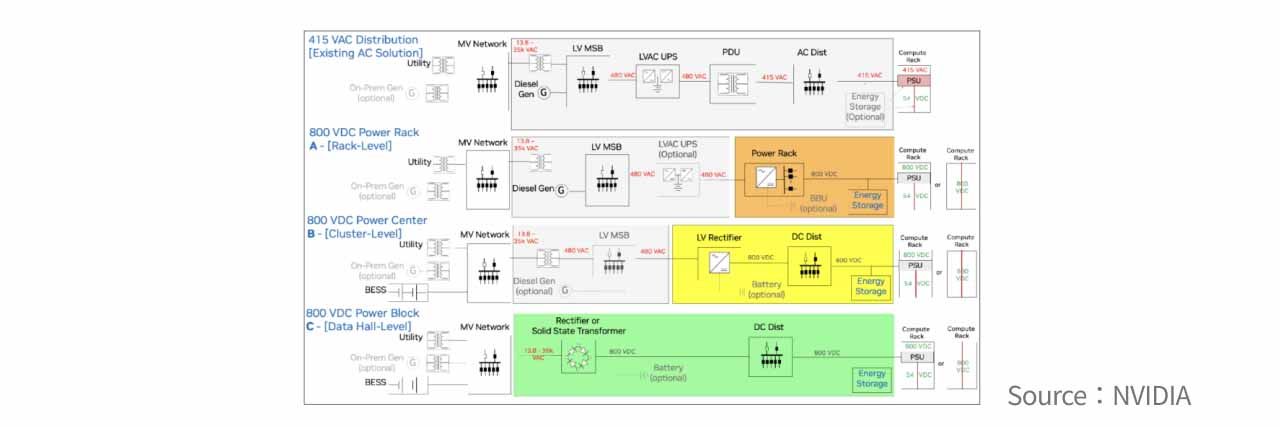
Since existing data center UPS and PDU infrastructure is primarily based on AC or low-to-medium-voltage DC systems, a full conversion to an 800VDC distribution architecture would require substantial equipment replacement and conversion costs. As a result, initial 800VDC deployments will focus primarily on GPU compute areas, where rack power is increasing the fastest and the efficiency and capacity advantages of high-voltage DC distribution are most evident. This approach of gradually introducing 800VDC in high-power areas allows it to be deployed at the rack, row, or specific compute-unit level while retaining existing power infrastructure. This reduces the cost and deployment risks associated with large-scale retrofits, accelerates practical adoption of 800VDC, and allows AC and DC distribution systems to coexist during the transition period. In the latest white paper, NVIDIA also proposes three 800VDC deployment architectures. These architectures are not sequential stages that data centers must follow. Instead, operators can flexibly choose among them based on existing infrastructure, construction timelines, business priorities, and target compute density, allowing data center power systems to transition toward 800VDC through targeted deployment and gradual expansion.
Current AC Power Architecture
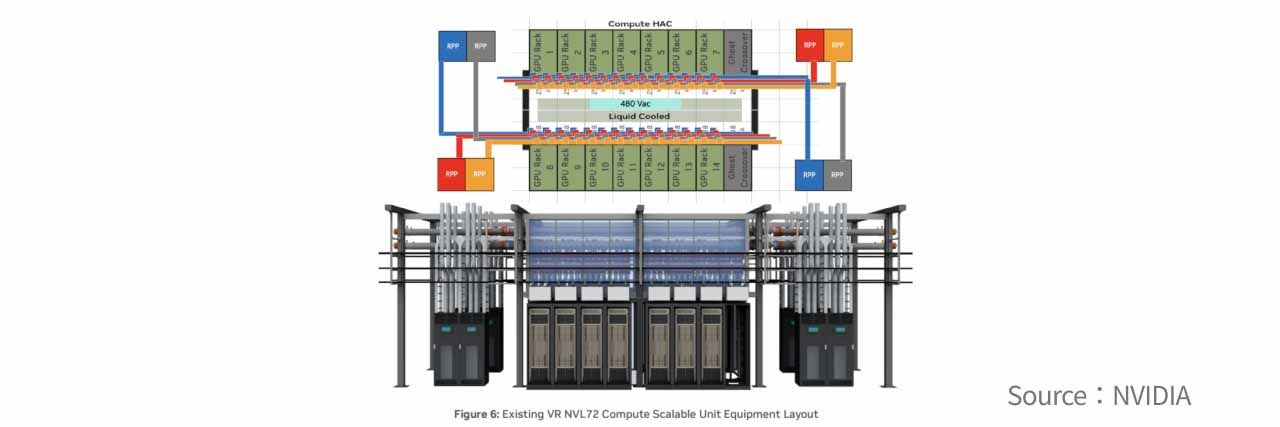
NVIDIA’s current data center power architecture uses a standard AC deployment model that retains the traditional UPS and PDU distribution design. The architecture distributes power through 480VAC, 100A AC power whips, and a 4-to-make-3 redundant power-feed configuration. Under this architecture, AC power is delivered directly to the compute rack’s power shelf, where it is converted into low-voltage DC.
Next-Generation 800VDC Power Solutions and Architecture Evolution
800VDC Option A: Power Racks Positioned Next to Compute Racks
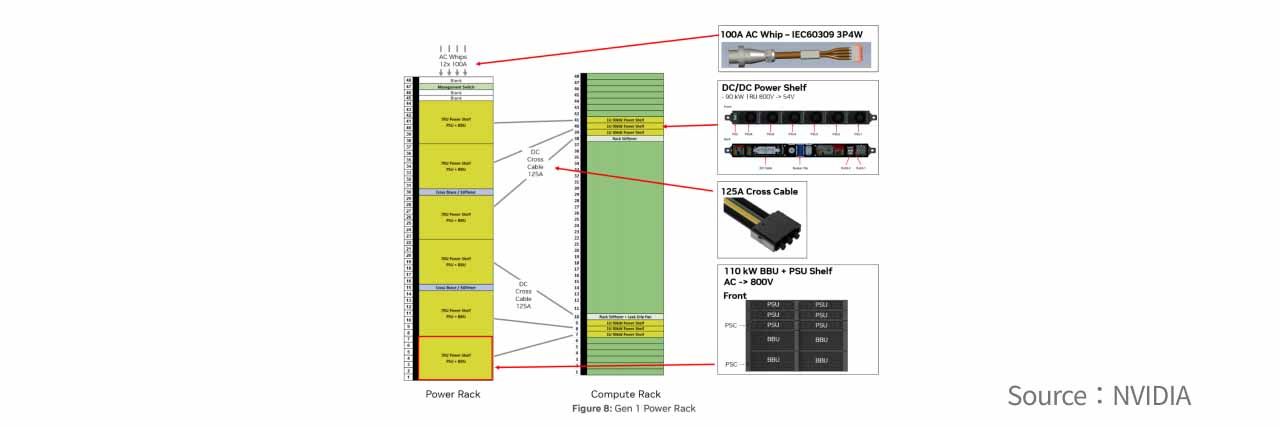
This option uses an AC power busway, with twelve 100A power whips entering from above the racks to deliver 415–480VAC power to the Power Rack, where it is converted into 800VDC. As an initial approach for introducing 800VDC into data centers, this architecture introduces BBU (optional) and Power Rack designs for the first time. It uses point-to-point cabling, with 125A, 800V DC cross cables delivering the 800VDC power generated by the Power Rack directly to adjacent compute racks. This eliminates the need for traditional AC or DC PDUs inside the compute racks.
Power Rack
The 800VDC Power Rack uses an air-cooled design and is equipped with six 18.3kW PSUs that convert AC power into 800VDC. Each PSU includes 1,200J of built-in energy storage, which can absorb transient fluctuations in AC input current, smoothing AC input under dynamic loads and improving power stability. The Power Rack can also optionally support an N+1 redundant BBU architecture, providing 80kW of backup power for up to 60 seconds through four 20kW BBUs. The 800VDC output generated by the BBUs and PSUs is connected to adjacent compute racks through 125A, 800VDC cross cables, delivering power directly from the Power Rack to individual compute and protection racks. Protection racks can be deployed either at a 1:1 ratio with Power Racks or at a 2:1 ratio. As AI computing continues to increase data center power density, next-generation Power Racks will gradually transition to liquid cooling while further increasing the power density of BBUs and power modules. The target is approximately 55kW of power capacity per U to support the power requirements of future high-power GPU racks.
800VDC Option B: Power Center at the End of a Row of Compute Racks
This option deploys a Power Center at the End-of-Row (EoR) position of a compute cluster to introduce 800VDC into the cluster. The system takes 480VAC input and outputs 800VDC, distributing power through a 1,250A 800VDC busway and 125A tap-off boxes or DC Remote Power Panels (RPPs). MCCBs or SSCBs provide protection and safety, with MCCBs currently more common and SSCBs representing the longer-term trend. This architecture also eliminates the traditional LVAC UPS (low-voltage AC UPS). The Power Center uses an integrated modular power architecture based on SiC (silicon carbide), allowing flexible output capacity of up to 2MW, while its modular power-cabinet design improves scalability. Key advantages of Option B include limited exposure to 800VDC, mature rectifier technology, scalable capacity through modular Power Centers, and flexible installation options for different data center deployment scenarios. Current engineering priorities include DC circuit-breaker selection and validation, protection coordination for tap-off boxes, grounding and protection architecture, integration of arc and ground-fault detection, busway and connector validation, and operations and maintenance procedures.
800VDC Option C: Dedicated Power Block
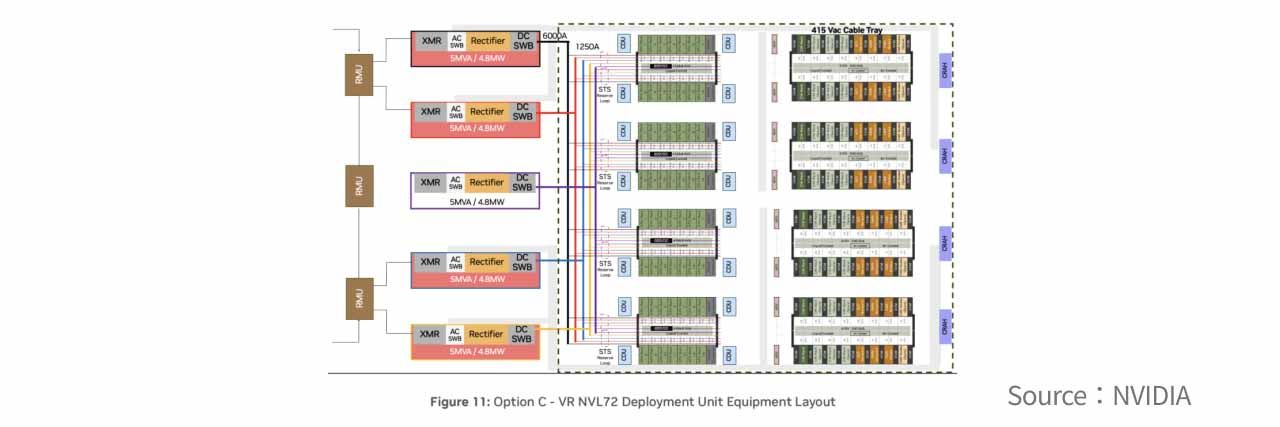
This option further separates the power system from the compute area and consolidates it into a Power Block, creating a centralized power block of approximately 4.8MW or more. It uses 6,000A-class 800VDC switchboards and 1,250A busway systems to enable direct 800VDC distribution at the data-hall level. The architecture primarily supports 800VDC compute racks and establishes modular building blocks that can be replicated across a campus, allowing the system to scale from hundreds of megawatts to ultimately support gigawatt-scale AI Factories.
For power redundancy, the Power Block uses a “4-to-make-3” architecture, with 1.6MW units providing redundant capacity. As Option C scales further to AI Factories with hundreds of megawatts or even gigawatts of capacity, a block-redundant architecture can be adopted. Under a 4+1 configuration, one 4.8MW Power Block serves as the redundant unit, improving system reliability while preserving flexible scalability for large AI Factories.
Key 800VDC Equipment
SST
Because Option C uses an all-800VDC architecture in the compute area, it depends more heavily on the ability to convert medium-voltage AC directly into 800VDC. As a result, the transformer responsible for voltage conversion becomes a critical component. Depending on the conversion technology, Option C can be implemented using either a TRU (Transformer Rectifier Unit) or an SST (Solid-State Transformer):
- TRUs offer mature transformer technology and greater familiarity in deployment. Compared with SSTs, their key advantage is the ability to leverage mature power equipment already deployed in NVIDIA’s existing compute infrastructure, resulting in relatively lower implementation risk.
- SSTs offer higher power density, faster dynamic response, more advanced power-control capabilities, a smaller equipment footprint, and greater functional integration, making them well suited for future high-power-density AI Factories.
SSTs are currently being actively evaluated as a potential long-term technology path for Option C Power Blocks. However, most SSTs currently available are designed for input voltages of around 15kV, while hyperscale AI Factories commonly use 34.5kV medium-voltage distribution. Existing SST technology therefore still needs to improve its medium-voltage input capabilities. If this technical bottleneck can be overcome, SSTs could become a key enabling technology for 800VDC architectures, with next-generation SSTs expected to arrive around 2029.
SSCB
SSCBs (Solid-State Circuit Breakers) are gradually emerging as a key technology for future high-density 800VDC power systems. Although MCCBs remain the most practical deployment option today due to their broad availability, mature supply chains, and extensive deployment experience, their fault-response time can be as long as approximately 20 milliseconds. By comparison, SSCBs electronically detect and isolate faults at much higher speeds, significantly reducing fault energy, equipment damage, and arc-flash risk while improving system and personnel safety.
SSCB technology is already relatively mature at lower current ratings, but broader deployment remains constrained by supply-chain maturity, regulatory certification, product availability, and cost competitiveness. Over the long term, as AI compute density and the scale of power zones continue to increase, SSCBs are expected to gradually become the primary protection solution for 800VDC systems under Options B and C, supported by their ultra-fast fault clearing, lower fault energy, selective protection coordination, and greater compatibility with high-density DC distribution architectures.
Rack Power Roadmap
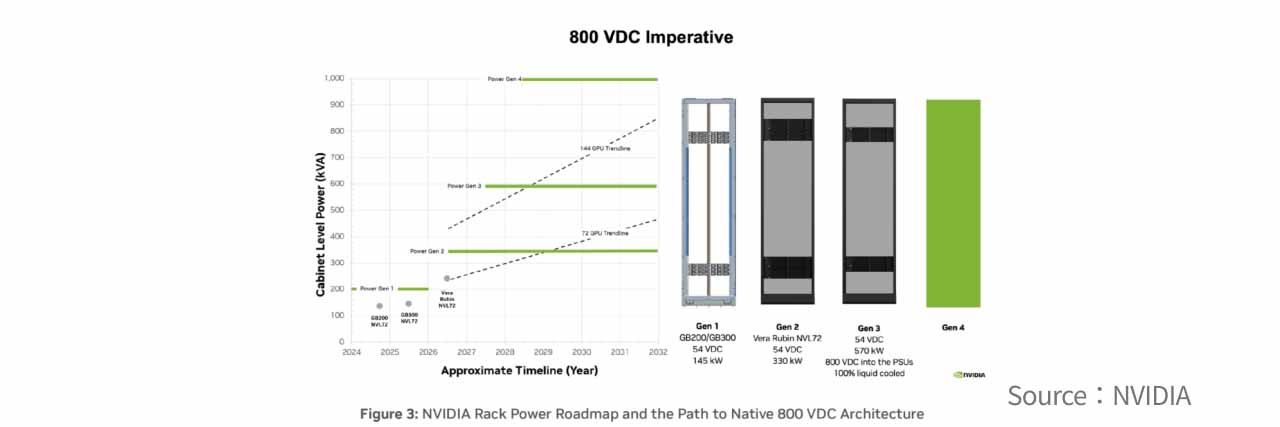
With the transition to the Vera Rubin generation, the Rack Power architecture for Vera Rubin NVL72 (72 GPUs) will be upgraded to Gen 2, with shipments expected to begin in the second half of this year. In addition to retaining the mature 54VDC distribution architecture, power capacity per rack will increase to 330kW, while support for both AC and DC inputs will help reduce customers’ transition costs to 800VDC. As GPU density continues to increase, NVL144 systems featuring 144 GPUs will also be gradually introduced, with power requirements expected to exceed 600kVA in 2028 and rise above 800kVA after 2030.
To address the rapid increase in power density, NVIDIA plans to introduce Gen 3 in the second half of 2027, featuring fully liquid-cooled power racks capable of supporting up to 570kW per rack. Gen 4 is expected to follow in the second half of 2028, upgrading in-rack power distribution to 800VDC. This will allow racks to receive high-voltage DC power directly from the data hall, while moving step-down conversion as close to the load as possible. The architecture is designed to overcome the power limitations of traditional 54VDC systems and continue supporting higher AI compute density.
Commentary
The latest white paper provides an important takeaway: 800VDC adoption does not have to follow a single, sequential path. Instead, operators can choose among four power-supply approaches based on their specific requirements. They can gradually introduce Option A or B while preserving existing AC investments, or move directly to Option C. More importantly, the downstream rack-level connection standards are highly consistent across the different options, providing strong compatibility and continuity between architectures.
For example, Option A can be added on top of an existing all-AC infrastructure simply by introducing Power Racks to support high-density GPUs. Option B, meanwhile, uses four Power Centers of approximately 1.6MW each in a “4-to-make-3” redundant configuration, providing 4.8MW of effective capacity—consistent with the target capacity of Option C. Both also use 1,250A-class row-level busway systems, allowing them to share related infrastructure and significantly reducing compatibility issues and development complexity across the ecosystem.
Overall, 800VDC has reached a level of technical maturity that supports initial deployment in data centers. Over the long term, as the number of GPUs accommodated within a single tray continues to increase, 800VDC is likely to become an essential architecture for high-density AI data centers. Although near-term adoption could still be delayed by factors such as customer transition costs and safety validation requirements, NVIDIA has introduced multiple options for different deployment needs. These architectures can be layered onto existing infrastructure and upgraded smoothly over time, lowering the barriers for customers transitioning from current power architectures toward full 800VDC deployment. As a result, 800VDC adoption is expected to accelerate gradually, with a favorable long-term penetration outlook.
