Apple’s fall launch centered on the iPhone Duo, iPhone 18 Pro series, Apple Watch Series 12, and AirPods 5. Its product strategy can be summarized across four key themes: new form factors, premiumization, health sensing, and the AI ecosystem. The iPhone Duo marks Apple’s first entry into the foldable smartphone market and establishes a new ultra-premium price tier starting at US$1,999. Meanwhile, the iPhone 18 Pro series continues Apple’s premiumization strategy with upgrades to the A20 Pro chip, cameras, and thermal management. In wearables, Apple Watch Series 12 enhances health sensing and personalized health insights, while AirPods 5 brings ANC to a lower price point and integrates Apple Intelligence. Overall, the new lineup expands Apple’s hardware portfolio and premium price bands while connecting AI capabilities across devices, further strengthening the integration of its hardware and software ecosystem.
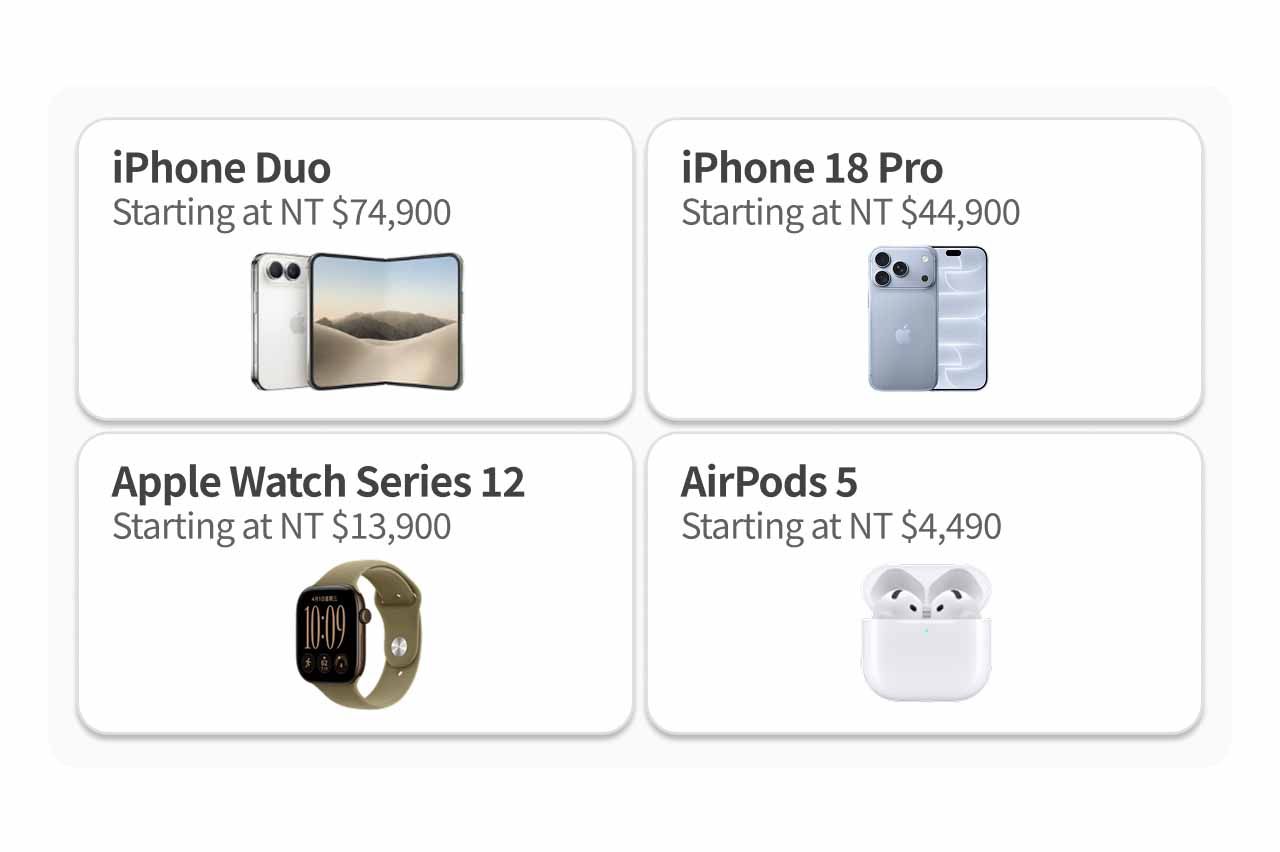
| Core Product | Starting Price in Taiwan | Key Features | Positioning Strategy |
|---|---|---|---|
| iPhone Duo | NT$74,900 | 5.4-inch outer display / 7.6-inch foldable inner display, A20 Pro, dual-app multitasking, C2 modem, N1 | Apple’s first foldable iPhone, designed to open a new market and new use cases, with the first generation focused on validating demand and building the ecosystem |
| iPhone 18 Pro / Pro Max | NT$44,900 / NT$49,900 | 2nm A20 Pro, 48MP variable-aperture main camera, next-generation vapor chamber, C2 modem | Specification upgrades accompanied by higher pricing, supporting a richer premium mix and higher blended iPhone ASP |
| Apple Watch Series 12 | NT$13,900 | Health Sensing System, high-frequency HRV sensing, Readiness Score, Vitals, 24-hour battery life | Moves beyond health-data tracking toward personalized health insights, further strengthening Apple’s health ecosystem |
| AirPods 5 | NT$4,490 | ANC, multi-port acoustic architecture, next-generation Adaptive EQ, Live Translation | Brings premium audio features to entry-level products and positions AirPods as a voice interface for Apple Intelligence |
iPhone Duo: Apple’s First Foldable Opens a New Ultra-Premium Market
Foldable Design Meets the iOS Ecosystem, Expanding iPhone Use Cases
The iPhone Duo is the most significant product unveiled at this event and represents the most noticeable change to the iPhone form factor since the iPhone X. The iPhone Duo adopts a book-style design with a 5.4-inch outer display and a 7.6-inch inner display when unfolded, providing 50% more screen area than the iPhone 18 Pro Max. It also supports Apple Pencil. The device uses Grade 5 titanium, integrates Touch ID into the side button, and is powered by the A20 Pro alongside Apple’s second-generation in-house C2 modem. Pricing starts at US$1,999, with storage configurations of up to 2TB. Pre-orders begin October 16, followed by availability on October 23.
In terms of positioning, the iPhone Duo sits at the intersection of iPhone and iPad mini use cases. Apple has redesigned elements of the iOS interface for the foldable form factor, supporting seamless transitions between the outer and inner displays as well as dual-app multitasking. This combines smartphone portability with a tablet-class workspace, enhancing content consumption, productivity, and AI applications. The dual-display setup also extends to photography, allowing users to use the outer screen for selfies with the rear cameras and real-time previews. As a result, the foldable design does more than simply provide a larger display; it creates new multitasking and photography use cases.
On the hardware side, Apple has focused on addressing several long-standing barriers to consumer adoption of foldable smartphones. The iPhone Duo uses a precision hinge consisting of more than 100 components, providing support beneath the center of the display to reduce the visibility of the crease while maintaining a smooth experience when switching between the inner and outer screens. The trade-off is a thicker and heavier device. Given that hinge durability, display creasing, and software optimization have historically constrained foldable adoption, Apple’s decision to enter the market after these technologies and user experiences have matured is consistent with its broader strategy of emphasizing tight hardware-software integration when entering new product categories.
The iPhone Duo is also the first device to feature Apple’s second-generation in-house C2 cellular modem. Compared with the first generation, transmission speeds improve by approximately 50% while power consumption declines by around 15%. The modem also supports 5G mmWave in the U.S. and uses AI algorithms to improve reconnection efficiency in weak-signal environments. Together with Apple’s N1 wireless chip, which supports Wi-Fi 7, Bluetooth 6, and Thread, Apple is bringing both cellular modems and wireless connectivity further into its in-house silicon portfolio. This strengthens integration among chips, operating systems, and end devices while optimizing connectivity and power efficiency.
US$1,999 Pricing Lifts ASP, While the First Generation Focuses on Market Validation and Penetration
The iPhone Duo creates an entirely new price tier within the iPhone lineup. Its US$1,999 starting price is roughly US$100 higher than comparable storage configurations of the Galaxy Z Fold8 and Pixel 11 Pro Fold, while the highest-end configuration reaches as much as US$3,199. Therefore, even if initial iPhone Duo shipments remain far below those of mainstream iPhones, converting even a portion of high-end Pro Max users could meaningfully increase the blended iPhone ASP. That said, as noted in our previous analyst commentary, the iPhone Duo carries a notably high price. The first generation is therefore more significant for establishing product positioning, validating market demand, and developing the foldable ecosystem than for immediately becoming a major driver of iPhone shipments.
Although its near-term shipment contribution is likely to remain limited, Apple is entering the segment at a time when foldables represent one of the few growth categories in the smartphone market. IDC forecasts foldable smartphone shipments to grow 12.6% YoY in 2026, while Counterpoint expects Apple to capture approximately 25% market share in its first year. Compared with Samsung’s focus on mature multitasking capabilities and Huawei’s emphasis on tri-fold designs, the iPhone Duo places greater emphasis on reducing the display crease, enabling seamless transitions between the inner and outer screens, and integrating Apple Intelligence with the broader iOS ecosystem. Supported by Apple’s existing premium user base, the product could quickly establish a presence in the market while expanding demand for related components.
iPhone 18 Pro Series: Specification Upgrades, Higher Pricing, and Continued Premiumization
A20 Pro and Upgraded Thermal Architecture Strengthen Performance and In-House Silicon Integration
The iPhone 18 Pro and Pro Max maintain their established market positioning, with this generation focusing upgrades on performance, cameras, thermal management, and battery life. Key enhancements include the A20 Pro, a 48MP variable-aperture Fusion Main camera, a next-generation vapor chamber, and larger batteries. Dynamic Island has also been further reduced in size and can simultaneously display up to three Live Activities. Unlike the iPhone Duo, which introduces an entirely new foldable form factor, the Pro series retains its existing 6.3-inch and 6.9-inch sizes and instead continues to enhance the core experiences most valued by premium users.
The A20 Pro is manufactured on a 2nm process and features a 6-core CPU, 7-core GPU, and dual 16-core Neural Engines. CPU and GPU performance improve by up to approximately 20% and 40%, respectively, while memory bandwidth increases by 50%. AI computing performance doubles compared with the A19 Pro, supporting on-device AI and computational photography. Apple has also redesigned the chip packaging, placing the processor and memory side by side. Combined with a next-generation vapor chamber offering approximately three times the thermal dissipation area of the previous generation, sustained performance improves by up to 40%. The Pro series also features the N1 wireless chip and C2 modem, further expanding Apple’s integration of in-house silicon across computing and connectivity.
Camera and Battery Upgrades Accompany Higher Pricing and Continued Premiumization
The camera system is another major upgrade. The 48MP Fusion Main Camera introduces a physical variable aperture for the first time, using six blades to adjust based on lighting conditions and depth of field. New Pro controls include aperture, shutter speed, white balance, and histogram settings. Apple has also introduced Reference Image, which uses a digital signature generated by the image sensor to preserve an unalterable reference image, helping users determine whether a photo has been post-processed or edited with AI.
Battery life has also improved. The iPhone 18 Pro and Pro Max provide up to 34 and 43 hours of video playback, respectively. The Pro can reach approximately 50% charge in as little as 15 minutes via wired charging, while a five-minute wired charge on the Pro Max can provide approximately seven hours of video playback.
Pricing remains a key area of market attention. The iPhone 18 Pro and Pro Max now start at US$1,199 and US$1,299, respectively, representing a US$100 increase from the previous generation, with storage options extending to 2TB. Against a backdrop of rising memory and storage costs, and alongside the new US$1,999 price tier established by the iPhone Duo, this launch raises the upper end of iPhone pricing and continues Apple’s premium pricing strategy.
Apple Watch Strengthens Health Sensing and AI Interpretation, Moving Toward Personalized Health Insights
Apple Watch Series 12 features the S11 chip and a new Health Sensing System. New optical and electrical heart-rate sensors increase the frequency of health-data collection, enabling heart-rate measurements every five seconds throughout the day. HRV measurement frequency is up to 24 times higher than the previous generation, while new daytime and nighttime Vitals help users monitor changes in stress, recovery, and overall physiological condition more closely.
This generation also introduces Readiness Score, which combines recent Activity, Training Load, Vitals, and Sleep Score data to generate a daily score from 0 to 10, accompanied by recommendations such as Recover, Pace Yourself, Ready, and Go For It. The score updates dynamically throughout the day based on the latest health and exercise data, moving Apple Watch beyond basic data tracking toward actionable health and training guidance.
Apple has also expanded the Health app with Insights, Health Age, Lab Testing, and camera-based movement assessment. In the U.S., users can arrange testing for more than 50 biomarkers through Quest Diagnostics. Compared with the previous approach of primarily presenting individual metrics such as Heart Rate, Sleep, and Activity, the latest update places greater emphasis on using Apple Intelligence to integrate and interpret different types of health information. This expands Apple Watch’s role from a health-data tracker to a platform for personalized health insights.
In terms of hardware experience, Series 12 retains up to 24 hours of everyday battery life, while outdoor workout battery life increases by 25% to 10 hours. A 15-minute charge can provide up to 12 additional hours of battery life, a 50% improvement from the previous generation. Combined with higher-frequency health sensing and continuous data analysis, Apple is further strengthening Apple Watch’s role as an all-day wearable health device.
AirPods 5 Brings ANC Downmarket and Integrates Apple Intelligence
AirPods 5 brings Active Noise Cancellation to the entry-level lineup while introducing a new multi-port acoustic architecture and next-generation Adaptive EQ. ANC performance improves by up to 50% compared with AirPods 4 with ANC, alongside improvements to Transparency Mode and Personalized Spatial Audio. Pricing in Taiwan starts at NT$4,490, while the version with a wireless charging case is priced at NT$5,190 and includes stem volume controls. With ANC enabled, battery life reaches up to five hours per charge, one hour longer than the previous generation, while total listening time with the charging case reaches up to 22 hours. Rather than simply using specification upgrades to justify higher prices, this generation focuses on bringing previously premium features such as ANC to a lower price point, improving the appeal of entry-level AirPods.
AI represents another major upgrade for AirPods 5. Apple Intelligence-powered Live Translation allows users to hear real-time translations directly through their earbuds and can be activated through Siri or by pressing both AirPods stems simultaneously. Head gestures can also be used to respond to Siri. Rather than focusing solely on audio quality, this generation integrates AirPods with Apple Intelligence, turning the earbuds into an everyday voice interface for AI features and expanding Apple Intelligence use cases across wearable devices. Overall, upgrades to Apple Watch and AirPods focus on health sensing and intelligent audio, respectively, broadening the role and value of wearables within the Apple ecosystem.
Siri AI Deepens Personal Context and Cross-App Actions, Connecting Apple’s AI Ecosystem
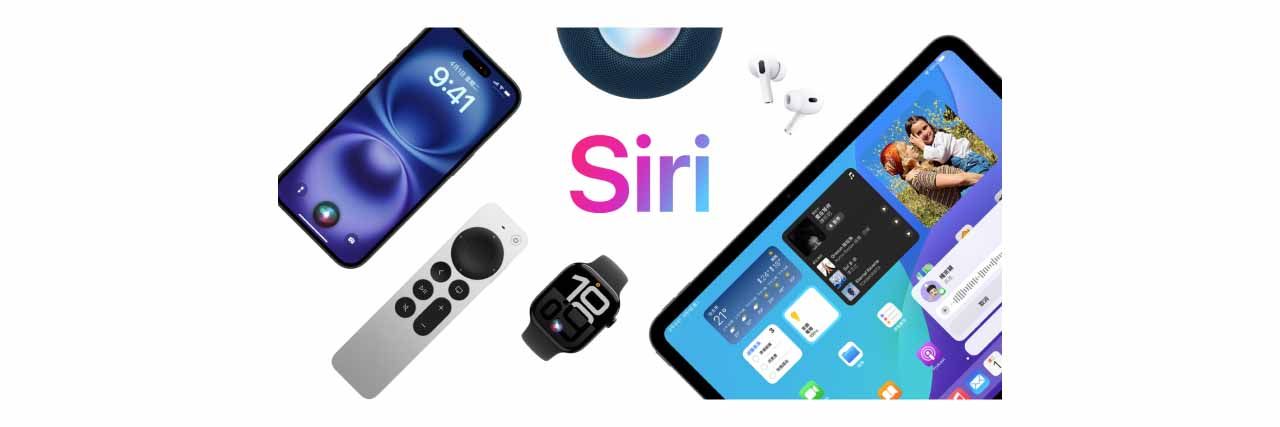
The latest Siri AI upgrade focuses on understanding personal context and executing real-world tasks and will officially launch with iOS 27 on September 14 U.S. time. The new Siri can search personal information across Photos, Mail, Notes, and other sources to answer questions. Based on the user’s current context, it can also perform actions directly within Apple and third-party apps such as Messages, Music, and Reminders, with support for more than 300,000 apps. It also adds broader world knowledge and more natural conversational capabilities.
Compared with the previous Siri, which primarily relied on individual voice commands, the new Siri evolves into an AI assistant capable of understanding personal information, drawing on external knowledge, and executing tasks. Apple has also introduced a standalone Siri app that centralizes conversations and enables users to begin a conversation on an iPhone and continue it on an iPad, improving the cross-device experience. Overall, the upgrade moves Siri closer to a personal AI assistant capable of understanding user context and completing tasks across apps.
On privacy, Apple Intelligence combines on-device processing with Private Cloud Compute in a hybrid AI architecture. Personal data can be processed directly on the device, while server-side computing is used only when larger models are required. Relevant data is not stored and is used solely to process the specific request. In short, Apple Intelligence more deeply integrates AI with personal data, apps, and the operating system while allowing third-party apps to connect with Apple Intelligence, establishing AI as a shared software layer across the Apple ecosystem.
Key Taiwan Suppliers
Traditional Supply Chain Benefits from Specification Upgrades; iPhone’s First Variable Aperture Adds Growth Momentum for Largan Precision
Taiwanese companies have long played a central role in Apple’s global supply chain. The latest product lineup continues the trend toward higher-end iPhones, while upgrades involving the 2nm process, foldable mechanisms, thermal solutions, and optical specifications further increase the component value per device for Taiwanese suppliers.
Among established suppliers, TSMC (2330.TW) remains a major beneficiary. Both the iPhone 18 Pro series and iPhone Duo use the A20 Pro manufactured on a 2nm process, supporting demand for advanced process nodes and increasing foundry value. Hon Hai Precision Industry / Foxconn (2317.TW) continues to serve as a major assembly partner while further participating in the supply of mechanical components for foldable devices.
Among this generation’s upgrades, changes to optical specifications are particularly noteworthy, with Largan Precision (3008.TW) positioned as a direct beneficiary. The iPhone 18 Pro’s 48MP main camera introduces a physical variable aperture for the first time, increasing the structural complexity and value of the lens module. The iPhone Duo also features dual 48MP cameras. As Apple continues to enhance premium imaging capabilities, Largan Precision should benefit from higher lens specifications and increased content value per device.
Emerging Suppliers Gain Exposure to Apple’s Upgrade Cycle, with AVC and Shin Zu Shing in Focus
Among emerging beneficiaries, Asia Vital Components (AVC, 3017.TW) and Shin Zu Shing (3376.TW) are particularly noteworthy.
On thermal management, the iPhone 17 Pro was the first iPhone to introduce an ultra-thin vapor chamber. As AI computing workloads and other high-performance applications increase, vapor chambers are expected to gradually become standard in Apple’s premium smartphones, tablets, and foldable flagship devices. The iPhone Duo is expected to use a dual ultra-thin vapor chamber solution, increasing both content per device and average selling prices. This positions AVC as a key beneficiary of thermal-management upgrades.
For foldable hinges, Apple has adopted a more complex internal structure to reduce the display crease and improve durability. The number of components and required machining precision are also higher than those of existing non-Apple foldables, increasing the average selling price of the hinge module per device, potentially by close to 100%. Shin Zu Shing appears particularly well positioned to benefit. Through its joint venture with Foxconn, the company combines mechanical-component manufacturing with assembly capabilities, which should help improve production yields during the initial ramp-up of Apple’s first-generation foldable device. It could also secure orders for high-end hinges for Apple’s first foldable iPhone, making Shin Zu Shing one of the Taiwanese suppliers with significant growth potential from new iPhone Duo components.
Conclusion: Premiumization and the AI Ecosystem Advance in Parallel, While Duo Opens a New Growth Curve
Apple’s latest launch centers on the iPhone Duo, expanding the company into an ultra-premium price tier while combining upgrades to the iPhone 18 Pro with Apple Intelligence to deepen hardware-software integration.
This is also the first major product launch under new CEO John Ternus. Since becoming Apple’s hardware engineering chief in 2021, Ternus has been involved in major projects including the foldable iPhone and Apple Silicon. The launch of the Duo therefore also carries symbolic significance as Apple seeks to renew its product innovation momentum. Meanwhile, the standard iPhone 18, iPhone 18e, and Air 2 were absent from this event, with their product refresh schedules extending into 2027.
For Taiwan’s supply chain, the latest products should increase component value per device through upgrades to advanced semiconductor processes, optics, thermal management, and foldable mechanisms. Among established suppliers, TSMC and Foxconn are positioned to benefit from the adoption of the 2nm process and increased assembly and mechanical-component demand, respectively, while Largan Precision stands to gain from the optical upgrade driven by the introduction of a physical variable aperture. Among emerging suppliers, the adoption of dual ultra-thin vapor chambers and high-precision hinges could increase content value per device for AVC and Shin Zu Shing, making them important names to watch for future growth in Taiwan’s Apple supply chain.
