Demand for AI servers continues to expand and has become the most important growth driver across the technology supply chain in recent years. Industries tied to chips, thermal management solutions, and substrates have already reflected the first wave of gains. However, as computing density continues to increase, system power consumption rises rapidly, and high-speed transmission standards advance, market attention is increasingly shifting toward passive components—an area that historically received less focus.
Unlike previous cycles, which were primarily driven by economic fluctuations and inventory adjustments, the current demand shift in passive components carries greater structural significance. At its core, power stability and signal integrity have become critical foundations for unlocking AI server performance. As the penetration of higher-specification and higher-value products increases, the passive components industry is gradually moving beyond its traditional cyclical-stock profile and entering a phase of structural growth and valuation re-rating driven by technological upgrades.
Passive Components: The Building Blocks of Electronic Circuits
Passive Components Are Fundamental Devices That Maintain Stable Current, Voltage, and Signals
| Passive Components | Active Components | |
|---|---|---|
| Function | Characterized by their ability to perform without requiring an external power source. They cannot amplify signals or actively generate energy and are primarily used to store, dissipate, block, filter, or regulate current and voltage. | Possess control, amplification, or switching functions, such as integrated circuits (ICs), transistors, and diodes. |
| Role | Serve as the foundational regulating elements in electronic circuits, maintaining stable current, voltage, and signal conditions to ensure reliable system operation. | Serve as the core elements responsible for computation and control. |
Classification of Passive Components: Capacitors, Resistors, and Inductors
The passive components industry is primarily divided into three major categories: capacitors, inductors, and resistors. Among them, MLCCs (Multilayer Ceramic Capacitors) represent the largest market segment and have the highest technological barriers to entry. They are also among the most closely watched products as AI server specifications continue to advance.
Capacitors: Storing Energy, Filtering Noise, and Stabilizing Voltage
Capacitors are passive components used to store electrical charge. Their primary functions include energy storage, noise filtering, and voltage stabilization. When voltage fluctuations occur within a circuit, capacitors can release or absorb charge to smooth voltage changes, thereby enhancing overall circuit stability.
MLCC (Multilayer Ceramic Capacitor)
MLCCs are the largest and most widely used capacitor products in the market and feature relatively high technological complexity. Their structure consists of multiple layers of ceramic dielectric materials and metal electrodes stacked alternately and then sintered at high temperatures.
Because of this multilayer architecture, MLCCs can deliver high capacitance within a very small footprint while offering advantages such as miniaturization, high capacitance, and strong high-frequency performance. As a result, they are widely used in smartphones, electric vehicles, AI servers, communications equipment, and industrial electronics.
The importance of the MLCC industry stems mainly from two factors: massive usage volume and ongoing specification upgrades. For example, a single smartphone may contain hundreds to thousands of MLCCs. In electric vehicles and AI servers, increasingly complex circuit architectures, higher system power consumption, and stricter reliability and power-stability requirements have driven both MLCC content per device and product specifications higher.
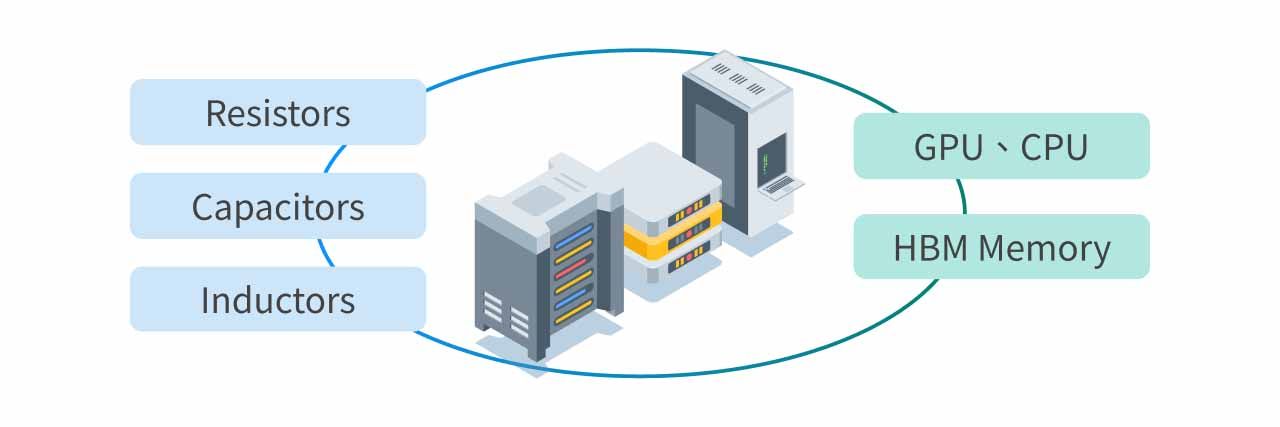
In AI servers in particular, GPUs, CPUs, HBM memory, and power modules all require stable power delivery. Excessive voltage fluctuations can negatively affect system stability and computing performance. As a result, demand for high-capacitance, low-ESR, high-voltage, and highly reliable MLCCs continues to grow and has become one of the most important growth drivers for the passive components industry.
Aluminum Electrolytic Capacitors
Aluminum electrolytic capacitors use aluminum foil as electrodes and an electrolyte as the conductive medium. Their key advantages are large capacitance, low cost, and suitability for high-current and power-filtering applications.
While MLCCs are mainly used in applications requiring miniaturization, high-frequency operation, and rapid voltage response, aluminum electrolytic capacitors function more like large energy-storage buffers within power systems. They provide substantial charge reserves and voltage stabilization at power-input and power-output stages.
As a result, aluminum electrolytic capacitors are commonly used in high-power and high-current applications, including power supplies, industrial automation equipment, and home appliances.
Tantalum Capacitors
Tantalum capacitors use tantalum metal as the anode material and are known for their high capacitance density and excellent stability, providing a strong balance between size and capacitance.
Compared with MLCCs, tantalum capacitors are generally more expensive and less widely used. Compared with aluminum electrolytic capacitors, they offer a smaller form factor and more stable capacitance characteristics.
However, tantalum capacitors have limitations, including higher costs, polarity requirements, and lower surge-current tolerance. Improper operating conditions may result in short circuits or component failure. Consequently, they are not typically deployed in the large quantities seen with MLCCs. Instead, they are mainly used in applications that demand high stability, reliability, and miniaturization, such as communications equipment and medical electronics.
| Comparison of Major Capacitor Types | MLCC | Aluminum Electrolytic Capacitor | Tantalum Capacitor |
|---|---|---|---|
| Primary Materials | Ceramic dielectric materials, metal electrodes | Aluminum foil, electrolyte | Tantalum metal |
| Size | Smallest | Larger | Medium |
| Capacitance | Wide range, from low to high | High | Medium |
| Cost | Low-end products are inexpensive; high-end products are more expensive | Low | Moderate |
| Lifespan | Long | Shorter | Long |
| Stability | Depends on material grade | Relatively weaker | Strong |
| Key Advantages | Miniaturization, high-frequency performance, high usage volume | Large capacitance, low cost | High stability and reliability |
| Key Disadvantages | Advanced manufacturing is challenging | Larger size; lifespan affected by temperature | Higher cost; more sensitive raw material supply |
| Major Applications | Smartphones, AI servers, automotive electronics, communications | Power supplies, home appliances, industrial equipment | Communications, medical devices, aerospace, automotive, and industrial applications |
Resistors: Controlling Current Flow and Voltage Distribution
Resistors are passive components used to limit current flow. Their primary functions include controlling current levels, dividing voltage, and dissipating energy.
Without resistors, excessive current could damage electronic components. As a result, resistors are often regarded as essential building blocks for circuit protection and system stability.
From an industry perspective, resistor products include chip resistors, metal film resistors, thick-film resistors, thin-film resistors, and power resistors. Among these, chip resistors are the most widely used due to their compact size, standardized specifications, and mature mass-production processes. They are commonly found in smartphones, laptops, automotive electronics, and servers.
Inductors: Suppressing Current Fluctuations, Stabilizing Current, and Filtering Electromagnetic Interference
Inductors are passive components used to store magnetic energy. Their primary functions include suppressing sudden current changes, stabilizing current flow, filtering signals, and reducing electromagnetic interference (EMI).
When current flows through an inductor, it generates a magnetic field. As current changes, the inductor produces an opposing effect that resists rapid fluctuations, helping to smooth current output. Consequently, inductors play a critical role in power management, high-speed data transmission, and EMI mitigation.
Common inductor types include power inductors, wire-wound inductors, thin-film inductors, ferrite beads, and common-mode chokes. As power consumption in AI servers, electric vehicles, and high-speed communication equipment continues to increase, demand for high-current, low-loss, and compact inductors is also rising.
Power Inductors
Power inductors are among the most important inductor products and are primarily used in power conversion and power management systems.
Their core function is to store and release magnetic energy, helping stabilize current output and improve power-conversion efficiency. They are widely used in DC-DC converters, power modules, and various power management IC applications that require high-current delivery and efficient power conversion.
Demand growth for power inductors is primarily driven by rising system power consumption and increasing requirements for power-conversion efficiency.
In AI servers, for example, the power demands of GPUs, ASICs, HBM memory, and high-speed switching chips have increased significantly. Power modules must therefore handle higher current loads while minimizing energy losses and heat generation, driving continued demand for high-performance power inductors.
Ferrite Beads
Ferrite beads are passive components designed to suppress high-frequency noise and electromagnetic interference. Their primary function is to convert unwanted high-frequency noise energy into heat and dissipate it, thereby reducing the impact of EMI on system operation and signal transmission.
Compared with conventional inductors, ferrite beads are more specifically focused on noise suppression. They are commonly used around power lines, signal lines, and high-speed interfaces to improve power quality and maintain signal integrity.
If you are interested in passive components, you can also read the following article: How AI Servers Drive the Upgrade of Passive Components Industry
