Hermes Testing Solutions (7856.TW), the highest-priced stock on Taiwan’s Emerging Stock Market, made its Taipei Exchange debut on September 22, drawing significant market attention. Its offering price of NT$2,250 per share surpassed the NT$1,495 record set by Hon. Precision (7769.TW) in late 2025, marking the highest offering price in Taiwan’s stock market history. Based on its recent average trading price on the Emerging Stock Market, investors allotted one 1,000-share lot could potentially earn an unrealized gain of more than NT$2 million, fueling strong demand for the public subscription. With full-year 2025 earnings per share (EPS) of NT$10.83 and a share price already above NT$4,800, what technologies and growth opportunities does Hermes Testing possess that make investors willing to pay more than twice its offering price?
Hermes Testing: A Core Hermes Group Company Focused on Semiconductor Testing
Founded in September 2004 and headquartered in Hsinchu, Hermes Testing’s main businesses include probe cards and cleaning materials, engineering services, and semiconductor equipment and customized products. It provides semiconductor customers with integrated services spanning equipment installation, technical support, and test product development. Its operating locations currently include Hsinchu and Tainan in Taiwan; Suzhou, China; Tokyo and Kumamoto, Japan; Singapore; Malaysia; and Arizona in the United States. These locations primarily support customers’ overseas capacity expansion by providing local installation and technical support services.
Three major milestones define the company’s development:
- In 2016, Hermes Testing established an engineering services team covering equipment installation, maintenance, relocation, modification, and troubleshooting. By participating in customers’ daily production operations, the company built an understanding of equipment performance, process conditions, and testing requirements.
- In 2020, the company secured a probe card technology transfer from MJC (6871 JP), a leading Japanese supplier, and established a production line. This expanded its ability to manufacture test interface products in-house, gradually integrating R&D, design, manufacturing, and after-sales repair services to provide customized probe cards. This milestone connected the experience gained from production-line services with product development and manufacturing capabilities, expanding the company’s role in semiconductor testing.
- In 2023, Hermes Testing began distributing Advantest’s (6857 JP) photomask metrology scanning electron microscopes, further expanding its measurement and inspection equipment business and broadening its offerings to semiconductor customers. As these capabilities developed, the company established a business model combining engineering services, product manufacturing, and equipment distribution. It can provide on-site technical support while supplying internally manufactured products and third-party equipment tailored to customer needs.
Hermes Testing’s Core Businesses: Semiconductor Equipment and Customized Products Become the Largest Revenue Source
Hermes Testing operates across three main business areas: probe cards and cleaning materials, engineering services, and semiconductor equipment and customized products. The revenue share of semiconductor equipment and customized products has continued to rise, reaching 52% and making it the company’s largest revenue source.
Three Probe Card Categories Address Diverse Testing Requirements
The first business area is probe cards and cleaning materials. Its probe cards fall into three main categories—membrane, cantilever, and vertical—each addressing different chip testing requirements:
- Membrane: Primarily used for high-frequency testing applications such as 5G/6G, radio-frequency ICs, millimeter-wave chips, and automotive radar chips. The company describes itself as Taiwan’s only supplier with independent R&D capabilities in this category. Shipments began in April 2026. In August, it supplied products for transimpedance amplifier testing to a U.S. customer, expanding into silicon photonics applications. It also continues to advance qualification and adoption by foundry customers.
- Cantilever: Used in applications such as wafer acceptance testing (WAT), logic chips, LCD driver ICs, entry-level power management ICs, and conventional consumer electronics. Technology partners include Japan’s MJC.
- Vertical: Primarily serves testing requirements for advanced system-on-chip devices, GPUs, application processors (APs), and flip-chip devices. Conventional Cobra probe cards are now manufactured entirely in Taiwan, while MEMS probe cards are developed in collaboration with MJC using components manufactured by Hermes Testing.
Engineering Services Provide a Stable Operating Foundation
The second business area, engineering services, provides a relatively stable operating foundation. Services include equipment installation, warranty support, scheduled maintenance, refurbishment and repair, relocation and modification, and troubleshooting, covering the equipment’s entire lifecycle from deployment through ongoing operation and maintenance. The company currently provides these services mainly for Tokyo Electron’s (TEL) wafer probers. According to Hermes Testing, it has Taiwan’s largest engineering services team in this field.
As demand for AI chip testing increases, the installed base of wafer probers expands, generating additional maintenance demand and supporting continued growth in engineering services. Even as rapid growth in other products reduces this segment’s revenue share, maintenance and repair of the existing equipment base can continue to provide recurring revenue.
Cooling Modules for AI Chip Testing Drive Equipment Business Growth
The third business area, semiconductor equipment and customized products, has delivered the company’s strongest recent growth. Products already in volume production include integrated thermal management systems, white-light interferometry inspection systems, and thermal load testing systems. Together with complementary offerings such as cleaning materials, probe card planarity monitoring, temperature control, and wafer measurement calibration, these products help customers improve testing efficiency and stability. Probe card cooling modules used in AI chip testing are the main growth driver, accounting for more than 30% of revenue in the first half of 2026.
Among new products, laser probe cleaning equipment remains in the qualification stage. The first reflow system has been completed and qualified by a packaging and testing customer, with limited shipments gradually beginning. The company also distributes electron-beam inspection equipment and Advantest photomask metrology scanning electron microscopes (SEMs). Through internal R&D, customized manufacturing, and equipment distribution, it continues to expand its product portfolio in wafer testing and advanced packaging.
Revenue Growth: Higher-Margin Products Drive Quarterly Profitability Improvements
Hermes Testing’s recent financial results show simultaneous growth in revenue and profitability. According to the presentation notes from its pre-listing investor conference, revenue increased from approximately NT$1.6 billion in 2024 to NT$2.425 billion in 2025, while EPS rose from NT$2.84 to NT$10.83. First-half 2026 revenue reached NT$2.185 billion, equivalent to about 90% of full-year 2025 revenue. EPS reached NT$21.50, nearly twice the previous year’s full-year figure, indicating that earnings growth significantly outpaced revenue growth.
View Hermes Testing’s Financial Statements
Quarterly results make the improvement in profitability even clearer. Revenue increased from NT$442 million in the first quarter of 2025 and NT$576 million in the second quarter to NT$985 million and NT$1.2 billion in the corresponding quarters of 2026. Second-quarter 2026 net income after tax reached NT$330 million, approximately 8.9 times the NT$37 million recorded in the first quarter of 2025.
As revenue expanded and the product mix improved, gross margin rose from 45.38% to 54.54%, while operating margin increased from 11.58% to 34.27%. These improvements reflect growing shipments of higher-margin products and the benefits of operating leverage, allowing incremental revenue to make a greater contribution to earnings.
Hermes Testing’s Industry Position: Serving Foundries and Packaging and Testing Companies in the Downstream Semiconductor Supply Chain
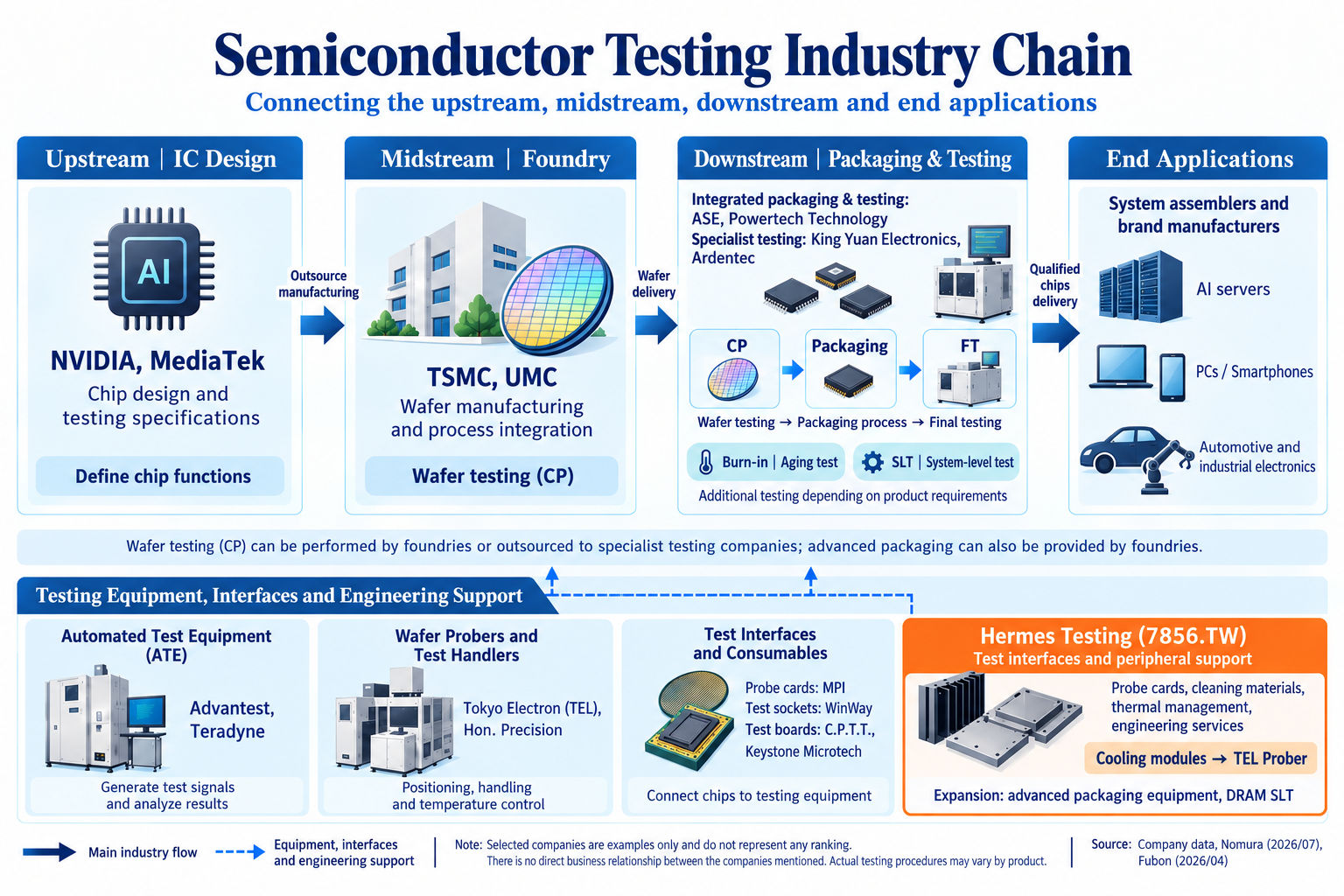
The semiconductor supply chain: Upstream IC design companies define chip functions and testing specifications, then outsource manufacturing to foundries. Relevant companies include Nvidia and MediaTek (2454.TW).
Midstream foundries manufacture wafers and integrate production processes, after which chips undergo wafer probing (CP). This step can be performed by the foundries themselves or outsourced to specialist testing companies. Relevant companies include TSMC (2330.TW) and UMC (2303.TW).
Screened dies are then sent to downstream packaging and testing companies for packaging and final testing (FT). Foundries may also provide integrated services for certain advanced packaging processes. Depending on reliability and application requirements, some products undergo additional burn-in testing and system-level testing (SLT). Chips that pass testing are ultimately delivered to system assemblers and brand manufacturers for use in end markets such as AI servers, PCs, smartphones, automotive electronics, and industrial electronics.
Semiconductor testing requires automated test equipment (ATE), wafer probers, and test handlers to operate together with interfaces such as probe cards, test sockets, and test boards. Equipment and engineering service providers support positioning, handling, temperature control, and maintenance. Hermes Testing primarily focuses on test interfaces and supporting systems, with products and services spanning probe cards, cleaning materials, thermal management, and engineering services. Its main cooling modules are installed on TEL wafer probers to address probe card cooling challenges during AI chip testing, closely linking demand to TEL’s equipment platform and customers’ testing lines.
The company also provides installation, warranty support, and scheduled maintenance for TEL wafer probers. Its on-site engineering teams identify customer requirements and translate them into customized products, creating a collaboration model spanning equipment deployment, module development, and ongoing maintenance. This model serves both new equipment installations and upgrades to existing equipment. Hermes Testing is also gradually expanding into advanced packaging equipment and DRAM system-level testing, primarily serving foundries and specialist packaging and testing companies.
- Integrated packaging and testing: ASE (3711.TW), Powertech Technology (6239.TW)
- Specialist testing: King Yuan Electronics (2449.TW), Ardentec (3264.TW)
- Wafer probers and test handlers: Tokyo Electron (TEL), Hon. Precision (7769.TW)
- Probe cards: MPI (6223.TW)
- Test sockets: WinWay (6515.TW)
- Test boards: Chunghwa Precision Test Tech. (6510.TW), Keystone Microtech (6683.TW)
Four Growth Drivers Set to Contribute to Hermes Testing’s Business
Hermes Testing’s future growth drivers include thermal management for high-power chips, advanced packaging equipment, silicon photonics testing, and high-speed memory testing. These products are at different stages of commercialization, with varying timelines for revenue contributions.
Driver 1: Rising Shipments of High-Power Thermal Management Solutions Make Cooling Modules the Main Current Growth Driver
Thermal management for high-power chips is already making a clear contribution to Hermes Testing’s revenue. As transistor density and chip power consumption continue to rise, testing generates more heat, increasing the need for temperature control and testing stability. The company’s integrated thermal management solutions effectively remove heat generated during high-power testing, improve cooling efficiency, reduce testing errors and incorrect results caused by heat buildup, and lower the risk of probe damage while extending probe card life.
Hermes Testing began small-scale production of its probe card cooling modules in late 2025 and ramped up volume production in the first quarter of 2026. Shipments exceeded 1,000 units in the first half of the year, contributing more than 30% of revenue. The first-generation product currently in volume production is mainly installed on TEL wafer probers to address probe card cooling challenges during AI chip testing. The company also plans to provide two second-generation units for customer qualification, with some demand expected to gradually shift to the new generation in 2027.
Future growth will come from both new equipment installations and upgrades to existing equipment. The actual timing of the transition between product generations will depend on customer qualification and adoption.
Driver 2: Reflow Equipment Passes Initial Qualification as Advanced Packaging Expansion Moves into Limited Deliveries
In advanced packaging equipment, Hermes Testing has developed reflow systems primarily for wafer bumping and advanced packaging processes such as CoWoS. These systems focus on addressing issues with existing equipment, including particle control, preventive maintenance (PM) frequency, and energy consumption.
The first system has been completed and passed initial qualification by an outsourced semiconductor assembly and test (OSAT) customer. The company plans to ship another one to two systems in the second half of 2026 and targets shipments of five to ten systems in 2027. This business is gradually moving from product qualification into limited deliveries. The pace of further expansion will depend on actual equipment performance, customer qualification progress, and follow-on orders.
Driver 3: Expansion Across Three CPO Testing Stages Moves Commercialization into Equipment Development
The co-packaged optics (CPO) testing process comprises Insertion 1 through Insertion 4, and Hermes Testing currently participates in the first three stages. For Insertion 1, the company has independently introduced a rapid alignment and optical coupling solution. For Insertion 2, it partners with Germany’s ficonTEC, with Hermes Testing undertaking OEM/ODM work. Insertion 3 also involves collaboration between the two companies, with Hermes Testing providing technical support and engineering services.
Under this partnership, ficonTEC contributes optical equipment technology, while Hermes Testing brings equipment production, assembly, and testing experience to improve automation and volume production efficiency.
The Insertion 2 collaboration agreement has been signed, and the first second-generation system is expected to be completed between late 2026 and early 2027. Second-generation Insertion 3 equipment is progressing on a similar schedule.
The second-generation Insertion 2 system will focus on better support for highly warped wafers, shorter probe card replacement times, and improved protection for wafers and probe cards. Insertion 3 will increase throughput by adding robotic arms and stage configurations. The company’s near-term plan is to establish production capacity of approximately 20–30 systems per month, with further expansion based on customer demand. However, this figure is a capacity-building target; actual deliveries will depend on the availability of engineering personnel, components, and assembly space.
This expansion is also connected to the development of TSMC’s COUPE platform. ficonTEC has publicly stated that its silicon photonics testing business unit, ficonTEST, is providing double-sided wafer-level testing solutions that support the COUPE platform. For Hermes Testing, CPO testing equipment remains in the early stages of commercialization. Future growth visibility will depend on key milestones such as completion of joint equipment development, customer qualification, and adoption in volume production.
Driver 4: Probe Cards Support Current Operations, While AI MEMS and DRAM SLT Offer Longer-Term Growth
The probe card business is currently supported mainly by conventional vertical and membrane products.
- Demand for conventional vertical probe cards is expected to remain strong from the second half of 2026 through 2027, and the company continues to expand related capacity. Shipments of membrane probe cards began in April 2026, followed in August by products for transimpedance amplifier (TIA) testing supplied to a U.S. customer.
- Company announcements also indicate that membrane probe cards have entered limited deliveries and begun contributing revenue. These products remain in the early stages of commercialization, with continued efforts to expand the customer base and applications such as silicon photonics.
For new products, Hermes Testing is collaborating with Japan’s MJC to develop MEMS probe cards for AI applications. The first card is expected to be completed in the first half of 2027 and submitted for customer qualification in the second half. If qualification proceeds successfully, capacity will be expanded further in 2028.
Unlike vertical and membrane probe cards, which have already entered volume production or limited deliveries, MEMS probe cards for AI applications remain under development. Near-term milestones are completion of the first card and successful customer qualification; the timing of volume production and revenue contributions remains to be confirmed.
The company is also developing high-speed memory system-level testing (DRAM SLT) solutions to address DDR5/DDR6 testing requirements. It is developing high-speed test sockets supporting data rates above 15 Gbps, with samples expected in 2027 as it seeks adoption in customers’ pilot production. This business also remains in the product development stage. Further commercialization will depend on sample delivery, customer qualification, and pilot production progress.
Competition: Peers Include MPI and WinWay, but Product Mixes Differ
Taiwanese test interface peers include Chunghwa Precision Test Tech. (6510.TW), MPI (6223.TW), Keystone Microtech (6683.TW), and WinWay (6515.TW). However, their product mixes and business models differ.
In addition to probe cards, Hermes Testing operates engineering services, semiconductor equipment, and customized product businesses. According to its pre-listing investor presentation, equipment and customized products accounted for approximately 52% of first-half 2026 revenue. Including engineering services would raise this share further. These differences make a fully like-for-like comparison difficult, so the following comparison focuses on businesses with greater overlap and their financial performance.
| Company | Main Businesses and Focus Areas | 2Q26 Revenue (NT$ billion) | 2Q26 Gross Margin | 2Q26 EPS (NT$) |
|---|---|---|---|---|
| Hermes Testing (7856.TW) | Probe cards, engineering services, equipment, and customized products | 1.20 | 54.5% | 12.15 |
| Chunghwa Precision Test Tech. (6510.TW) | Advanced test boards, probe cards, and related components | 1.64 | 57.5% | 15.02 |
| MPI (6223.TW) | Probe cards, semiconductor and optoelectronic testing equipment | 5.23 | 58.4% | 15.6 |
| Keystone Microtech (6683.TW) | Test boards, burn-in boards, and integrated probe card solutions | 0.65 | 50.8% | 6.01 |
| WinWay (6515.TW) | Test sockets, precision probes, probe cards, and temperature control products | 3.52 | 38.3% | 18.7 |
Test boards and probe cards are important businesses for both Chunghwa Precision Test Tech. and Keystone Microtech, but their approaches to technology integration differ. Chunghwa Precision Test Tech. emphasizes in-house integration across test boards, probes, and probe placement equipment. Its main growth drivers include GPU and TPU test boards, as well as probe cards for autonomous driving chips and AI CPUs. Keystone Microtech has expanded from post-packaging test boards and burn-in boards into complete probe card solutions, focusing on circuit design and integration while actively expanding its U.S. AI ASIC customer base. However, probe heads account for a relatively high share of the cost of its complete probe card solutions, making future gross margins dependent on product mix and integration efficiency.
MPI and Hermes Testing have overlapping businesses in both probe cards and testing equipment. In the second quarter of 2026, probe cards and equipment accounted for approximately 75% and 23% of MPI’s revenue, respectively. Its products include cantilever, vertical, and MEMS probe cards, alongside optoelectronic automation, semiconductor testing, and temperature control equipment.
MPI’s priorities include expanding probe card supply for AI ASICs and server CPUs, increasing in-house production of key components, and developing CPO Insertion 2 and Insertion 3 testing equipment. Hermes Testing’s competitiveness in equipment therefore needs to be assessed against peers through customer qualification, delivery capabilities, and volume production performance.
WinWay focuses on test sockets and precision contact components, serving post-packaging testing, system-level testing, and burn-in testing, while using probe cards to expand into wafer testing. It primarily benefits from demand for high-speed transmission, high pin counts, and high power consumption in AI GPUs and ASICs, which supports the development of advanced test sockets, spring probes, and temperature control solutions.
The impact of MEMS probe cards on gross margins differs across companies. A report on MPI identifies a higher MEMS product share as a driver of gross margin improvement, while KGI’s report on WinWay notes that its MEMS products have relatively lower gross margins. Even when product names are similar, differences in manufacturing responsibilities and cost structures must be considered.
Hermes Testing’s Competitive Advantages: Independent R&D, Customization, and Strong Customer Relationships
Hermes Testing’s competitive advantages center on independent R&D and manufacturing capabilities, flexible customization, and strong customer relationships. The company describes itself as Taiwan’s only supplier with independent R&D capabilities in membrane probe cards and can provide one-stop solutions for complete probe cards. Platform-based and modular designs also help it respond quickly to different customer requirements and shorten product development timelines. Long-standing relationships with foundries and specialist packaging and testing companies allow it to continuously build on-site experience and process knowledge.
From a business model perspective, engineering services provide an important entry point into customers’ production lines and a way to understand their practical requirements. Through equipment installation, maintenance, and troubleshooting, the company identifies problems involving cooling, cleaning, and mechanical design at testing sites, then translates this experience into customized modules or equipment.
It also applies technologies developed through these projects to other customers and applications. This creates a growth model in which engineering services uncover needs, customized development turns those needs into products, and the resulting technologies are applied across additional markets.
Key Factors to Monitor
- Product and customer concentration: Cooling modules entered small-scale production in late 2025 and accounted for more than 30% of revenue in the first half of 2026. Orders, pricing, and delivery schedules for a single product now have a significantly greater impact on overall operations. The company currently works mainly with Taiwan’s largest foundry but has not disclosed its exact customer revenue share. Key areas to monitor include demand from major customers and progress in expanding into new customers and applications.
- Dependence on the equipment platform: Cooling modules are currently installed on TEL wafer probers, closely linking demand to new installations and upgrades to the existing equipment base. Sustained shipments will depend on the platform’s installed base, customer adoption rates, and upgrade demand.
- Product generation transitions and competition: The company expects some cooling module demand to gradually shift to second-generation products in 2027. Areas to monitor include customer qualification and the pace of the transition, as well as whether other suppliers secure qualification and enter the market, potentially affecting order share and product gross margins.
- New product commercialization timelines: Major development and qualification milestones for MEMS probe cards, DRAM SLT, and CPO testing equipment are concentrated around 2027. Delays in development, qualification, or volume production for any of these products could postpone revenue contributions.
- Volume production execution and working capital: The planned CPO equipment capacity of approximately 20–30 systems per month requires sufficient engineering and assembly personnel, component supply, and assembly space. Some components have long lead times and must be procured in advance. In addition to capacity and shipments, investors should monitor inventory turnover, customer equipment acceptance, and cash flow from operating activities.
