NVIDIA, the global leader in AI computing and accelerated computing, has gradually transformed from a GPU supplier into an AI infrastructure platform company in recent years. GTC 2026 is not only an important venue for NVIDIA to showcase its next-generation products and system architectures, but also a key event for observing new trends in AI computing models, data center deployment, enterprise agent applications, PC transformation, and Physical AI development.
Key Takeaway 1: AI Computing Moves from Generative AI to the Agentic AI Era
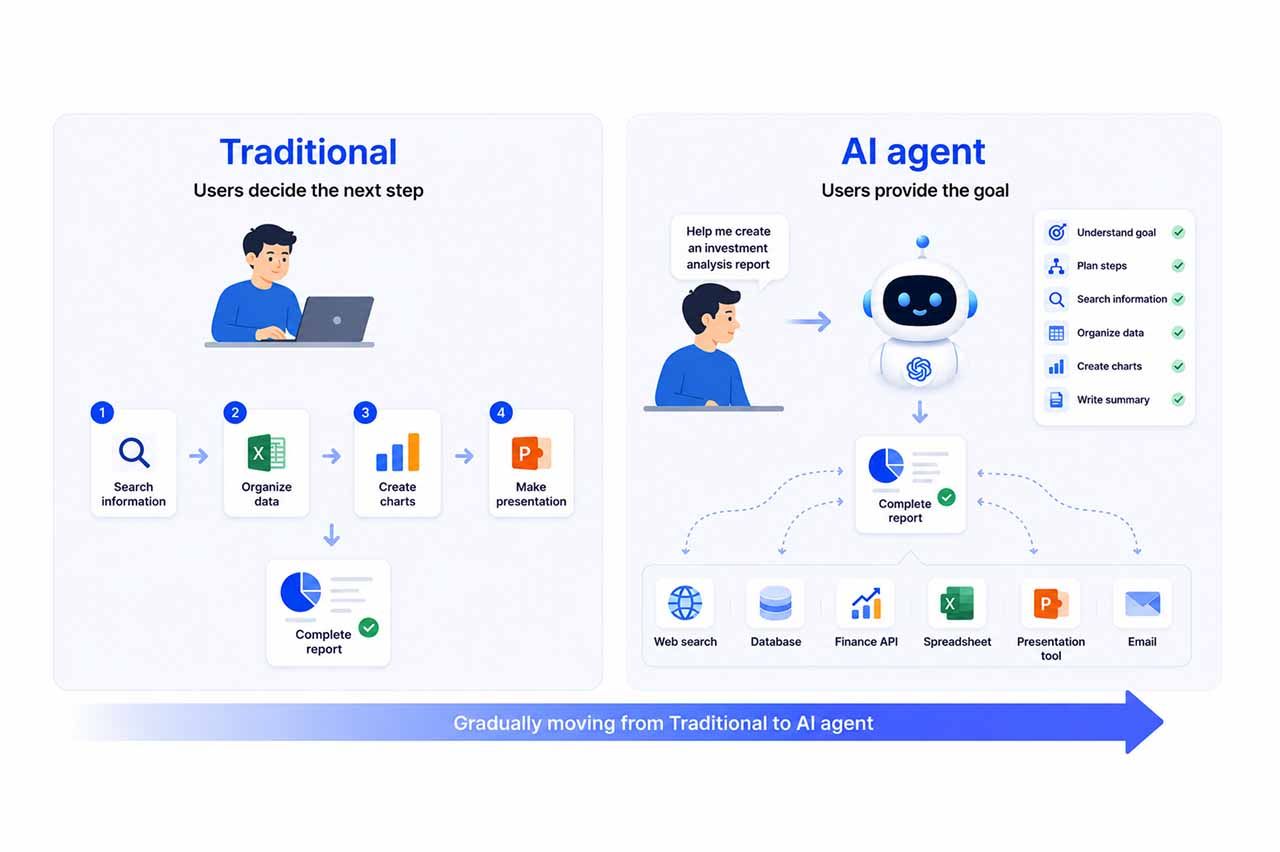
AI development has progressed beyond generative AI, which focused on text, image, and content creation, and is now entering the Agentic AI stage.
Agentic AI places greater emphasis on observation, understanding, reasoning, planning, and execution. By leveraging tools, accessing memory, and autonomously completing complex tasks, it moves beyond simple content generation and toward executing real-world workflows. As a result, it is widely viewed as the first AI paradigm capable of creating substantial economic value.
Jensen Huang used software engineering as an example, noting that GitHub commit volumes in early 2026 increased nearly threefold compared with the same period previously, highlighting AI’s growing impact on software developer productivity. Given that the world's roughly 300,000 to 400,000 professional software engineers generate economic output far exceeding total salary expenses, further productivity gains from Agentic AI could drive significant economic growth. At the same time, NVIDIA emphasized that AI is not expected to simply replace software engineers. Instead, it is likely to expand demand for software and system development, enabling engineers to handle more tasks, create more applications, and further increase overall industry demand.
Key Takeaway 2: A New Computing Paradigm — From Application + OS to an Agent-Based Architecture

One of the central themes of GTC 2026 is that computing is undergoing a fundamental transformation. Traditional computers are primarily built around Applications and Operating Systems, with users completing tasks through different software programs. In the Agentic AI era, however, the new computing architecture will revolve around a combination of LLMs, Harness, Tools, and Memory.
LLMs serve as the core engine for reasoning and language understanding, Harness coordinates workflows, Tools provide external capabilities and skills, and Memory enables long-term context retention and task continuity. This means future computing will no longer simply execute predefined programs. Instead, agents will autonomously decompose objectives, invoke tools, and complete actions. Because this model is highly distributed, heterogeneous, and dynamic, it creates new requirements across CPUs, GPUs, DPUs, networking, memory, and software stacks, forming the foundation for NVIDIA’s next-generation platform strategy.
Key Takeaway 3: NVIDIA’s Strategy for the Agentic Architecture
Vera Rubin Platform: A Next-Generation AI Supercomputer Built for Agentic AI
The Vera Rubin platform is positioned as a multi-rack, pod-scale AI supercomputer specifically designed for Agentic AI and has now entered full-scale production. Compared with the previous-generation Grace Blackwell platform, Vera Rubin is not merely a GPU upgrade. It represents a complete system platform spanning GPUs, CPUs, DPUs, NVLink, and networking architecture.
The Vera Rubin platform includes the Vera Rubin GPU, Vera CPU, BlueField-4 DPU, NVLink 72, and Spectrum-X networking stack, emphasizing co-design across chips, servers, racks, and entire data centers. NVIDIA stated that the Vera Rubin supply chain is approximately twice the size of Grace Blackwell’s. In addition, system assembly efficiency has improved dramatically, reducing assembly time from roughly two hours to about five minutes. This demonstrates NVIDIA’s continued push toward factory-scale, modularized, and large-scale AI infrastructure deployment.
DSX AI Factory: From Compute Deployment to Operational Efficiency Optimization
As demand for AI computing continues to grow rapidly, data centers are evolving beyond traditional IT infrastructure into AI factories capable of continuously generating tokens and revenue. NVIDIA introduced DSX as a blueprint for AI factories, covering the entire lifecycle from design and simulation to deployment and operations.
At its core, DSX treats the AI factory as a production system that can be designed, simulated, and optimized. Through Omniverse digital twins, data centers can be validated before physical deployment, including rack configurations, liquid-cooling systems, power distribution, thermal management, and workload simulations. NVIDIA emphasized that key performance metrics for AI factories are shifting away from raw compute capacity toward token output per watt, dynamic power allocation, minimum token costs, and maximum profitability. Ultimately, future data center competitiveness will depend on the ability to generate the highest number of monetizable AI tokens at the lowest energy and infrastructure cost.
Vera CPU: A CPU Designed for Agents
Beyond GPUs, the Vera CPU was another major hardware highlight at GTC 2026. NVIDIA noted that traditional CPUs were designed primarily for human-operated computers and conventional applications. In the Agentic AI era, however, agents perform large volumes of tool calls, data queries, real-time streaming, database operations, and workflow coordination, requiring a new CPU architecture capable of handling increasingly complex tasks.
The Vera CPU delivers four primary advantages: high performance, high bandwidth, low latency, and superior energy efficiency. These characteristics make it particularly well-suited for agent workloads, including SQL queries, real-time stream processing, and tool invocation scenarios, where it can provide multiple-fold performance improvements. More importantly, its energy-efficient design enables greater CPU deployment within AI factories without reducing GPU capacity, reinforcing CPUs as an important growth driver within NVIDIA’s AI infrastructure ecosystem.
NVIDIA Agent Toolkit: A Complete Toolkit for Enterprise Agent Deployment
On the software side, NVIDIA introduced the Agent Toolkit to help enterprises build, deploy, and manage agent applications. The toolkit consists of four key components: Models, Harness, Tools/Skills, and Runtime, covering the full Agentic AI workflow from model inference and task orchestration to tool usage and execution environments.
Among these, Nemotron 3 Ultra is NVIDIA’s new open model built on a hybrid SSM and MoE architecture, offering five times faster performance and 30% lower costs while providing open access to models, datasets, and training scripts. OpenShell serves as a secure sandbox environment that allows agents to use tools and execute tasks under controlled conditions. It has already been adopted by ecosystem partners including Red Hat, Canonical, and Microsoft.
As a practical example, NVIDIA showcased a chip design Super Agent developed in partnership with Cadence. The solution assists engineers with design verification and workflow automation, reducing validation cycles from several weeks to just a few hours. This demonstrates that Agentic AI is moving beyond consumer chatbots and into engineering, EDA, enterprise workflows, and other high-value professional applications.
Key Takeaway 4: PCs Are Entering Their Biggest Transformation in 40 Years

NVIDIA believes personal computers are about to experience their most significant transformation in four decades, driven by Agentic AI. Traditionally, PCs have been designed to run applications. In the future, they will evolve into local AI platforms running personal agents, transforming from standalone computing devices into personal AI workstations. Users may eventually deploy compact AI supercomputers at home or in the office to power personal assistants, software development, content creation, research analysis, workflow automation, and local inference. For NVIDIA, this also means AI computing demand will expand beyond cloud data centers and move increasingly toward personal and edge environments.
To address this trend, NVIDIA and Microsoft introduced the RTX Spark platform, integrating Blackwell RTX GPUs, Grace CPUs, NVLink, and 128GB of unified memory while supporting a new Windows Agent platform. The product lineup will span laptops, desktops, and workstations, while maintaining full compatibility with both Windows and the CUDA ecosystem.
Key Takeaway 5: Physical AI and Robotics — Extending Agents into the Physical World
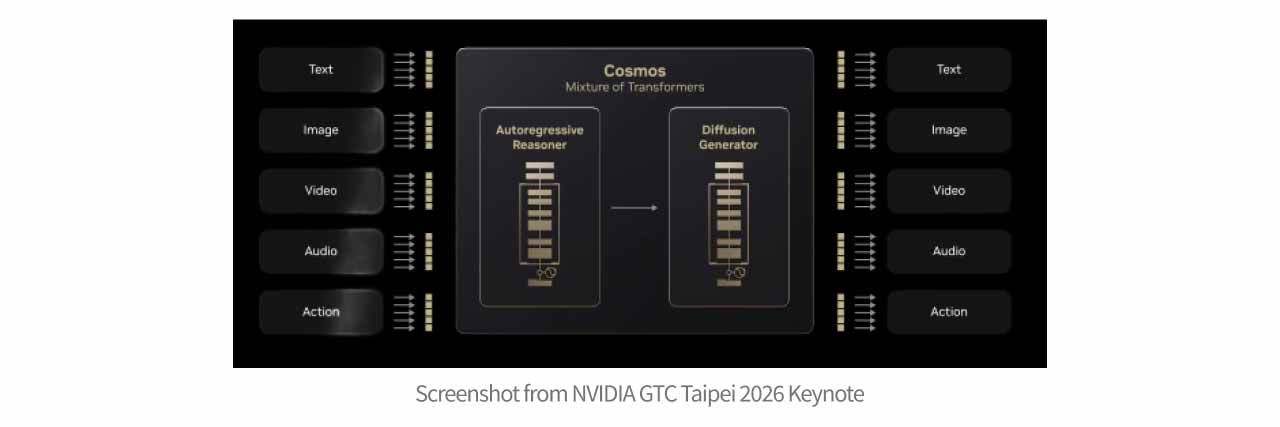
GTC 2026 also highlighted the growing importance of Physical AI. As AI moves beyond text and digital tasks into the real world, models must understand physical environments, motion, sound, space, and causality in order to support robots, autonomous vehicles, industrial equipment, and edge devices.
NVIDIA introduced Cosmos 3 as a foundational world model for Physical AI, supporting video, motion, audio, and language while generating physically accurate synthetic videos for simulation, policy training, and robotics learning. Isaac Groot is an open humanoid robot reference platform featuring 31 degrees of freedom and is primarily aimed at universities and research institutions to accelerate humanoid robotics algorithms and hardware ecosystem development. In autonomous driving, NVIDIA also unveiled the Alpamayo 2 open model alongside the Hyperion platform, further expanding its presence in self-driving and in-vehicle AI systems.
Overall, NVIDIA views Agentic AI as a computing paradigm that can scale across all physical devices. In the future, robots, autonomous vehicles, base stations, industrial equipment, and edge systems may all incorporate embedded agents, creating a unified AI network spanning cloud infrastructure, enterprises, PCs, and the physical world.
Conclusion
Overall, NVIDIA GTC 2026 reinforced the view that the AI industry is transitioning from the generative AI era into the next phase of Agentic AI. AI is no longer limited to generating content; it is becoming capable of understanding objectives, invoking tools, executing workflows, and creating tangible economic value through autonomous agents. This shift is driving a new computing architecture and accelerating upgrades across GPUs, CPUs, DPUs, networking, memory, data center design, and software toolchains.
From a hardware perspective, the Vera Rubin platform marks the beginning of NVIDIA’s next-generation AI infrastructure production cycle, while the Vera CPU highlights the renewed importance of CPUs within AI factories. At the system level, the DSX AI Factory concept moves data centers beyond compute deployment toward operational efficiency optimization, with key metrics centered on tokens per watt and compute revenue. On the application side, the Agent Toolkit, RTX Spark PC platform, and Physical AI ecosystem demonstrate how Agentic AI is expected to permeate enterprises, personal computers, robotics, autonomous vehicles, and edge devices simultaneously.
The core message of GTC 2026 can therefore be summarized as follows: computing power has become a productive asset that can be directly converted into revenue. NVIDIA has evolved beyond being a GPU company into a provider of AI systems and AI infrastructure. As Agentic AI emerges as the next mainstream computing paradigm, AI factories, personal agents, enterprise automation, and Physical AI will collectively drive the next wave of growth across the semiconductor and technology industries.
