-logo-on-building.jpg&w=3840&q=75)
What Does ASML Do? The Global Leader in Semiconductor Lithography Equipment
Company Overview: The World's Only Supplier of Mass-Produced EUV Lithography Systems
Founded in 1984 and headquartered in Veldhoven, the Netherlands, ASML is the global leader in semiconductor manufacturing equipment and currently the only company capable of mass-producing Extreme Ultraviolet (EUV) lithography systems. ASML primarily provides lithography equipment used in semiconductor manufacturing, including EUV lithography systems for advanced process nodes such as 3nm and 2nm, as well as Deep Ultraviolet (DUV) lithography systems, which are widely used in mature process technologies, selected advanced nodes, and memory manufacturing. In addition, the company offers metrology and inspection equipment, computational lithography software, and after-sales services to help customers improve manufacturing precision, yield, production efficiency, and equipment utilization.
Position in the Semiconductor Supply Chain: Connecting Chip Design, Foundries, and Memory Manufacturing
Within the global semiconductor supply chain, ASML operates in the equipment manufacturing segment, positioned between upstream materials and component suppliers and downstream semiconductor foundries and integrated device manufacturers (IDMs). Its customers include TSMC, Samsung Electronics, Intel, Micron Technology, and SK hynix, while its products are widely used in the production of advanced logic chips, DRAM, High Bandwidth Memory (HBM), and NAND Flash.
Compared with deposition, etching, cleaning, and packaging equipment, lithography is the core manufacturing process that determines transistor dimensions, chip density, and process nodes, making it one of the most technologically demanding steps in advanced semiconductor manufacturing. As AI chips continue to evolve toward 3nm, 2nm, and even more advanced process nodes, the importance of leading-edge lithography continues to grow. This has made ASML an indispensable equipment supplier for semiconductor manufacturers worldwide and a critical link connecting chip designers, foundries, and memory manufacturers across the global semiconductor supply chain.
Why ASML Equipment Demand Is a Leading Indicator of Semiconductor Capacity Expansion
Advanced Logic Chips: Driving Demand for Leading-Edge Process Technologies
The rapid adoption of generative AI, high-performance computing (HPC), and expanding cloud data centers has significantly accelerated demand for advanced logic chips in recent years. According to Fortune Business Insights, the global Advanced Node Logic Semiconductor market is projected to grow from US$62.31 billion in 2025 to US$70.78 billion in 2026, reaching US$229.62 billion by 2034, representing a compound annual growth rate (CAGR) of 15.8% between 2026 and 2034. Asia Pacific accounted for 43.36% of the global market in 2025, making it the largest regional market.
Compared with conventional processors, AI training and inference workloads require significantly higher computing performance and better energy efficiency, driving strong demand for advanced logic chips—including GPUs, AI accelerators, ASICs, and high-end CPUs—manufactured on process nodes below 7nm. As global cloud service providers continue expanding their AI infrastructure investments and companies such as NVIDIA, AMD, Google, and Amazon roll out next-generation AI chips, semiconductor foundries are increasing production capacity for 5nm, 3nm, and future 2nm technologies to meet growing demand for advanced computing. Because these leading-edge process nodes rely heavily on advanced lithography equipment, rising demand for advanced logic chips directly translates into higher foundry capital expenditures and stronger demand for ASML's lithography systems, making the company one of the most direct beneficiaries of the AI investment cycle.
HBM Memory: Driving Investment in Advanced Memory Manufacturing
AI demand has also made High Bandwidth Memory (HBM) the primary growth engine of the global memory market. HBM is an advanced form of DRAM that utilizes 3D stacking and a high-bandwidth architecture to deliver faster data transfer rates and lower latency for GPUs, AI accelerators, and HPC systems, making it an indispensable component of AI servers.
According to The Business Research Company, the global HBM market reached US$3.0 billion in 2025 and is projected to grow to US$3.81 billion in 2026, representing annual growth of approximately 26.7%. The market is expected to reach US$9.84 billion by 2030, with a CAGR of approximately 26.8% between 2026 and 2030. Growth is being driven by expanding HPC and AI/ML workloads, increased data center deployments, and rising demand for high-performance, low-power memory solutions.
Because HBM is fundamentally built on DRAM dies, continued advances in DRAM process technology require memory manufacturers to invest more heavily in leading-edge lithography equipment. As a result, AI-driven HBM demand ultimately translates into higher capital expenditures by memory makers and stronger equipment demand for ASML, particularly in HBM capacity expansion.
ASML Equipment Orders: A Leading Indicator of Global Capital Spending and Capacity Expansion
Lithography is one of the earliest steps in the semiconductor manufacturing process, while EUV and DUV lithography systems feature long lead times, high selling prices, and early deployment schedules. Semiconductor manufacturers typically begin planning capital expenditures and placing equipment orders with ASML one to two years before new production capacity comes online.
As a result, whether semiconductor foundries and logic chip manufacturers expand leading-edge production capacity or memory manufacturers increase DRAM and HBM output, these investments are ultimately reflected in ASML's equipment bookings, shipments, and management outlook. Compared with chip production data or end-market demand, ASML's equipment orders often provide an earlier signal of global semiconductor capital spending and capacity expansion, making them one of the market's most closely watched leading indicators for the Logic and Memory industry cycles as well as the broader AI investment cycle.
ASML's Core Business and Technologies: What Are EUV and DUV?
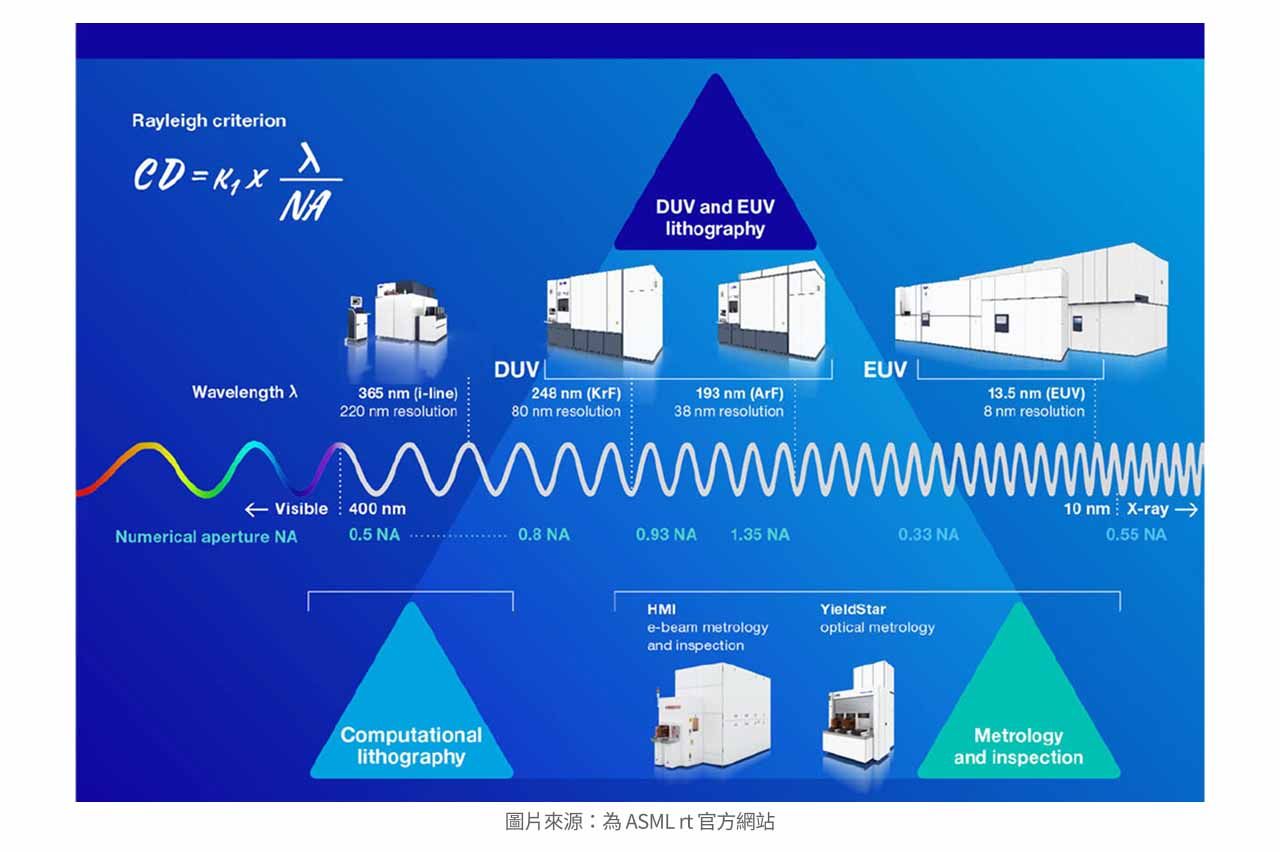 Source: ASML
ASML's business is built around three core technology platforms: DUV and EUV lithography systems, Computational Lithography, and Metrology & Inspection.
- Lithography systems are the company's core business. Using DUV and EUV technologies, these systems precisely project circuit patterns onto silicon wafers, making them indispensable for advanced semiconductor manufacturing.
- Computational Lithography uses algorithms, modeling, and software to improve patterning accuracy and enhance manufacturing yields.
- Metrology & Inspection solutions measure and inspect wafer manufacturing quality, providing process control data that helps chipmakers continuously improve yield and production efficiency.
Together, these three technology platforms form ASML's Holistic Lithography solution, providing a comprehensive lithography ecosystem that underpins the company's global technology leadership.
DUV (Deep Ultraviolet): The Backbone of Mature Process Technologies and Memory Manufacturing
Deep Ultraviolet (DUV) lithography is the most widely adopted lithography technology in the semiconductor industry and remains one of ASML's most stable sources of revenue. Its product portfolio includes i-line, KrF, ArF Dry, and ArF Immersion systems, with 193nm ArF serving as the primary wavelength alongside selected 248nm KrF systems. Compared with EUV, DUV has a much broader range of applications, supporting process nodes above 7nm, non-critical layers in advanced process technologies, as well as the production of DRAM, NAND Flash, automotive semiconductors, industrial chips, power management ICs, microcontrollers (MCUs), and analog chips.
From a technology perspective, DUV competition is no longer focused solely on improving resolution. Instead, manufacturers prioritize cost efficiency, throughput, yield, and energy efficiency. ASML continues to enhance the energy consumption and operational efficiency of its installed base through both hardware and software upgrades. Although DUV offers lower long-term growth potential than EUV, it benefits from a large installed base and stable service revenue while continuing to benefit from ongoing semiconductor capacity expansion.
From a business standpoint, DUV remains strategically important because it serves a broader customer base across a wider range of applications and is closely tied to overall semiconductor manufacturing capacity. Moreover, DUV is used alongside EUV for non-critical layers in advanced process nodes, creating a hybrid EUV + DUV manufacturing approach. In other words, even fabs producing 3nm or 2nm chips with EUV still require a significant number of DUV systems to complete the remaining lithography layers.
Notably, DUV technology continues to evolve toward higher throughput and broader applications. ASML's latest ArFi immersion systems now support production rates of more than 300 wafers per hour while continuously improving overlay accuracy and manufacturing efficiency to meet the growing demand for non-critical lithography layers in advanced process technologies.
In addition, DUV applications have expanded beyond front-end wafer fabrication into advanced packaging and 3D heterogeneous integration. ASML's recently introduced XT:260 i-line system is specifically designed for advanced packaging technologies such as micro-bumping and hybrid bonding. This demonstrates that even as EUV advances toward 2nm and future leading-edge nodes, DUV will continue to play an indispensable role across front-end manufacturing, advanced packaging, and memory production.
Overall, DUV complements EUV rather than competing with it. Even when semiconductor manufacturers adopt EUV for 3nm, 2nm, and future advanced nodes, they still rely heavily on DUV systems to process non-critical lithography layers and advanced packaging, ensuring DUV remains a cornerstone of global semiconductor capacity expansion.
EUV (Extreme Ultraviolet): The Core Technology Behind Advanced Semiconductor Manufacturing
Extreme Ultraviolet (EUV) lithography is ASML's most technologically advanced product and the foundation of its dominant position in the global semiconductor equipment industry. Operating at a 13.5nm wavelength, EUV can print much finer circuit patterns than conventional DUV systems, making it the preferred technology for critical layers in 3nm, 2nm, and future leading-edge process nodes below 7nm.
According to ASML's annual report, EUV systems are used for the most complex and critical layers in the world's most advanced chips. By requiring fewer exposure steps to produce intricate patterns, EUV reduces the number of photomasks needed, simplifies manufacturing processes, lowers defect risks, and improves yield and scalability for both advanced logic and leading-edge memory technologies.
From a technology perspective, ASML's EUV portfolio consists of 0.33 NA Low-NA EUV (NXE) systems and 0.55 NA High-NA EUV (EXE) systems.
The NXE series is currently the industry's primary platform for volume production. During its first-quarter 2026 earnings call, ASML announced that the TWINSCAN NXE:3800E had increased its throughput from 220 wafers per hour to 230 wafers per hour, highlighting continued improvements in EUV productivity and cost efficiency.
The EXE platform represents ASML's next-generation technology, designed to support semiconductor manufacturing beyond the 2nm node. High-NA EUV reduces the need for double patterning and triple patterning, lowering process complexity, defect risks, and manufacturing cycle times. ASML expects the EXE platform to begin supporting high-volume manufacturing in 2027.
EUV has become ASML's unique competitive advantage because of its extraordinary technological complexity and highly integrated global supply chain. Unlike DUV, which relies on conventional refractive lenses, 13.5nm EUV light is absorbed by virtually every material and cannot pass through traditional optical lenses. As a result, the entire lithography system must employ reflective optics while operating in a near-vacuum environment.
Generating EUV light is equally challenging. The light source is created by firing high-power lasers at molten tin droplets approximately 50,000 times per second, producing plasma that emits sufficiently bright 13.5nm radiation.
Behind this breakthrough technology is a highly specialized global supply chain. ZEISS of Germany exclusively supplies the ultra-precision mirrors used in EUV systems, whose surface flatness is accurate to the atomic level—so precise that, if enlarged to the size of Germany, surface variations would be less than one millimeter. TRUMPF, another German industrial technology leader, exclusively develops the ultra-high-power laser systems that amplify laser pulses by more than 10,000 times. These lasers are integrated with EUV light-source technology developed by Cymer, ASML's subsidiary, before ASML performs the final system integration and precision control.
More than two decades of joint development with key suppliers and investments totaling tens of billions of euros, together with continuous advancements toward the next-generation High-NA (0.55 numerical aperture) platform, have created enormous technological and capital barriers to entry. As a result, ASML remains the world's only company capable of mass-producing EUV lithography systems, establishing an industry-leading position that has proven extremely difficult to replicate.
DUV vs. EUV: What the Difference Means for ASML Investors
Overall, DUV and EUV are complementary technologies that together support global semiconductor capacity expansion. Thanks to its broad range of applications, DUV underpins mature process technologies, memory manufacturing, and non-critical lithography layers in advanced nodes, providing ASML with stable equipment shipments and recurring Installed Base Management (IBM) service revenue.
EUV, meanwhile, is driven by the rapid growth of AI, HPC, and advanced semiconductor manufacturing, serving critical layers for advanced logic chips and leading-edge DRAM, making it the primary engine of ASML's long-term growth and technology leadership.
From an investment perspective, EUV and DUV orders signal different industry trends. Rising EUV orders typically indicate that semiconductor manufacturers are accelerating investments in 3nm, 2nm, and future leading-edge logic technologies, as well as expanding capacity for HBM and advanced DRAM. In contrast, stronger DUV demand reflects broader expansion in mature process technologies, memory manufacturing, and overall semiconductor production capacity.
| Category | DUV (Deep Ultraviolet) | EUV (Extreme Ultraviolet) |
|---|---|---|
| Wavelength | 193nm (ArF), 248nm, 365nm | 13.5nm |
| Main Product Lines | i-line, KrF, ArF Dry, ArF Immersion | NXE (0.33 NA), EXE High-NA (0.55 NA) |
| Target Process Nodes | Mature process technologies and non-critical layers of advanced nodes | Critical layers for 3nm, 2nm, and future A14 and A10 process nodes |
| Key Advantages | Broad applications, mature technology, lower cost | Highest resolution, fewer exposure steps, improved yield |
| Primary Applications | Mature logic, DRAM, HBM, NAND Flash, automotive semiconductors | Advanced logic, leading-edge DRAM, HBM |
| Customer Base | Foundries, IDMs, memory manufacturers | Leading-edge foundries and advanced memory manufacturers |
| Growth Drivers | Semiconductor capacity expansion, automotive electronics, industrial applications, memory | AI, HPC, 2nm migration, High-NA EUV |
| Strategic Importance to ASML | Stable equipment shipments and recurring service revenue | Core driver of long-term growth and high-margin business |
ASML's Financial Performance and Equipment Orders: Reading the Semiconductor Industry Cycle
ASML delivered a strong financial performance in 2025, with net sales reaching €32.7 billion, up 15.6% year over year and marking a record high. Gross margin improved to 52.8%, while net income reached €9.6 billion, resulting in earnings per share (EPS) of €24.73. During the year, the company shipped 535 systems, including 48 EUV systems, and ended the year with a backlog of €38.8 billion, reflecting customers' continued commitment to future capacity expansion.
ASML's Product Mix: Revenue Continues to Shift Toward Advanced Process Technologies
From a product portfolio perspective, EUV remains ASML's highest-value product line. Although the company shipped only 44 NXE systems in 2025, these generated €10.45 billion in revenue, accounting for approximately 43% of system sales, highlighting that advanced lithography equipment continues to be the company's primary revenue driver.
Meanwhile, shipments of ArF Immersion (ArFi) DUV systems increased to 131 units, with revenue rising 6.7% year over year to €10.31 billion, reflecting resilient demand from mature process technologies, non-critical layers in advanced nodes, and memory manufacturing. In addition, Metrology & Inspection revenue increased 27.7% to €824.6 million, supported by growing demand for YieldStar optical metrology and HMI e-beam inspection systems, as semiconductor manufacturers continue investing in process measurement, defect inspection, and yield optimization.
In contrast, revenue from more mature DUV platforms—including ArF Dry, KrF, and i-line systems—declined 44.9%, 49.7%, and 16.8%, respectively. This suggests that market demand continues to shift away from legacy lithography equipment toward advanced immersion DUV and EUV systems, with ASML's revenue mix becoming increasingly concentrated in products supporting leading-edge semiconductor manufacturing.
However, investors should also be aware that if spending on advanced process technologies slows or major semiconductor manufacturers delay capital expenditures, demand for high-end lithography equipment could weaken, affecting ASML's product mix and future revenue growth.
| Product | FY25 Units Shipped | FY25 Revenue (€ million) | FY25 Revenue Mix | FY25 YoY Revenue Growth |
|---|---|---|---|---|
| EXE | 4 | 1,156.9 | 4.7% | 148.8% |
| NXE | 44 | 10,445.8 | 42.7% | 33.0% |
| ArF Immersion | 131 | 10,311.4 | 42.1% | 6.7% |
| ArF Dry | 16 | 427.0 | 1.7% | -44.9% |
| KrF | 78 | 1,001.3 | 4.1% | -49.7% |
| i-line | 54 | 307.3 | 1.3% | -16.8% |
| Metrology & Inspection | 208 | 824.6 | 3.4% | 27.7% |
| Total | 535 | 24,474.3 | 100.0% | 12.4% |
Looking at end markets, Logic remained ASML's largest source of revenue in 2025, contributing €16.05 billion, or approximately 66% of system sales. Memory revenue declined modestly from 2024 to €8.42 billion, but remained well above 2023 levels, indicating that investment in advanced memory technologies such as HBM and DDR5, fueled by AI demand, continues to stay at relatively elevated levels.
Overall, advanced logic remains ASML's primary growth engine, while high-end memory provides a second source of growth, underscoring that AI infrastructure investment continues to be the key driver of global semiconductor capital spending. Nevertheless, investors should monitor potential risks, including slower demand for AI chips, a moderation in HBM capacity expansion, or changes in investment plans by major customers across the logic and memory markets, all of which could weigh on future equipment demand and order growth.
| End Market | FY24 Units | FY24 Revenue (€ million) | FY25 Units | FY25 Revenue (€ million) | FY25 YoY Revenue Growth |
|---|---|---|---|---|---|
| Logic | 399 | 13,195.1 | 364 | 16,054.1 | 21.7% |
| Memory | 184 | 8,573.6 | 171 | 8,420.2 | -1.8% |
| Total | 583 | 21,768.7 | 535 | 24,474.3 | 12.4% |
Bookings: A Leading Indicator of Semiconductor Capital Spending
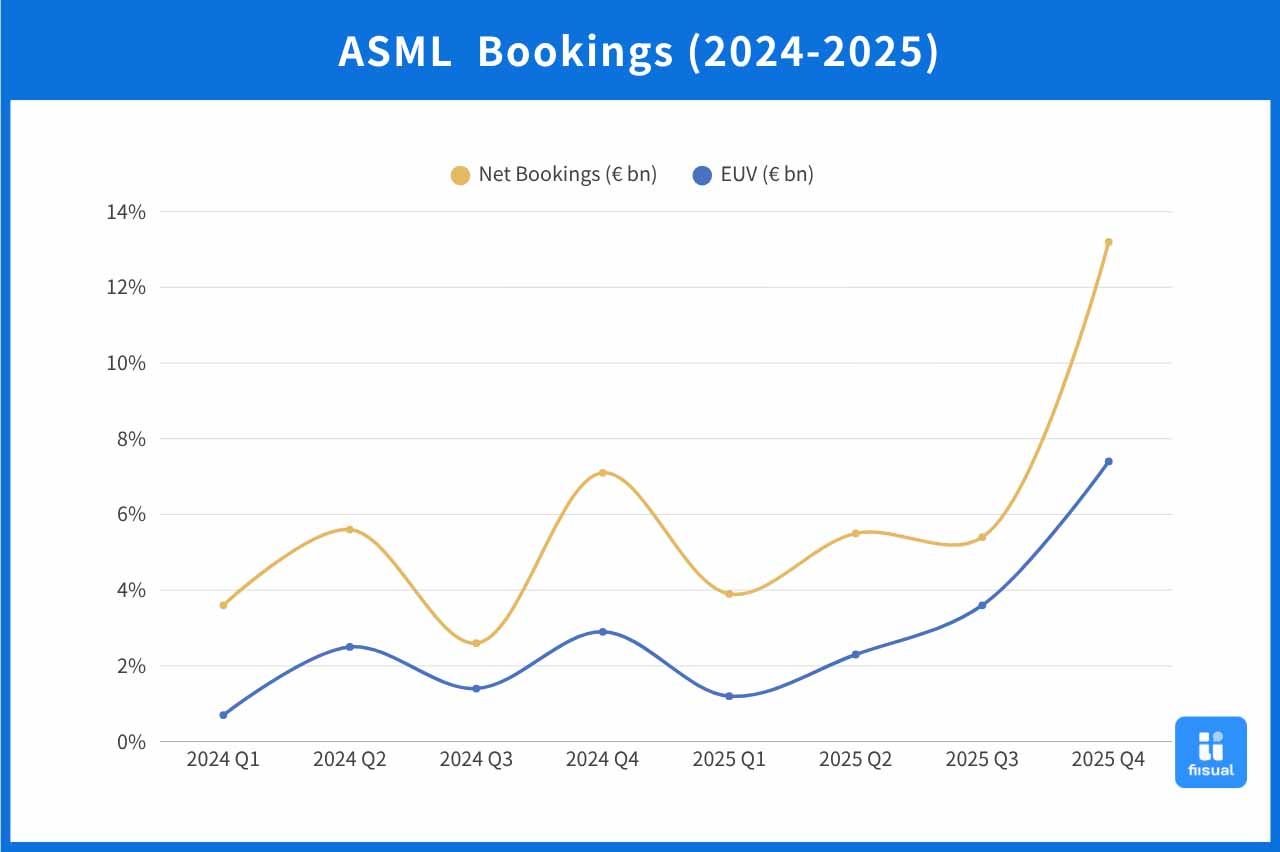
Compared with revenue, which reflects equipment that has already been delivered, net bookings provide a more forward-looking view of semiconductor manufacturers' future capital spending plans. ASML's equipment bookings were notably volatile throughout 2024, beginning at €3.6 billion in the first quarter, recovering to €5.6 billion in the second quarter, before declining again to €2.6 billion in the third quarter. This reflected an industry still undergoing a semiconductor downturn and customers adjusting their capital expenditure plans. However, bookings rebounded sharply to approximately €7.1 billion in the fourth quarter, indicating that major chipmakers had resumed purchasing equipment for advanced manufacturing capacity.
Momentum continued into 2025, with quarterly bookings remaining in the €3.9–5.5 billion range until surging to a record €13.2 billion in the fourth quarter, representing 144% quarter-over-quarter growth. During the same period, EUV bookings climbed steadily from €1.2 billion in the first quarter to €7.4 billion in the fourth quarter, highlighting a significant acceleration in demand for advanced lithography systems.
Overall, the trend in equipment bookings suggests that global semiconductor capital spending has transitioned from the correction phase of 2024 into a recovery, with the strongest momentum coming from investments in leading-edge process technologies.
The sharp increase in bookings during the fourth quarter of 2025 was primarily driven by customers expanding capital expenditures to support new production capacity. TSMC planned approximately US$40.9 billion in capital spending to expand 2nm, 3nm, and advanced packaging capacity. Samsung Electronics invested approximately KRW 52.7 trillion to strengthen its advanced DRAM, HBM, and logic manufacturing capabilities. Meanwhile, Intel continued advancing its Intel 18A process technology and High-NA EUV deployment, while Micron Technology and SK hynix accelerated expansion of HBM and advanced DRAM capacity.
With both logic and memory customers increasing capital expenditures, demand for advanced lithography equipment continued to strengthen, driving ASML's year-end backlog from €36.0 billion in 2024 to €38.8 billion in 2025. The growing backlog provides solid support for equipment deliveries and revenue over the coming years.
 Source: ASML; compiled by fiisual
Contract Liabilities: Measuring Order Quality and Revenue Visibility
In addition to equipment bookings and backlog, contract liabilities and Remaining Performance Obligations (RPO) provide valuable insight into the quality of ASML's order book and the visibility of future revenue.
As of the end of 2025, contract liabilities increased from €18.196 billion in 2024 to €19.373 billion, representing 6.5% year-over-year growth, as customers made larger down payments for future equipment deliveries and service contracts. Because EUV and high-end DUV systems carry high selling prices and long lead times, semiconductor manufacturers typically sign purchase agreements and make advance payments well before delivery. Rising contract liabilities therefore indicate that customers continue securing future production capacity in advance and that the company's order book carries a high level of execution certainty.
Meanwhile, Remaining Performance Obligations (RPO) reached €46.5 billion at the end of 2025, up from €43.3 billion a year earlier. These obligations primarily relate to NXT Immersion, NXE, and EXE lithography systems, together with associated service contracts. Management expects approximately 65% of the RPO balance to be recognized as revenue over the next 12 months, compared with 59% in the previous year, indicating improved short-term revenue visibility.
In addition, ASML recognized €11.517 billion of revenue from contract liabilities during 2025, up from €9.048 billion in 2024, demonstrating that existing orders continue to convert into equipment deliveries and reported revenue.
Overall, equipment bookings, backlog, contract liabilities, and Remaining Performance Obligations all continued to grow, indicating that semiconductor manufacturers worldwide remain committed to expanding advanced logic and high-end memory capacity while securing future lithography equipment well ahead of time. This provides ASML with both a high-quality order book and strong visibility into future revenue.
The continued growth in both backlog and RPO also reflects that, driven by demand for AI chips, HBM, and advanced process technologies, demand for high-end lithography equipment continues to exceed short-term supply. As a result, customers must plan capital expenditures and reserve production capacity years in advance, leaving the market in a supply-constrained environment.
That said, RPO and contract liabilities are ultimately recognized as revenue only as equipment is delivered and contractual obligations are fulfilled. If major customers postpone fab construction schedules, delay equipment acceptance, or are affected by factors such as export controls, revenue recognition may be deferred in the short term. Such delays, however, do not necessarily indicate a meaningful deterioration in underlying equipment demand.
ASML FY2Q26 Outlook: What Is the Market Watching?
FY1Q26 Earnings Review: Results Beat Expectations, but Investor Focus Shifted to China and Export Controls
ASML's FY1Q26 results, released in April, exceeded market expectations. Quarterly revenue reached €8.8 billion, including €6.3 billion from system sales and €2.5 billion from Installed Base Management (IBM) revenue. Gross margin came in at 53.0%, at the upper end of the company's guidance, while net income totaled €2.8 billion, resulting in earnings per share (EPS) of €7.15.
The company also raised its FY2026 revenue guidance to €36–40 billion, while maintaining its gross margin outlook of 51%–53%. Management expressed greater confidence in demand visibility and expects to produce at least 80 NXE systems in FY2027.
Growth during the quarter was driven by capacity expansion in advanced logic and memory. Continued AI adoption is fueling semiconductor demand, while advanced logic and memory manufacturing require an increasing number of critical lithography exposures, providing structural support for demand across EUV, DUV, and IBM services. Within first-quarter system sales, EUV accounted for 66% of revenue, while memory represented 51% of end-market sales, up from 30% in the previous quarter, highlighting accelerating investment in DRAM, HBM, and advanced memory production.
On the technology front, ASML continues to execute its NXE and EXE product roadmap. As discussed earlier, the company introduced the NXE:3800E Productivity Enhancement Package, increasing throughput from 220 wafers per hour to 230 wafers per hour while maintaining comparable overlay performance. ASML's EUV roadmap also shows that the NXE:3800F, NXE:4200G/H, and High-NA EXE platforms are designed to support post-2nm process nodes such as A14 and A10. This demonstrates that ASML is benefiting not only from customers' capacity expansion but also from improving the productivity and efficiency of each lithography system.
Despite stronger-than-expected earnings and an upward revision to full-year guidance, ASML's share price fell approximately 6% following the earnings announcement. Investor attention shifted away from near-term financial performance toward concerns over weakening demand from China, tighter export controls, and reduced transparency around equipment bookings.
China's contribution to system sales fell from 36% in the previous quarter to 19% in the first quarter, significantly reducing the company's exposure to the Chinese market. At the same time, concerns emerged that the United States could impose additional restrictions on DUV equipment exports to China, raising questions about the impact of weaker Chinese demand for mature-node manufacturing equipment on ASML's future revenue mix. In addition, the company decided to stop regularly reporting bookings, reducing investors' ability to monitor demand trends in real time and adding to market uncertainty.
Overall, the key takeaway from FY1Q26 was not a deterioration in ASML's underlying business fundamentals. Demand for AI, DRAM, HBM, and advanced logic remains strong, but investors have become increasingly sensitive to the company's China exposure and the potential impact of expanding export restrictions.
Recent Development: ASML Signs MoU with Tata Electronics to Expand India's Semiconductor Ecosystem
Following its earnings announcement, ASML announced in May 2026 that it had signed a Memorandum of Understanding (MoU) with Tata Electronics to support the construction of a 300mm semiconductor fab in Dholera, Gujarat, India. Under the agreement, ASML will provide integrated lithography solutions, technical support, workforce training, and supply chain collaboration.
The facility represents an investment of approximately US$11 billion and is expected to manufacture chips for automotive electronics, mobile devices, AI, and other strategic semiconductor applications. Initial production will focus on 28nm, 40nm, 55nm, 90nm, and 110nm process technologies.
The significance of this partnership extends beyond incremental equipment demand. It demonstrates ASML's efforts to expand into emerging semiconductor manufacturing markets outside China. As geopolitical tensions and export restrictions continue to reshape global technology supply chains, India is becoming an increasingly important hub for supply chain diversification and semiconductor localization.
While near-term demand from the Tata project is expected to focus primarily on mature process technologies and DUV equipment, the partnership could strengthen ASML's customer base outside China, diversify geopolitical risk, and establish long-term relationships within India's growing semiconductor ecosystem.
The agreement also highlights ASML's broader strategy of diversifying its end markets as Chinese demand slows and export restrictions become more stringent. As investors look ahead to the FY2Q26 earnings call, one key question will be whether management provides additional insight into demand from India, Southeast Asia, and other regions outside China, and whether these markets can partially offset uncertainty surrounding China.
Market Outlook: Near-Term Noise and Geopolitical Risks, but Long-Term Demand Remains Positive
Ahead of the upcoming earnings release, ASML's share price has declined roughly 7%, primarily due to renewed geopolitical tensions in the Middle East and a series of negative developments surrounding the AI sector, which have weighed broadly on semiconductor equipment stocks.
Despite these short-term headwinds, ASML's major customers continue to signal robust long-term demand, while the company's substantial backlog provides strong visibility into future operations. In the lead-up to the earnings announcement, multiple analysts raised their forecasts for ASML's financial performance, reflecting continued confidence in the company's equipment demand, revenue growth, and order visibility over the next several years.
FY2Q26 Key Focus: Can Demand Continue Expanding, and Can Growth Outside China Offset Weakness in China?
Looking ahead to ASML's FY2Q26 earnings call, investor attention is increasingly shifting toward whether semiconductor demand can continue expanding and translate into stronger revenue growth and greater order visibility. Against the backdrop of sustained investment in AI chips, HBM, and advanced process technologies, any further increase in the company's full-year guidance, confirmation that new orders remain robust, and evidence that demand outside China is offsetting slower Chinese demand would reinforce the view that the semiconductor capital spending cycle remains firmly in an expansion phase.
Conversely, if customers adopt a more cautious approach to capital expenditures, equipment demand slows, or the impact of weaker demand from China becomes more pronounced, the earnings call could mark an important turning point in how investors assess ASML's long-term growth prospects.
Key areas to watch during the FY2Q26 earnings call include:
- Will FY2026 guidance be raised again? Market expectations remain optimistic, supported by strong demand for AI infrastructure and advanced process technologies. Investors will be watching whether ASML raises its current €36–40 billion revenue guidance toward the upper end of the range and whether gross margin expectations also move toward the high end of guidance.
- Order visibility and future demand trends. Although ASML no longer reports quarterly bookings, management's commentary on order trends, backlog, Remaining Performance Obligations (RPO), customer demand, and supply-demand dynamics remains one of the most important leading indicators of future semiconductor capital spending. Investors will be particularly focused on whether both logic and memory customers continue expanding production capacity.
- Can demand outside China offset weakness in the Chinese market? China's contribution to ASML's revenue has already declined significantly from previous highs. Investors will closely monitor the impact of U.S. export restrictions on DUV shipments to China, while assessing whether demand from India, Taiwan, South Korea, the United States, and other regions can compensate for slower Chinese demand. ASML's recent Memorandum of Understanding with Tata Electronics underscores its commitment to expanding India's semiconductor ecosystem, making management's outlook on India and other emerging markets another key topic to watch.
- Will capacity expansion continue across both Logic and Memory? AI remains the primary driver of investment in advanced logic, HBM, and DRAM. Investors will look for management's latest views on capital spending plans at major customers—including TSMC, Samsung Electronics, Intel, Micron Technology, and SK hynix—and whether memory continues to serve as an important source of equipment demand growth during this investment cycle.
- Can ASML further expand EUV and High-NA production capacity? Beyond demand, the market will also focus on whether ASML plans to increase production capacity for Low-NA EUV systems, provide updates on the rollout of High-NA EUV, and discuss improvements in supply chain constraints, delivery schedules, and customers' fab construction progress. These factors will help investors determine whether future revenue growth will continue to be constrained primarily by manufacturing capacity.
Overall, the central question for the FY2Q26 earnings call is whether management once again confirms that AI-driven demand for semiconductor equipment remains in a structural growth cycle, while demonstrating that demand outside China is sufficient to offset uncertainty in the Chinese market and sustain—or even improve—visibility into future orders and revenue.
If these signals remain positive, investor confidence in ASML's long-term growth prospects and the broader global semiconductor capital spending cycle is likely to strengthen further, potentially providing renewed support for the company's share price following its recent pullback.
Market Consensus: Upward Guidance Revisions and Order Visibility Remain the Primary Focus
The market expects ASML to deliver another quarter of solid growth in FY2Q26, with revenue forecast at approximately €9.03 billion, close to the upper end of the company's €8.4–9.0 billion guidance provided during the first-quarter earnings call.
However, because Installed Base Management (IBM) carried a relatively high margin in the previous quarter and ASML continues investing in manufacturing capacity and workforce expansion, consensus estimates suggest that gross margin may ease slightly to 51.5%–52.0%, while earnings per share (EPS) are expected to decline modestly to approximately €6.90. Even so, overall earnings are still projected to deliver double-digit year-over-year growth.
More importantly, investors will be looking for any additional increase in ASML's full-year 2026 guidance and management's assessment of future order visibility. If the company raises its revenue outlook toward the upper end of the current guidance range—around €40 billion—while reaffirming strong demand for AI, HBM, and advanced process technologies, confirming that demand outside China can offset slower Chinese sales, and maintaining its view that supply remains constrained alongside a substantial backlog, market confidence in ASML's long-term growth trajectory and the broader semiconductor capital spending cycle would likely strengthen further.
| Key Metric | FY2Q26 (Market Consensus) | FY1Q26 (Actual) |
|---|---|---|
| Revenue | €9.032 billion | €8.77 billion |
| Gross Margin | 51.5%–52.0% | 53.0% |
| EPS | €6.90 | €7.15 |
| Net Income | €2.7–2.8 billion | €2.76 billion |
| FY2026 Revenue Guidance | Market expects guidance to move toward the upper end of the range (~€40 billion or higher is the bullish expectation) | Company guidance: €36–40 billion |
Conclusion
ASML remains one of the most important indicators of advanced semiconductor manufacturing and global wafer fabrication capital spending. Because EUV and DUV lithography systems must be ordered and installed well before new semiconductor capacity enters production, trends in equipment demand, management guidance, and customer investment plans provide valuable insight into whether global expansion in logic and memory manufacturing is likely to continue.
Current industry trends remain supportive. AI continues to drive investment in advanced logic, HBM, and DRAM, while major customers—including TSMC, Samsung Electronics, Micron Technology, and SK hynix—continue expanding capacity. At the same time, ASML is broadening its presence in markets outside China, including India, providing additional support for long-term equipment demand and growth.
Nevertheless, export controls targeting China, geopolitical uncertainties, and shifts in customers' capital spending plans remain important factors that could influence short-term market sentiment and the composition of future equipment demand.
As a result, the upcoming FY2Q26 earnings call will be judged not only on whether quarterly financial results exceed expectations, but more importantly on whether management once again confirms that AI-driven expansion in both logic and memory manufacturing remains intact, raises its full-year outlook, maintains strong order visibility, and demonstrates that demand outside China is sufficient to offset the slowdown in the Chinese market.
