
Kimi K3 Shakes Up Silicon Valley with Powerful Performance, Reshaping the AI Competitive Landscape
Chinese AI startup Moonshot AI launched its latest large language model, Kimi K3, in July 2026. With powerful coding capabilities, a one-million-token context window, and multiple architectural innovations, Kimi K3’s performance trails only Claude Fable 5 and GPT-5.6 Sol. Using only open-source tools, it was even able to autonomously complete a functional semiconductor chip within 48 hours. Kimi K3 quickly became a market focus and was dubbed a “DeepSeek Moment 2.0,” prompting investors to reassess the competitive landscape for AI models and putting pressure on U.S. semiconductor stocks.
Within 48 hours of Kimi K3’s launch, user requests far exceeded expectations and pushed its available computing capacity beyond its limits, prompting Moonshot AI to suspend new consumer subscriptions. The development has also led the market to reconsider previous concerns that AI computing demand could slow or even face oversupply.
Kimi K3 Boosts Computing Efficiency Through Innovative Architecture
Kimi K3 has more than 2.8 trillion parameters, a one-million-token context window, and vision capabilities. It is designed for advanced AI use cases including long-horizon coding, knowledge work, and reasoning.
Kimi K3’s breakthroughs are built around two key innovations: Kimi Delta Attention (KDA) and Attention Residuals (AttnRes).
- KDA replaces most conventional attention computation with linear attention while retaining a small number of full-attention layers for complex scenarios that require precise retrieval. This reduces KV Cache usage by 75% and increases decoding throughput by up to 6x with a one-million-token context.
- AttnRes overcomes the limitation of traditional models, where information is accumulated sequentially from one layer to the next. It enables dynamic cross-layer retrieval, helping preserve features learned in earlier layers as information passes through deeper layers.
In addition, Kimi K3 incorporates the Stable LatentMoE framework to further increase the sparsity of its Mixture-of-Experts (MoE) architecture. Only 16 of as many as 896 experts are activated at a time, limiting the amount of computation required to generate responses. Together, these architectural advances make Kimi K3 approximately 2.5x more efficient overall than its predecessor, K2.
K3’s Overall Performance Trails Only Fable 5 and GPT-5.6 Sol, at a Lower Cost
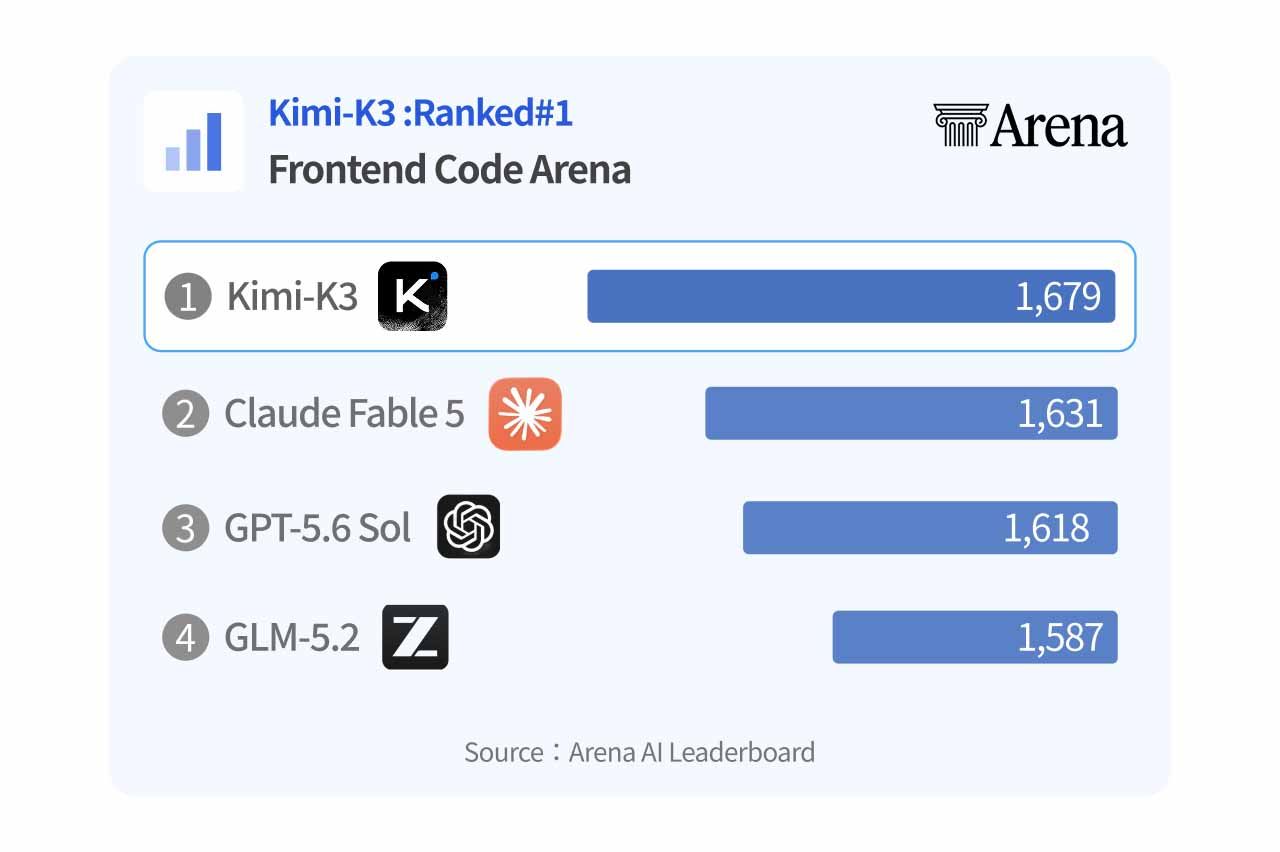 Source: Arena AI Leaderboard
Kimi K3 delivers strong performance in coding and software engineering. It debuted at the top of the Frontend Code leaderboard on Arena.ai, surpassing Claude Fable 5, GPT-5.6 Sol, and GLM-5.2.
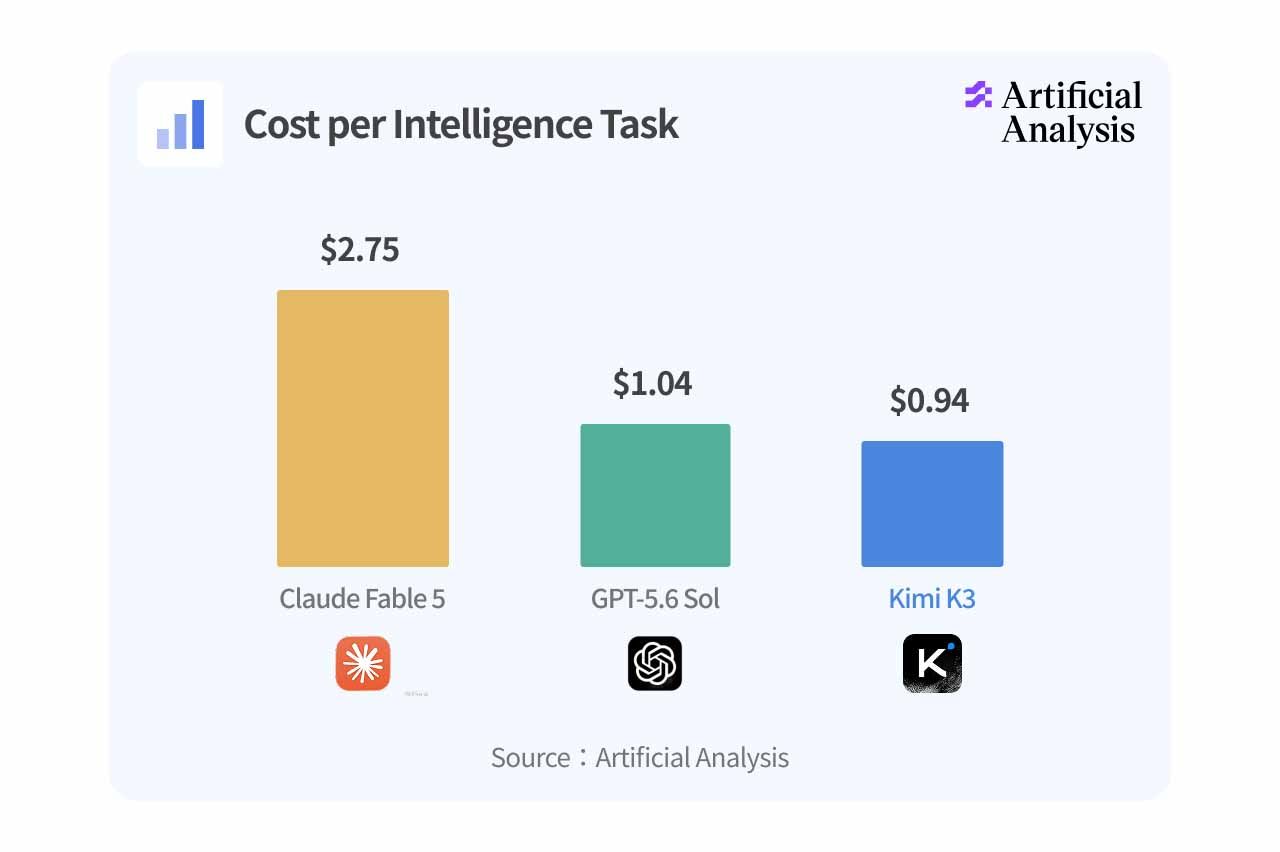 Source: Artificial Analysis
In Artificial Analysis’ latest Intelligence Index, Kimi K3 scored 57, ranking behind only Claude Fable 5 and GPT-5.6 Sol and placing it among the world’s leading AI models.
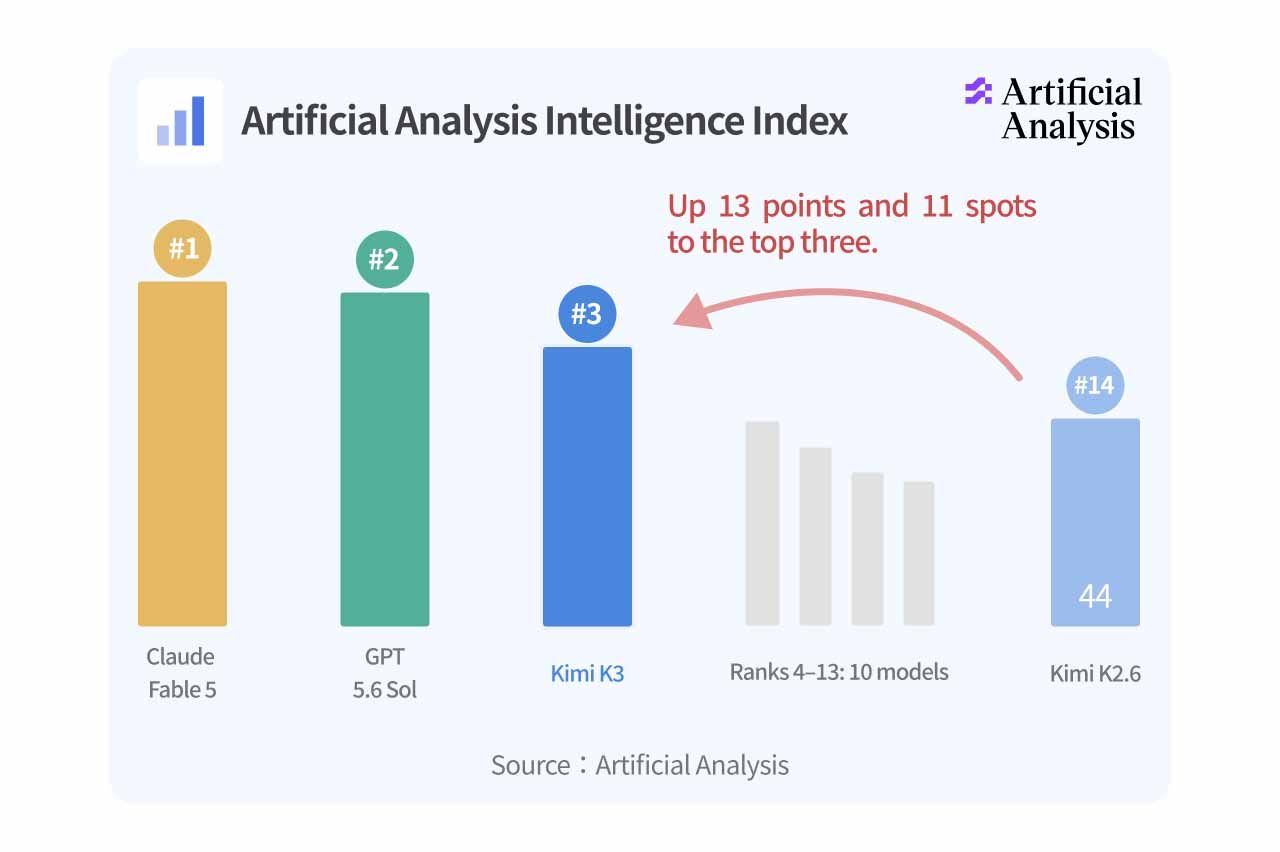 Source: Artificial Analysis
In terms of pricing, K3 costs $3 per million input tokens and $15 per million output tokens. Although this represents a new high among Chinese models, it remains well below Anthropic’s Fable model, which costs $10 per million input tokens and $50 per million output tokens. However, K3 is less token-efficient, tends to produce more verbose outputs, and runs more slowly than the average model in its class. According to Artificial Analysis, K3’s average cost per task is $0.94, slightly below GPT-5.6 Sol’s $1.04 and less than half of Fable 5’s $2.75.
With its strong performance and relatively low cost, K3 quickly gained user traction following its launch, pushing available computing capacity to its limit within just 48 hours.
Improved Model Efficiency Redefines AI Computing Demand
Over the past two years, the AI narrative has largely focused on how many GPUs are required to train a model. As model efficiency continued to improve, the market even began to worry that demand for AI computing could gradually slow, potentially resulting in excess capacity.
However, the launch of Kimi K3 has challenged concerns about computing oversupply. Although Moonshot AI may already have deployed high-end inference clusters consisting of thousands or even tens of thousands of A800 and H800 GPUs, user requests far exceeded expectations after K3’s launch, rapidly pushing existing computing infrastructure close to its capacity limits. Moonshot AI even suspended new consumer subscriptions, indicating that improvements in model efficiency have not reduced overall computing demand.
As Jevons’ Paradox suggests, when technological efficiency improves and the cost per unit of usage declines, demand can rise rapidly enough that total resource consumption increases rather than decreases. For AI, more efficient and lower-cost models reduce the barriers to adoption for enterprises and developers. As willingness to deploy AI increases and inference demand grows rapidly, overall computing demand could expand even further.
Independent AI model companies such as Moonshot AI (月之暗面) , BigModel AI(智譜) , and MiniMax currently obtain computing capacity primarily by renting public cloud resources or building their own computing clusters. The former is constrained by the availability of cloud resources, while the latter requires significant capital expenditure and lengthy construction timelines. As a result, computing supply is difficult to expand rapidly in the short term. Data from the China Academy of Information and Communications Technology (CAICT) shows that China’s AI computing demand increased 417% year over year in the first quarter of 2026, while computing supply grew only 128% over the same period, meaning demand grew at roughly three times the pace of supply.
Meanwhile, as long-context models and AI Agent applications become more widespread, memory capacity, data-access speeds, and the efficiency of model-parameter transfers are increasingly becoming key constraints on inference performance. SemiAnalysis notes that K3 has more than 2.8 trillion parameters, with the model weights alone requiring more than 1.5TB of HBM. Even with relatively few concurrent users, large amounts of KV Cache still need to be offloaded to server DDR5 memory and NVMe solid-state drives, suggesting that improved model efficiency has not meaningfully eased HBM capacity requirements.
As token usage continues to increase, servers must handle greater volumes of data transfers and heavier inference workloads, making high-bandwidth, high-performance DDR5 server memory increasingly important. At the same time, large-scale deployment of AI Agents will increase demand for data storage and high-speed read/write performance, further raising the capacity and performance requirements for enterprise SSDs (eSSDs).
