In the past, the power supply industry was widely regarded as a mature component market with limited room for margin expansion. However, the explosive growth in AI computing demand has significantly increased power consumption in data centers. Power requirements for a single AI rack have already exceeded 120kW in the NVIDIA GB300 generation, making traditional low-voltage power architectures increasingly inadequate for handling such massive electrical loads.
To improve power efficiency and thermal performance, data centers are rapidly adopting new architectures such as 800V High-Voltage Direct Current (HVDC) power distribution and Solid-State Transformers (SSTs). Meanwhile, soaring electricity demand is placing unprecedented pressure on power generation, transmission, and distribution infrastructure, leading to supply shortages and accelerating grid modernization. As a result, both the value content and technological barriers across the power supply value chain continue to rise, driving a market re-rating of the industry and positioning it as one of the primary beneficiaries of the AI infrastructure upgrade cycle.
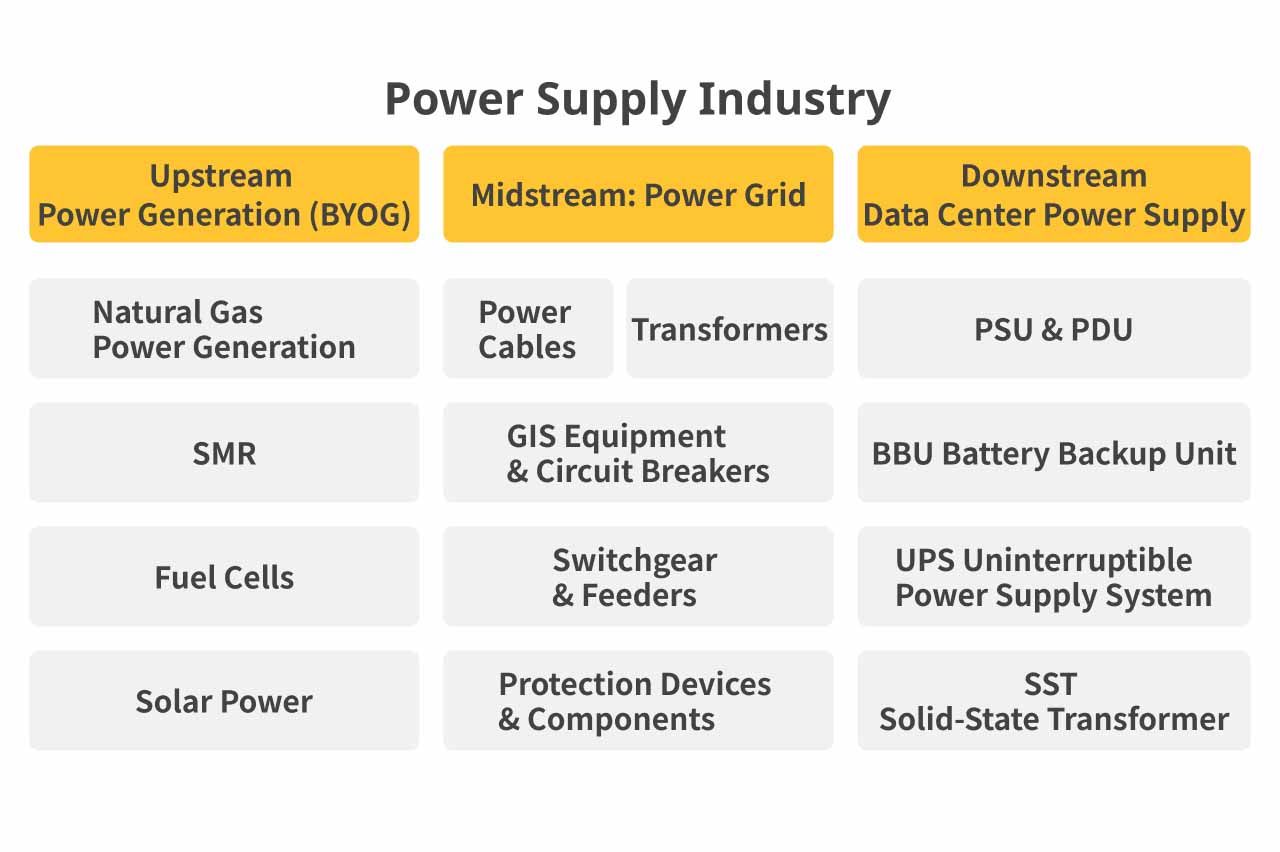
Power Supply Industry Value Chain
- Up-stream:Delta (2308.TW)、 Kaori (8996.TW)、
- Mid-stream:Walsin (1605.TW)、Ta Ya (1609.TW)、FE (1519.TW)、SEEC (1503.TW)、CHEM (1513.TW)、AEC (1514.TW)、Thinking (2428.TW)、TA-I (2478.TW)
- Down-stream:LTC (2301.TW)、Acbel (6282.TW)、FSP (3015.TW)、Dynapack (3211.TW)、STL (4931.TW)、AES-KY (6781.TW
Upstream: Natural Gas and Fuel Cells Become the Mainstream Power Sources
The upstream segment is responsible for electricity generation. To support the rapidly growing power demand from AI data centers, the United States is expected to require at least 44GW of additional generation capacity. However, due to aging grids, interconnection congestion, and transformer shortages, only around 25GW is currently available, widening the supply-demand gap and extending the median grid interconnection waiting time to five years. Tight supply has also pushed electricity prices significantly higher. For example, in the PJM market serving Northern Virginia, capacity prices for 2026–2027 have climbed to US$333.44, more than four times the level recorded in 2020.
Against this backdrop, cloud service providers (CSPs) are gradually shifting from traditional utility power purchasing toward the Bring Your Own Generation (BYOG) model, investing in on-site power generation while remaining connected to the grid. CSPs are also willing to pay substantial premiums to secure critical generation equipment such as gas turbines, strengthening suppliers' pricing power and revenue visibility.
On the policy front, the U.S. government is simultaneously increasing the costs associated with relying solely on the public grid while lowering regulatory barriers for self-generated electricity. For example, the White House's Rate Fairness and Infrastructure Commitment requires major technology companies to contribute to grid upgrade costs while encouraging them to install on-site generation in regions where grid capacity is constrained. The Federal Energy Regulatory Commission (FERC) is also proposing to replace the traditional "first-come, first-served" interconnection process with a "first-ready, first-served" approach, allowing projects equipped with self-generation capabilities to gain faster grid access. In addition, both PJM and ERCOT require large power consumers to maintain islanding capability during peak demand, while Virginia and Texas are gradually relaxing regulations governing behind-the-meter generation, further accelerating enterprise adoption of self-generated power.
Bring Your Own Generation (BYOG) BYOG refers to a power strategy in which companies generate part of their own electricity while remaining connected to the public grid, allowing both sources to operate in coordination.
| Policy | Authority | Key Measure |
|---|---|---|
| Rate Fairness and Infrastructure Commitment | White House | Large enterprises share grid upgrade costs and must build on-site generation in power-constrained regions |
| Priority Interconnection Pathway | FERC | Projects with self-generation can bypass lengthy interconnection studies |
| Large Load Review Program | PJM / ERCOT | Large facilities are required to maintain islanding capability during peak demand |
| Behind-the-Meter Generation Legalization | Virginia / Texas | Allows on-site power generation with simplified regulatory approval |
Current BYOG solutions adopted by CSPs primarily include natural gas generation, Small Modular Reactors (SMRs), solar power, and fuel cells. Among these, natural gas generation and fuel cells have become the leading choices due to their technological maturity and rapid deployment capabilities.
Natural Gas Power Generation
Balancing Rapid Deployment and Large-Scale Baseload Demand
Natural gas power generation produces electricity by burning natural gas to drive gas turbines, while recovering high-temperature exhaust heat to generate steam that powers steam turbines, forming a highly efficient combined-cycle power generation system. Depending on equipment characteristics, gas turbines are generally classified into Aero, Industrial Gas Turbines (IGT), Reciprocating Internal Combustion Engines (RICE), and Heavy-Duty Gas Turbines (HDGT).
- Aero, IGT, and RICE offer shorter delivery times, faster startup and ramp-up speeds, highly modular designs, and superior land-use efficiency, making them well suited for behind-the-meter generation and temporary power solutions for data centers.
- HDGTs, by contrast, are primarily used in large combined-cycle power plants. Although construction takes longer, their large unit capacity, 50%–60% generation efficiency, and lower levelized cost of electricity make them the primary baseload power source for utility grids and gigawatt-scale power facilities.
Growing AI Data Center Power Shortages Drive Short-, Medium-, and Long-Term Demand
As AI data center construction accelerates, grid interconnection timelines lengthen, and CSPs increasingly adopt BYOG strategies, gas turbines have become the most mature and rapidly deployable solution for closing today's power supply gap. In the near term, Aero, IGT, and RICE technologies are expected to experience the fastest demand growth by enabling data centers to secure stable power before grid connections are completed. Over the longer term, as AI campuses expand toward gigawatt-scale deployments, demand for large combined-cycle gas power plants will also rise. Future adoption of hydrogen co-firing technologies could further improve decarbonization while maintaining reliable power generation, extending the industry's long-term growth outlook.
Fuel Cells
Fuel Cells Offer Low Emissions and High Efficiency
Fuel cells generate electricity through electrochemical reactions between hydrogen or natural gas and oxygen without combustion, resulting in low emissions, high efficiency, and high-quality stationary power generation. The two dominant technologies today are Solid Oxide Fuel Cells (SOFCs) and Proton Exchange Membrane Fuel Cells (PEMFCs).
SOFCs currently account for roughly 60% of the stationary fuel cell market, achieving electrical efficiency of approximately 60% while offering excellent fuel flexibility. They can leverage existing natural gas infrastructure today and gradually transition toward hydrogen in the future. In addition, SOFCs utilize ceramic electrolytes instead of platinum-based catalysts, providing greater long-term cost reduction potential than PEMFCs.
SOFCs Become a Key Growth Driver for AI Data Center Power
As AI data centers demand faster deployment, greater reliability, and higher energy efficiency, SOFCs are emerging as one of the most promising self-generation technologies. Compared with traditional grid expansion, which often takes several years or longer, fuel cell systems can typically be deployed within 90 days, delivering around-the-clock distributed baseload power near data centers while offering low noise, low water consumption, and fewer environmental constraints.
Furthermore, the native DC output of SOFCs is highly compatible with future 800V HVDC architectures, reducing power conversion losses and improving overall data center energy efficiency. The U.S. Inflation Reduction Act (IRA) also provides a 30% investment tax credit for fuel cell projects, lowering the levelized cost of electricity for SOFCs to approximately US$0.055 per kWh, making them increasingly competitive with conventional natural gas generation.
The market is currently led by Bloom Energy, whose SOFC systems have already been adopted by Equinix, Amazon Web Services (AWS), and Intel. As CSP deployment continues to expand, SOFCs are expected to become one of the key growth engines for self-powered AI data centers.
Data Center Power Supply Is Evolving Toward a Dual-Track Model
Today, data center power strategies are evolving from relying solely on natural gas generation toward a dual-track approach combining natural gas and fuel cells. Fuel cells are increasingly viewed as an incremental power source because they better satisfy AI-era requirements for rapid deployment, reliable power delivery, and minimal environmental constraints.
Natural gas generation remains the dominant solution today, offering approximately 95% reliability, continuous around-the-clock operation, mature technology, and relatively fast deployment, making it well suited for supplying large-scale AI campuses. However, as AI computing demand continues to surge, prolonged grid interconnection delays, land availability challenges, and environmental restrictions are increasing the strategic importance of fuel cells.
Fuel cells offer modular designs, rapid deployment, high efficiency, low noise, and minimal water consumption, enabling installation close to data centers to provide distributed baseload power and help alleviate AI-related electricity shortages. Among them, SOFC technology, with its high efficiency and compatibility with next-generation DC power architectures, is widely regarded as one of the long-term power solutions for AI data centers.
Overall, natural gas generation will remain the primary power source for AI data centers in the near term. However, as AI-driven electricity demand continues to grow, fuel cells—supported by their rapid deployment capabilities and stable baseload generation—are expected to become an increasingly important component of future self-powered data center infrastructure.
Midstream: The Power Grid Handles Voltage Transformation and Transmission
The power grid represents the midstream segment of the electricity supply chain, responsible for safely and reliably delivering electricity generated at power plants to industrial users, residential customers, and data centers through transmission, substations, and distribution networks. Electricity is first stepped up through transformers to minimize transmission losses over long distances before being progressively stepped down at substations and ultimately distributed to end users.
Key equipment includes transformers, Gas-Insulated Switchgear (GIS), circuit breakers, power cables, Solid-State Transformers (SSTs), and High-Voltage Direct Current (HVDC) transmission systems. Transformers perform voltage conversion throughout the transmission process and are among the most critical components of the power grid. GIS and circuit breakers provide switching, fault isolation, and system protection to ensure grid safety and reliability.
AI Electricity Demand Accelerates Grid Modernization
The power industry is entering a new growth cycle driven by two major trends: the explosive rise in AI computing demand and the modernization of aging power grids worldwide. As AI models become increasingly sophisticated and data center construction accelerates, global electricity consumption for AI inference is projected to reach 472TWh by 2030, while incremental AI data center demand in the United States is expected to exceed 61GW between 2026 and 2030.
However, while AI data centers can typically be built within 18 to 24 months, transmission infrastructure expansions often require five to seven years, creating a significant mismatch between computing deployment and electricity delivery that has become one of the primary bottlenecks for AI infrastructure expansion.
Meanwhile, much of the U.S. grid infrastructure was built between the 1950s and 1970s. Aging transformers and transmission equipment have exceeded their designed service lives, while growing renewable energy integration is driving another large-scale replacement and expansion cycle worldwide. Government policy further supports long-term investment through initiatives such as the Infrastructure Investment and Jobs Act (IIJA), the Inflation Reduction Act (IRA), and AI infrastructure programs including Stargate, all of which encourage substantial investment in generation, transmission, and distribution infrastructure.
Transformers Become Strategic Assets Amid Supply Shortages
Transformers are essential components of transmission and distribution systems, responsible for adjusting voltage levels to ensure electricity can be delivered safely and efficiently to end users. As grids modernize, high-voltage transmission expands, and AI data centers move toward higher power densities, transformers are becoming increasingly critical—particularly large power transformers, which feature high capacity, stringent specifications, and extensive customization.
Manufacturing large transformers requires specialized electrical steel and advanced production processes, making capacity expansion difficult. Entering the U.S. market also requires certifications such as IEEE, ANSI, and UL, and suppliers often need three to five years to become qualified vendors for utility companies, creating substantial barriers to entry.
The global market for large power transformers is currently experiencing severe supply-demand imbalances, with lead times extending to approximately three to five years. Although major manufacturers including Eaton, Hitachi Energy, and Siemens Energy are expanding production, most new capacity will not become available until 2027–2028, leaving near-term supply constraints largely unresolved.
The global supply gap for transformers rated above 100kV is projected to reach approximately 30% in 2025, with cumulative shortages expanding from 708GVA today to around 1,360GVA by 2030. Rising capacity requirements, increasingly demanding specifications, and constrained supply continue to support higher average selling prices. Large transformers rated above 220kV in the U.S. are expected to reach US$450–500 million per GVA over the next one to two years, improving both order visibility and profitability for manufacturers.
Downstream: Data Center Power Architectures Undergo a Major Upgrade
As AI computing platforms continue to evolve, server performance and power consumption are increasing exponentially, pushing conventional low-voltage power architectures toward physical and efficiency limits. By the NVIDIA Kyber generation, power consumption per AI rack is expected to reach 1MW, far exceeding the capabilities of traditional power delivery systems.
To overcome these limitations and improve overall energy efficiency, next-generation AI data centers are expected to accelerate adoption of 800V HVDC architectures while upgrading key components including Solid-State Transformers (SSTs), Power Supply Units (PSUs), and Battery Backup Units (BBUs), triggering a comprehensive transformation of data center power infrastructure.
800V HVDC Breaks Through High-Power Bottlenecks
800V HVDC converts incoming AC power into centralized 800V high-voltage DC before delivering electricity directly to server racks via DC busbars. Compared with conventional low-voltage DC architectures, 800V HVDC significantly reduces AC/DC conversion stages while lowering transmission current through higher operating voltages, improving energy efficiency, reducing transmission losses, and simplifying overall power system design. It is increasingly viewed as the preferred architecture for next-generation high-power AI data centers.
The greatest advantage of 800V HVDC lies in reducing power conversion stages. Under traditional architectures, electricity must undergo multiple AC/DC conversions before reaching GPU chips, with each conversion resulting in approximately 5%–8% energy loss, limiting overall efficiency to roughly 83%–88% while generating additional waste heat that increases cooling requirements.
By contrast, HVDC systems convert 13.8kV utility AC into 800V DC at the facility entrance and deliver it directly to server racks, reducing the conversion process to just one or two stages and improving system efficiency to over 92%, significantly enhancing overall data center Power Usage Effectiveness (PUE).
From both hardware and operational perspectives, 800V HVDC also delivers substantial benefits. High-voltage DC can be supplied directly to server racks, allowing traditional AC UPS systems to be replaced by BBUs connected directly to the DC bus. This eliminates inverters, frees valuable white-space capacity, reduces failure points, and improves system reliability.
According to NVIDIA, HVDC architectures can reduce copper usage by approximately 45%. Centralized rectification also eliminates the need for multiple conventional PSUs and cooling fans within individual racks, lowering maintenance costs by an estimated 70%. With improvements in efficiency, operating costs, and space utilization, power capacity per distribution system can increase from approximately 3–4MW under traditional architectures to 8MW, making 800V HVDC the emerging standard for future AI data centers.
Traditional Power Architecture
| Stage | Power Conversion Path | Core Equipment / Location | Operating Principle |
|---|---|---|---|
| Stage 1: Incoming Voltage Reduction | High-voltage AC → Medium-voltage AC | Building electrical room | Receives 13.8kV utility power and steps it down to facility operating voltage. |
| Stage 2: Backup Power | AC → DC → AC | Centralized UPS | Stores energy in batteries and converts it back to AC during outages, introducing significant conversion losses. |
| Stage 3: Rack-Level Rectification | AC → 12V–48V DC | Power Supply Unit (PSU) | Converts AC into low-voltage DC for server motherboards. |
| Stage 4: Chip-Level Regulation | 48V DC → 0.65V–1.8V DC | Voltage Regulator Module (VRM) | Delivers precisely regulated low-voltage power to CPUs and GPUs. |
800V HVDC Architecture
| Stage | Power Conversion Path | Core Equipment / Location | Operating Principle |
|---|---|---|---|
| Stage 1: Centralized Rectification & Backup | High-voltage AC → 800V DC | Centralized rectifier with BBU | Converts utility power into 800V DC while connecting battery backup directly to the DC bus, eliminating traditional UPS conversion losses. |
| Stage 2: Rack-Level Voltage Conversion | 800V DC → 54V DC | Power Shelf / Power Rack | Delivers 800V DC through a main DC bus before stepping down to a 54V rack busbar for server distribution. |
| Stage 3: Chip-Level Regulation | 54V DC → 0.65V–1.8V DC | VRM | Provides the final voltage regulation required by CPUs and GPUs. |
400V Serves as a Transitional Step Toward 800V HVDC
Although 800V HVDC is widely viewed as the long-term solution for AI's rapidly increasing power demands, deployment costs, component maturity, and compatibility with existing infrastructure mean the industry is currently progressing through an intermediate phase. Major CSPs, including Meta and Google, are initially favoring ±400V architectures because they offer lower component costs, broader supply availability, easier integration with existing facilities, and approximately 40% copper savings.
Nevertheless, as rack-level power consumption continues to increase, 400V systems will eventually encounter current handling and capacity limitations. The industry is therefore expected to transition toward 800V HVDC combined with Solid-State Transformers (SSTs), enabling high-voltage DC to be delivered directly to server racks. Overall, the migration from 400V to 800V represents a clear long-term evolution for AI data center power architectures.
Key Taiwanese Suppliers
Taiwanese companies primarily participate in the downstream portions of the data center power and thermal management supply chain, providing products such as high-power PSUs, BBUs, HVDC power shelves, key fuel cell modules, and liquid cooling systems.
Looking ahead to 2026, growth in the power supply industry will be driven by two major trends:
- Higher AI rack power consumption and upgraded power architectures, increasing the value content of high-power PSUs, backup systems, and HVDC equipment.
- Grid supply shortages accelerating demand for on-site power generation and liquid cooling solutions.
Since power and cooling equipment directly affect data center reliability, customers maintain extremely high standards for product quality, system integration, and supplier certification. Taiwanese manufacturers that have already entered the supply chains of leading global customers while establishing strong technological capabilities and mass production experience are expected to become the clearest long-term beneficiaries of this structural growth trend.
Kaori Heat Treatment Co., Ltd. (8996.TW)
Founded in 1970, Kaori Heat Treatment Co., Ltd. (8996.TW) specializes in heat treatment, copper brazing, vacuum brazing, and heat exchanger technologies. Its products include plate heat exchangers, fuel cell components, thermal energy equipment, and liquid cooling modules. In recent years, the company has transformed from a traditional industrial component supplier into a provider of green energy and AI data center thermal management solutions.
The company's primary growth drivers are its fuel cell and liquid cooling businesses. Through its deepening partnership with Bloom Energy, Kaori supplies critical SOFC modules responsible for high-temperature gas management, fuel conversion, and waste heat recovery. These products require advanced materials, precision manufacturing, and sophisticated thermal management, making them essential to SOFC efficiency and system reliability.
As Bloom Energy aggressively expands into AI data center self-generation, its SOFC manufacturing capacity is expected to increase from 1GW to 2GW by the end of 2026, driving Kaori to expand production of its Hot Box modules and further strengthen its strategic position within the SOFC supply chain. Meanwhile, the company continues to leverage its thermal management expertise to expand into AI server liquid cooling products, new customers, and additional orders, creating two complementary growth engines that support strong long-term earnings growth.
Delta Electronics (2308.TW)
Delta Electronics (2308.TW) is a global leader in power management and thermal solutions. As AI computing demand accelerates and data center power architectures evolve, the company has transformed from a component supplier into a comprehensive systems integrator.
Its product portfolio includes high-power AC/DC and DC/DC power modules, PSUs, BBUs, liquid cooling systems, cooling fans, and HVDC power distribution systems, enabling integrated solutions covering power delivery, backup power, thermal management, and energy management.
As AI rack power consumption continues to increase, the shift from conventional UPS systems toward high-capacity PSUs and BBUs is expected to raise both technological barriers and profit margins. Delta's 400VDC and 800VDC power shelves have already entered mass production and are expected to begin limited shipments in the fourth quarter of 2026.
Over the longer term, Delta is also investing in high-frequency Solid-State Transformers (SSTs) and edge power management technologies to further reduce copper consumption, power conversion losses, and data center space requirements.
Supported by deep expertise in power electronics algorithms, power modules, and thermal management, Delta is one of the few companies capable of delivering a fully integrated solution encompassing high-power PSUs, high-voltage BBUs, liquid cooling, and HVDC infrastructure, positioning it to benefit from ongoing AI data center upgrades and global investment in power infrastructure.
