
Marvell, a key global provider of data infrastructure and high-speed connectivity technologies, has transformed itself in recent years from a traditional consumer electronics chip company into a core semiconductor company focused on data centers, AI infrastructure, and optical connectivity.
At Computex 2026, Marvell CEO Matthew J. Murphy delivered a keynote speech outlining the company’s transformation over the past decade and sharing his vision for the future of AI infrastructure. Murphy argued that AI computing is rapidly evolving toward hyperscale distributed architectures, where the primary constraint on system performance is no longer the capability of an individual processor, but rather how hundreds of thousands—or even millions—of processors can be interconnected efficiently. As a result, connectivity is becoming the most critical technology in AI infrastructure, while optical connectivity is poised to drive the next major technological revolution in AI infrastructure over the coming decade.
The Evolution of AI Bottlenecks: High-Speed Connectivity Becomes the Next Critical Layer
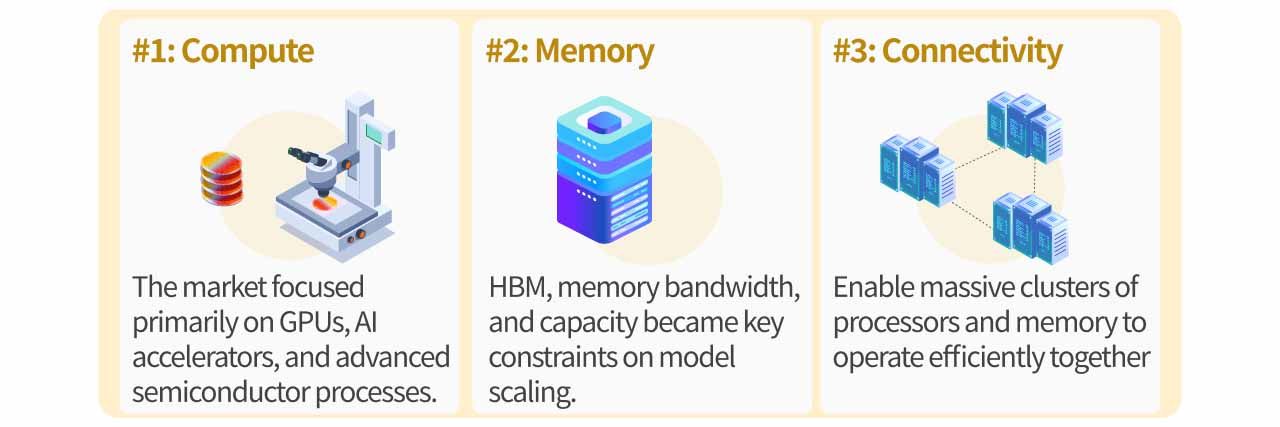
Murphy summarized the evolution of AI infrastructure bottlenecks into three stages. The first stage was the compute bottleneck, where the market focused primarily on GPUs, AI accelerators, and advanced semiconductor processes. The second stage was the memory bottleneck, where HBM, memory bandwidth, and capacity became key constraints on model scaling. The third stage is the connectivity bottleneck, which emerges as computing and memory resources expand rapidly, creating the challenge of enabling massive clusters of processors and memory to operate efficiently together.
Major cloud service providers around the world are currently redesigning their network architectures because AI infrastructure expansion is no longer constrained by insufficient compute at a single point, but by the challenges of data transfer, synchronization, and coordination across large-scale systems. Going forward, the competitiveness of AI data centers will increasingly depend on how quickly, reliably, and efficiently data can move between chips, racks, and even entire data centers.
AI Enters the Useful AI Era: Optical and Copper Technologies Will Coexist
During the keynote, NVIDIA CEO Jensen Huang joined the discussion and reinforced Marvell’s view on connectivity. Jensen noted that AI has entered the era of Useful AI, where it is beginning to generate real economic value rather than simply demonstrating model capabilities or generating content. With the rise of Agentic AI and new computing paradigms, AI systems will become increasingly distributed, heterogeneous, and dynamic. Different types of processors, memory systems, networking equipment, and software platforms must work together to support more sophisticated training, inference, and agent-based workloads. This significantly increases the importance of connectivity compared with traditional data center architectures.
Jensen also highlighted practical engineering trade-offs, noting that copper should be used whenever possible, while optical technologies should be deployed when necessary. In other words, scale-up environments will continue to rely heavily on copper due to its cost advantages and technological maturity. However, optical connectivity will become essential in scale-out and scale-across environments. Over the next five to ten years, AI data centers are expected to adopt both copper and optical technologies extensively, rather than seeing one completely replace the other. This suggests that copper and optics are complementary rather than competitive, with each serving different requirements based on distance, bandwidth, power consumption, and cost.
Physical Limits of Copper Become More Apparent, Driving the Importance of CPO
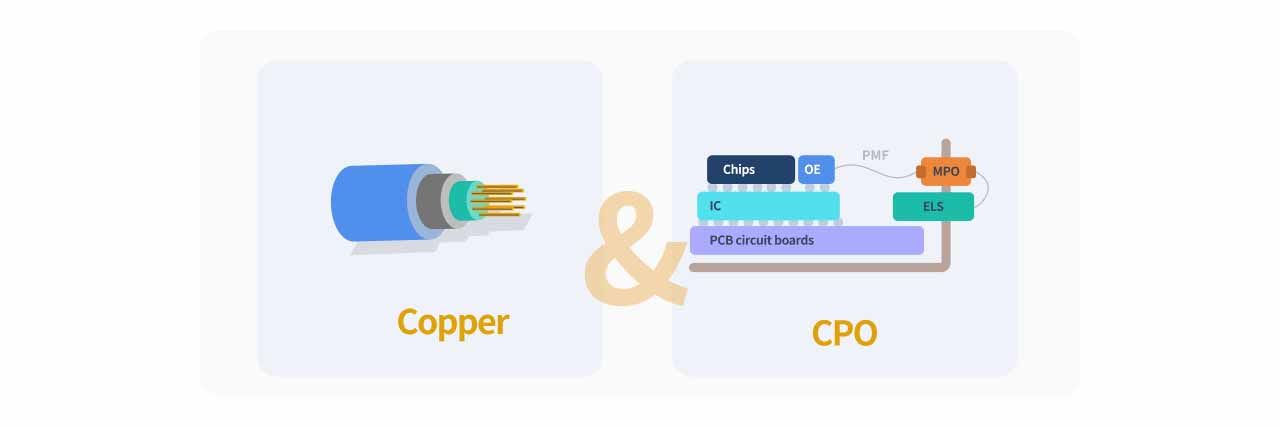
As data transmission speeds advance from 200G to 400G and beyond, the physical limitations of copper are becoming increasingly apparent. Murphy explained that copper transmission distance and bandwidth are generally inversely related. As bandwidth doubles, the supported transmission distance of copper decreases significantly. Today, copper links operating at 200G per lane can support transmission distances of roughly 2.5 meters, which is already close to the practical limit for in-rack connections. As systems move toward 400G, copper will struggle to support full connectivity requirements within a rack.
This trend reflects the movement of the so-called “Copper Wall.” Historically, copper limitations mainly affected longer-distance communications. However, as AI systems demand ever-higher bandwidth, those limitations are moving into increasingly shorter distances, ultimately driving more in-rack connections toward optical solutions.
Against this backdrop, Co-Packaged Optics (CPO) has emerged as a key solution. The core concept of CPO is to place optical connectivity directly within the package, alongside compute chips, custom accelerators, or switch silicon. This reduces electrical signal travel distance, increases bandwidth density, and lowers power consumption. Murphy emphasized that in-rack connections outnumber inter-rack connections by roughly ten to one. If traditional pluggable optical modules continue to be used, power and space constraints will become increasingly problematic. As a result, CPO is expected to play a critical role in bringing optical connectivity into rack-level networking.
Marvell Offers a Comprehensive High-Speed Connectivity Portfolio
Murphy further highlighted Marvell’s unique position within the industry. While GPU companies focus on computing and memory vendors focus on bandwidth and capacity, Marvell is among the few companies with both meaningful revenue scale and a comprehensive technology portfolio dedicated to data movement. He noted that the vast majority of Marvell’s data center revenue comes from connectivity-related products, including intra-data-center networking, long-haul optical connectivity, and switching infrastructure, making the company a leader in data movement technologies.
- For long-distance transmission, Marvell offers coherent optical modules that integrate advanced-process CMOS DSPs, fourth-generation silicon photonics, and proprietary broadband analog components. Its portfolio has progressed from 100G and 400G to volume production of 800G products, with 1.6T solutions planned for the future.
- Within data centers, Marvell provides PAM4 optical technologies, including PAM4 DSPs, transceivers, TIAs, laser drivers, and switching infrastructure. The company has supported multiple generations ranging from 50G, 100G, 200G, 400G, and 800G, and is now advancing 1.6T PAM4 connectivity solutions.
- For in-rack applications, copper interconnects and electrical SerDes remain dominant. Marvell has already achieved production-ready 200G SerDes and has demonstrated 400G SerDes technology, helping customers extend the viability of copper-based deployments.
- For package-level connectivity, Marvell supports multi-chiplet architectures through high-speed short-reach SerDes and advanced packaging technologies.
| Distance Category | Technology Solution | Marvell Advantage |
|---|---|---|
| Inter-data-center: Hundreds to thousands of kilometers | Coherent Optics + DSP | Proprietary DSPs, silicon photonics, broadband analog components, and 1.6T solutions |
| Within data centers: Hundreds of meters | PAM4 Optics + Switch | PAM4 DSPs, high-speed switch silicon, and 1.6T PAM4 solutions |
| Within racks: Several meters | Electrical SerDes + Copper | Production-ready 200G SerDes and demonstrated 400G SerDes |
| Within packages: Millimeter scale | Advanced Packaging SerDes / Chiplet Interconnect | Support for complex multi-chip packaging and high-speed short-reach interconnects |
Future Outlook for Data Centers: Distance Will No Longer Be a Design Constraint

Looking ahead, Marvell believes that as optical technologies continue to overcome the limitations of copper, data center architectures will enter a fully distributed era. Traditionally, server, rack, and data center designs have all been constrained by physical distance, while software workloads had to be optimized around hardware limitations. However, if optical connectivity can deliver sufficient bandwidth, low latency, and power efficiency, distance will no longer be a primary constraint on system design.
In such an architecture, computing, memory, networking, and photonics will function as a unified system. CPUs, XPUs, memory, and network interfaces will no longer need to reside within the same server and can instead be dynamically composed based on workload requirements, improving resource utilization while reducing idle capacity. Over the longer term, millions of compute and memory resources could operate together through high-speed optical networks, effectively creating a single massive AI computer. Murphy believes this represents the next era of AI data centers, and Marvell is building the connectivity foundation required to make it possible.
Conclusion
The central message of Marvell’s Computex 2026 keynote is that the competitive focus of AI infrastructure is shifting from individual chip performance to system-level connectivity. As AI models continue to scale and Agentic AI applications move into production, future data center bottlenecks will no longer be limited to GPU compute power or HBM bandwidth. Instead, success will depend on how efficiently hundreds of thousands—or even millions—of processors, memory systems, and networking resources can work together.
Copper and optical technologies are not replacing one another; rather, they will serve different roles based on distance, bandwidth, power consumption, and cost requirements. As the Copper Wall continues to move toward shorter distances, technologies such as CPO, silicon photonics, optical DSPs, SerDes, and advanced packaging will become essential building blocks of next-generation AI data centers. Leveraging its comprehensive high-speed connectivity portfolio, Marvell has successfully transformed itself from a traditional consumer chip supplier into a leader in AI data infrastructure and connectivity, positioning the company to play an increasingly important role in future distributed data center architectures.
