Many investors are familiar with the concept of value investing: buying quality stocks at low prices and waiting for the market to recognize their intrinsic worth, generating strong returns. But if you're only drawn in by how "cheap" a stock looks—while overlooking the risks beneath the surface—you could be stepping into one of the most common pitfalls in investing: the value trap. This article explains what a value trap is, why it happens, and how to spot one—so you can avoid costly mistakes and invest more wisely.
What Is a Value Trap?

A value trap refers to investments that appear cheap based on traditional valuation metrics, such as a low price-to-earnings (P/E) ratio or a high dividend yield, but are actually risky and fail to deliver expected returns.
Think of it as buying a flashy used car at a bargain price, only to find out the engine is faulty and the repairs cost more than the car itself. In the end, it wasn’t a good deal—it was a bad investment.
In the stock market, value traps often attract investors with low P/E ratios, high dividend yields, or low price-to-book (P/B) ratios. These indicators make the stock seem undervalued. But behind these numbers, the company may be struggling—due to deteriorating business fundamentals, industry decline, or shrinking profits—leading to a prolonged or permanent drop in share price. What seemed like a value buy turns out to be a trap.
What Causes a Value Trap?
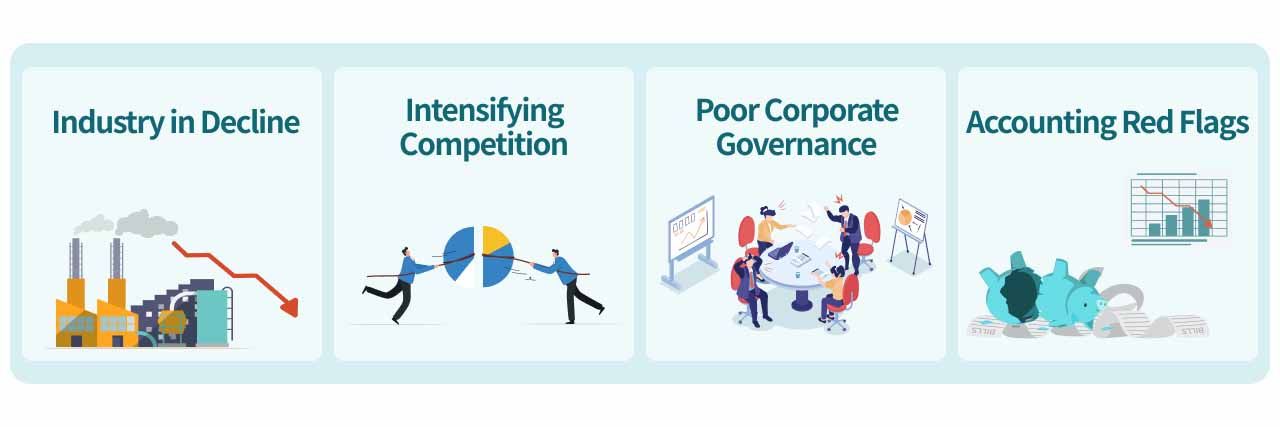
Value traps are usually only confirmed in hindsight—investors often realize they’ve fallen into one after the fact. Still, based on experience, here are four common causes that can help you identify whether a stock is simply “cheap” or genuinely worth buying:
1. Industry in Decline
If a company operates in an industry that’s entering a decline, even strong management can’t fight against the tide. Profit margins shrink, growth opportunities dry up, and the stock price remains depressed.
Take film cameras replaced by digital ones, or 2G and 3G networks rendered obsolete by 5G. Companies based on outdated tech may look cheap, but are unlikely to recover because demand has fundamentally changed.
In such cases, even if P/E charts suggest the company is undervalued, falling valuation multiples across the entire sector could be a red flag: the market is discounting the whole industry due to a bleak outlook.
2. Intensifying Competition
Fierce competition can erode profit margins and market share, especially for smaller players. This is common in sectors such as tech and e-commerce, where dominant firms hold significant advantages in brand strength, scale, and customer loyalty.
Just because companies are in the same sector doesn’t mean they deserve the same valuation. Market leaders with clear competitive moats may justifiably trade at higher multiples. Meanwhile, lower valuations for smaller, weaker firms are often a fair market discount—not a bargain. That’s a textbook value trap.
3. Poor Corporate Governance
Internal mismanagement—such as poor strategic decisions, corruption, inefficient use of resources, or reckless expansion—can gradually weaken a business. These issues might not be immediately visible in financial statements, but they often lead to long-term underperformance.
A company might look undervalued due to a low share price, but if that’s driven by deep-rooted structural issues, it's not a buying opportunity. Unless the governance problems are resolved (which can be difficult), the stock may remain depressed for years.
That’s why corporate governance is a core part of ESG scoring. It helps investors assess whether a company has the leadership and discipline to maintain long-term value, rather than being fooled by superficial discounts.
4. Accounting Red Flags
Some companies use aggressive accounting tactics to make financials look better—such as inflating revenue, deferring expenses, or hiding losses in subsidiaries. These tricks can make a company seem profitable and attract value investors.
Others may report a one-off earnings surge due to asset sales, restructuring, or non-recurring income. If investors fail to analyze where those profits come from, they might mistakenly see a temporary spike as sustainable growth.
Understanding earnings quality is more important than looking at the numbers in isolation. A stock that looks cheap based on distorted earnings is often a value trap waiting to spring.
Real-World Examples
Blockbuster
Blockbuster was once the largest video rental chain in the world, with thousands of physical stores. However, it failed to adapt to shifts in technology and consumer behavior. As Netflix rose with DVD-by-mail and later streaming, Blockbuster stuck to its legacy model.
Heavy overhead, internal disorganization, a high debt load, and a slow response to change all contributed to its collapse. Even when its stock seemed cheap, the company had already lost its competitive edge. In 2010, it filed for bankruptcy—a classic example of a value trap caused by industry disruption.
Nokia
Nokia dominated the mobile phone industry during the feature phone era. However, when smartphones emerged, it underestimated the importance of touchscreens, ecosystems, and software integration.
While Apple and Samsung surged ahead with robust R&D and sleek user experiences, Nokia lagged behind. Despite its strong brand and patent portfolio, Nokia couldn’t catch up.
What looked like a well-known brand trading at a discount was actually a company with diminishing relevance, caught in a value trap driven by lost competitiveness. Its share price remained low because the business itself was structurally weakened.
Comparison Table
| Criteria | Value Stock | Value Trap |
|---|---|---|
| Financial Health | Stable cash flow, manageable debt | Negative cash flow, high leverage |
| Industry Position | In growth or successful transition | Sunset industry or outdated technology |
| Competitive Edge | Strong moat, consistent innovation | Losing relevance, no tech/business edge |
| Management | Transparent, competent leadership | Poor strategy, questionable integrity |
| Valuation Reason | Temporarily undervalued | Low valuation reflects real risk |
How to Avoid Value Traps

Value traps often hide deeper problems—declining industries, poor management, or accounting risks. Smart money tends to exit first, leaving retail investors buying in at “bargain” prices without knowing the full story.
Here are some ways to avoid falling into these traps:
1. Understand the Fundamentals
Don’t rely solely on financial ratios. Study the company’s business model, product viability, market position, and leadership. Confusing strategies or opaque decision-making can signal hidden risks.
2. Watch Industry Trends
No business operates in a vacuum. A solid company in a dying sector can still underperform. Assess the industry’s lifecycle, barriers to entry, valuation trends, and tech disruption. Compare the company to its peers to spot structural challenges.
3. Check Financial Health
Look at revenue and profit trends—are they stable or declining? A shrinking profit margin could mean competitive pressure or internal inefficiency. Also check leverage: high debt levels increase financial risk. Most importantly, monitor cash flow. A company that can’t generate cash from operations is vulnerable.
4. Keep a Rational Mindset
Don’t buy a stock just because it looks cheap. The key is not price—but value. Avoid chasing trends or unverified online tips. Rational, well-researched investing is the best defense against value traps.
Bottom Line
In Value Investing, “Cheap” Isn’t the Goal—“Value” Is
The essence of value investing lies in identifying fundamentally strong companies that the market has temporarily mispriced—not just looking for low P/E stocks. That means digging into the business, understanding industry dynamics, and applying a disciplined investment approach.
By avoiding surface-level indicators and staying alert to potential traps, you can invest with more confidence—and unlock true long-term value.
