The Regional Comprehensive Economic Partnership (RCEP) came into effect on January 1, 2022, and is currently the largest free trade agreement in the world by coverage. The agreement includes major economies across East Asia and Oceania, covering a total population of around 2.2 billion people and a combined GDP close to $39 trillion, accounting for roughly 30% of the global economy. Its primary objective is the gradual elimination of tariffs on more than 90% of goods traded among member states.
RCEP is not only a tariff-reduction agreement, but also a regional integration framework led by ASEAN, with the core goal of strengthening the integration and resilience of Asian supply chains.
What Is RCEP?
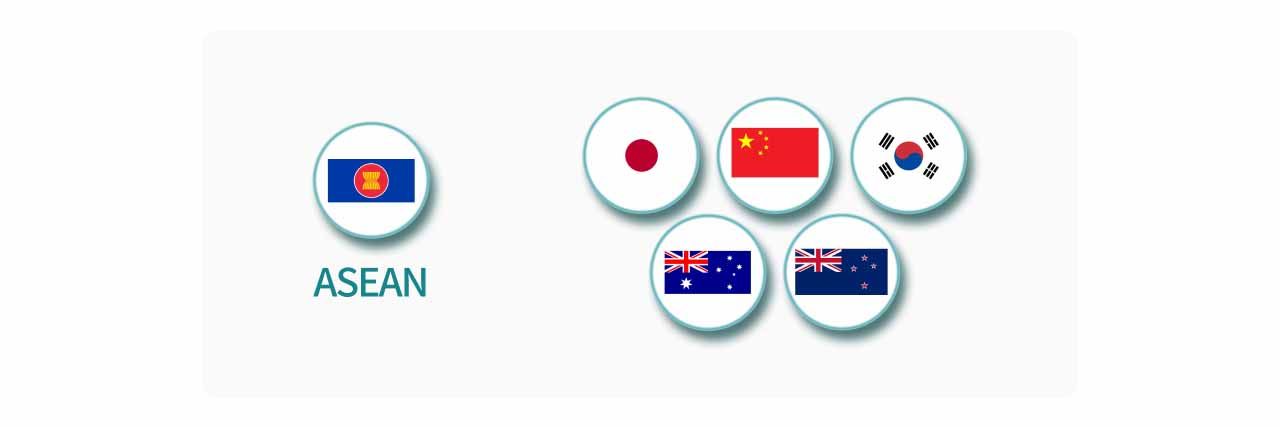
The Regional Comprehensive Economic Partnership (RCEP) was initiated by the 10 ASEAN member states, which invited China, Japan, South Korea, Australia, and New Zealand to participate, forming an “ASEAN+5” regional economic cooperation framework.
Its central principle is “ASEAN centrality.” By integrating the existing five ASEAN+1 free trade agreements (with China, Japan, South Korea, Australia, and New Zealand) into a single institutional framework, RCEP effectively resolves the “spaghetti bowl effect” caused by inconsistent rules of origin across multiple trade agreements. This greatly improves trade facilitation and supply chain efficiency within the region.
Spaghetti Bowl Effect The Spaghetti Bowl Effect is a concept proposed by economist Jagdish Bhagwati in 1995. It describes the complex web of rules created when countries sign numerous overlapping free trade agreements (FTAs), resulting in a structure resembling a tangled bowl of spaghetti.
From a geoeconomic perspective, one of RCEP’s most significant milestones is that it institutionally connects the three largest Northeast Asian economies—China, Japan, and South Korea—under the same free trade agreement for the first time.
Before this, only the China–South Korea FTA, which took effect in 2015, existed. There were no bilateral FTAs between China and Japan or between Japan and South Korea. The implementation of RCEP fills this gap by establishing a tariff reduction framework for trilateral trade, creating a foundation for potential future China–Japan and Japan–South Korea FTAs to be negotiated on top of the RCEP framework.
FTA Relationships Among Member States (Before the Agreement)
| China | Japan | South Korea | New Zealand | Australia | |
|---|---|---|---|---|---|
| China | X | △ | O | O | O |
| Japan | △ | X | △ | O | O |
| South Korea | O | △ | X | O | O |
| New Zealand | O | O | O | X | O |
| Australia | O | O | O | O | X |
| As ASEAN | O | O | O | O | O |
| Thailand | O | O | O | ||
| Indonesia | O | O | O | ||
| Malaysia | O | O | O | O | |
| Philippines | O | O | |||
| Singapore | O | O | O | O | O |
| Vietnam | O | O | O | O |
Source: Taiwan Ministry of Economic Affairs, International Trade Administration
(O = Signed/In force, △ = Under negotiation, blank = Not negotiated)
RCEP Coverage and Economic Scale
RCEP currently consists of 15 countries, including the 10 ASEAN member states plus China, Japan, South Korea, Australia, and New Zealand, forming a highly integrated regional market both geographically and economically.
Hong Kong, Sri Lanka, and Chile applied to join the agreement in 2022, 2023, and 2024 respectively.
The agreement covers around 2.2 billion people, approximately one-third of the world’s population, with a combined economic output close to $39 trillion. This represents about 30% of global GDP and global trade, making RCEP the largest free trade agreement in the world in terms of both economic scale and population coverage.
With the agreement now in force, the overall tariff elimination rate among member states will reach roughly 90%, significantly increasing trade liberalization across the region.
Beyond tariff reductions for goods and services, the agreement also includes non-tariff areas such as investment, labor mobility, and technical cooperation, further deepening regional economic integration.
RCEP Framework and Core Rules
RCEP is not merely a tariff schedule but a modern rulebook for trade. Its legal text contains 20 chapters establishing unified rules for goods, services, investment, and digital trade. Key provisions include:
Trade in Goods
- Gradual tariff reduction: Member states commit to eliminating tariffs on more than 90% of tariff lines over 10 to 20 years.
- Rules of Origin: RCEP adopts regional cumulation, allowing materials or intermediate goods sourced from any of the 15 member countries to be treated as originating content during production.
As long as the regional value content (RVC) reaches 40%, the final product qualifies for preferential tariffs. This strongly encourages companies to source materials and arrange production within the region. For example, a garment factory in Vietnam using fabric from China can export finished products to Japan tariff-free. Such rules strengthen the integration of Asian manufacturing supply chains, while potentially creating competitive pressure on intermediate goods produced outside the region.
Trade in Services and Investment
RCEP requires member countries to remove various restrictions on trade in services, including:
- Complying with market access commitments
- Implementing national treatment and most-favored-nation principles
- Recognizing local presence requirements and domestic regulatory frameworks
- Using a negative list approach for market access
In the financial sector, the agreement allows financial system exception clauses, enhances transparency in financial supervision, and ensures the free transfer and processing of information related to cross-border financial activities, preventing unnecessary restrictions on financial services.
E-Commerce
Chapter 12 of RCEP establishes baseline rules for digital trade.
Although not as strict as those under the CPTPP, the agreement still requires members to allow cross-border data flows and generally prohibits mandatory data localization, except under public policy or security exceptions.
Key Turning Point: India’s Withdrawal

India was originally one of the 16 negotiating countries in RCEP, but announced its withdrawal from the negotiations on November 4, 2019. Indian Prime Minister Narendra Modi stated that India would not join the agreement at that time, leaving the final pact to be signed by 15 countries.
Major reasons behind India’s withdrawal include:
- Concerns over Chinese imports India runs a large trade deficit with China. Removing tariff barriers could allow low-cost Chinese manufactured goods to flood the Indian market, potentially undermining its “Make in India” initiative.
- Agricultural protectionism Australian and New Zealand dairy products are highly competitive, posing a significant threat to India’s large and politically influential dairy farming sector.
- Lack of safeguard mechanisms India requested a special safeguard mechanism against import surges—allowing tariffs to be automatically restored when imports exceed certain thresholds. Other members argued this would contradict the spirit of free trade and did not fully accept the proposal.
Despite India’s withdrawal, RCEP members left the door open for India to join in the future, reflecting expectations about the potential of India’s large market.
The Impact of RCEP on Taiwan
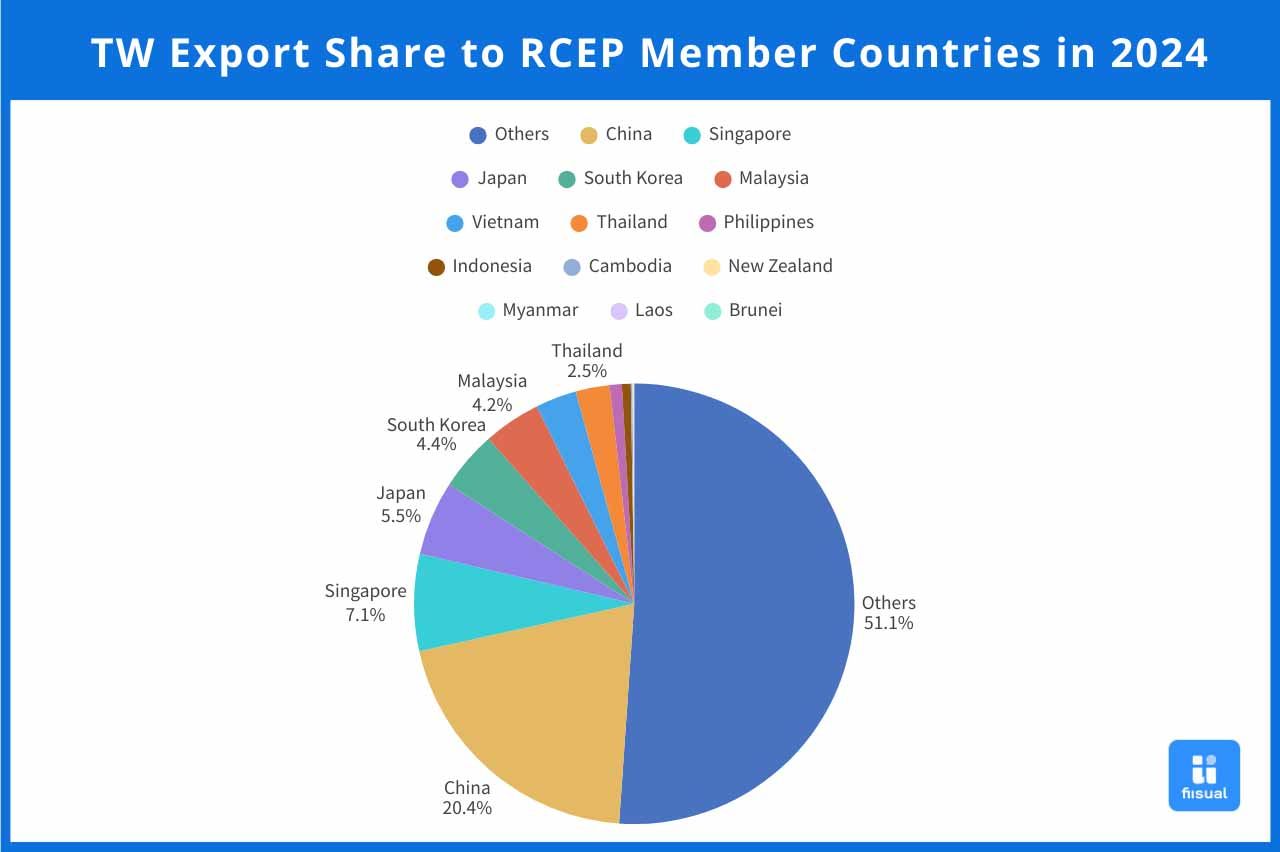
Taiwan exported a total of $231.7 billion to the 15 RCEP member countries in 2024, accounting for about 49% of Taiwan’s total exports that year.
Since Taiwan’s exports are heavily concentrated in electronic components and ICT products, many of which already enjoy tariff-free treatment under the Information Technology Agreement (ITA), the overall impact on Taiwan’s exports is relatively manageable.
However, some traditional industries, including: petrochemicals, machinery, steel, textiles still face tariffs of more than 5% in certain markets. As RCEP members reduce tariffs among themselves—sometimes to zero—Taiwanese products could experience declining price competitiveness, increasing the risk of order diversion.
For Taiwanese businesses operating overseas, companies with production facilities in China or ASEAN countries may benefit from RCEP’s integrated supply chains and rules of origin cumulation, which provide tariff advantages. At the same time, they must also face stronger competition from Japanese and South Korean firms expanding their regional market share.
| 2024 Export Value | ||
|---|---|---|
| Amount (USD million) | Share of Taiwan’s Total Exports (%) | |
| RCEP | 231,709 | 49 |
| China | 96,954 | 20.41 |
| Singapore | 33,741 | 7.10 |
| Japan | 25,830 | 5.44 |
| South Korea | 20,790 | 4.38 |
| Malaysia | 19,888 | 4.19 |
| Vietnam | 14,275 | 3.01 |
| Thailand | 11,819 | 2.49 |
| Philippines | 4,248 | 0.89 |
| Indonesia | 3,063 | 0.65 |
| Cambodia | 550 | 0.12 |
| New Zealand | 405 | 0.09 |
| Myanmar | 95 | 0.02 |
| Laos | 37 | 0.01 |
| Brunei | 14 | 0.00 |
Future Development of RCEP
- Institutionalization and Secretariat Establishment RCEP members have agreed to promote the creation of a permanent RCEP Secretariat. Jakarta, Indonesia, has expressed interest in hosting it to strengthen implementation, coordination, and transparency, while further advancing regional economic integration.
- Potential New Members Hong Kong has formally applied to join RCEP and is considered one of the most likely near-term candidates. Chile, Sri Lanka, and Bangladesh have also expressed interest in joining. Admission of new members requires unanimous approval from existing members. Hong Kong’s entry could enhance the region’s financial and logistics functions, serving as a hub for companies utilizing RCEP benefits.
- China–Japan–South Korea FTA Development As RCEP members, China, Japan, and South Korea discussed accelerating negotiations for a trilateral free trade agreement at the 13th China–Japan–South Korea Economic and Trade Ministers’ Meeting in March this year. The three countries hope to deepen economic cooperation based on the RCEP framework, particularly in services trade, investment, and digital trade.
Conclusion
The implementation and continued development of RCEP mark a new institutional phase of economic integration in the Asia-Pacific region. Through gradual tariff reductions, unified rules of origin, services and investment liberalization, and digital trade regulations, the agreement significantly enhances trade facilitation and supply chain efficiency across the region, while providing a more stable and predictable cooperation framework for member economies.
For Taiwan, electronic components and ICT products benefit from tariff-free treatment, helping keep exports relatively stable. However, traditional industries such as petrochemicals, machinery, steel, and textiles still face tariff pressures and stronger regional competition. Overseas Taiwanese businesses can mitigate these impacts by leveraging production networks in ASEAN and China together with RCEP’s rules of origin cumulation, optimizing supply chains.
Looking ahead, the establishment of an RCEP Secretariat, the potential addition of new members, and deeper China–Japan–South Korea cooperation within the RCEP framework could further strengthen regional economic integration. For businesses, this development may create long-term opportunities in market expansion, supply chain restructuring, and investment strategies.
Overall, RCEP is not merely a tariff reduction agreement—it is also a key platform shaping the economic landscape and competitive dynamics of the Asia-Pacific region.
Related Articles: What is CPTPP, and Why Does Taiwan Want to Join?
