
As chip computing power and data center density continue to rise, the importance of cooling systems has also increased. In the past, the cooling industry primarily focused on air-cooling modules for general servers and PCs, a relatively mature field in both technology and demand. However, with the rapid advancement of AI, high-power chips and high-density data center racks are becoming more widespread, transforming cooling systems from a supporting role into a critical component of AI infrastructure.
Background of Gold-Plated Cold Plate Technology
Data Center Cooling Systems: System, Rack, and Chip Levels
Data center cooling systems can be categorized into three levels based on architecture: system level, rack level, and chip level. While each serves a different role, their core objective is the same—efficiently transferring heat generated by chips out of the data center as power consumption and thermal density continue to rise.
In recent years, significant advancements have been made in cooling technologies at both the system and rack levels. In contrast, although the chip level is closest to the heat source, it has seen limited structural innovation in the past. The gold-plated cold plate technology discussed in this article is part of chip-level cooling advancements.
| Level | Description | Technology Upgrades |
|---|---|---|
| System Level | Focuses on how the entire data center or server system dissipates heat, with emphasis on cooling sources, heat exchange architecture, and overall energy efficiency management. | Most data centers currently use air-to-water cooling architectures. However, as design specifications evolve, the industry is expected to gradually shift toward water-to-water cooling solutions to improve heat transfer efficiency and reduce overall energy consumption. |
| Rack Level | Focuses on thermal management within a single rack and liquid cooling configuration, including cold plate layout, piping design, manifolds, CDUs, quick connectors, and full-rack liquid cooling integration. | Upgrades are centered on optimizing cold plate configurations and cooling architectures. As single GPU power exceeds 1,000W, traditional cold plates face bottlenecks, driving the transition to microchannel cold plate designs that increase the contact area between coolant and heat surfaces, improving hotspot cooling performance. |
| Chip Level | Focuses on how heat generated at the chip surface is effectively transferred to the heat sink, representing the closest layer to the heat source and the starting point of the cooling process. | Despite being closest to the heat source, there has been limited structural innovation historically at this level. |
Two Core Components of Chip-Level Cooling: TIM 1 and TIM 2
Chip-level cooling is primarily passive, with the main objective of efficiently conducting heat generated at the chip surface to the heat sink, which then transfers the heat out of the server rack through interaction with air or liquid. Since thermal conduction efficiency is critical, two key components are involved: TIM 1 (Thermal Interface Material 1) between the chip die and the package lid, and TIM 2 (Thermal Interface Material 2) between the package lid and the heat sink.

- TIM 1 is typically completed during semiconductor packaging and does not require maintenance or replacement afterward. Therefore, it must offer high thermal conductivity, long-term reliability, and resistance to warping or degradation, while also being extremely thin. Common materials include metals or graphite with high thermal conductivity.
- In contrast, TIM 2 connects the package lid to the heat sink. Due to manufacturing tolerances and potential warping of the heat sink, gaps often exist between surfaces. TIM 2 fills these gaps to ensure tight contact. Additionally, because heat sinks may need replacement, TIM 2 must be reworkable and capable of reapplication. As a result, it is typically made from thermally conductive composite pastes.
As chip power consumption continues to rise, the market has begun exploring improvements in thermal interface materials to enhance heat transfer efficiency between chips and heat sinks.
Adoption of Indium in TIM 2 to Improve Thermal Efficiency and Interface Flexibility
With the rapid increase in cooling demands driven by high-power GPUs and high-density servers, TIM 2 at the chip level is undergoing material upgrades to address higher heat flux density.
Reports suggest that next-generation chips may adopt composite materials combining graphite and indium. Graphite offers excellent in-plane thermal conductivity, allowing rapid heat spreading from localized hotspots. However, it lacks ductility and compressibility, making it difficult to use alone as TIM 2. By incorporating highly ductile indium, the material can effectively fill surface gaps between the heat sink and chip package while improving vertical thermal conductivity. Data indicates that graphite–indium composites outperform pure indium sheets in vertical thermal conductivity.
By comparison, TIM 1 has seen limited upgrades due to its fundamentally different role. It serves as a stable internal thermal conduction layer within the package and is already extremely thin, typically using high-conductivity metals or graphite. TIM 2, on the other hand, must also compensate for mechanical tolerances and warping on the heat sink side. Because of surface height differences and deformation, TIM 2 must provide gap-filling capability to ensure tight contact between the cold plate and package surface. Graphite alone cannot meet these requirements, but when combined with indium, the composite achieves both high thermal performance and mechanical adaptability, making it more suitable for TIM 2 applications.
Gold-Plated Cold Plates Solve Indium–Copper Reaction Issues
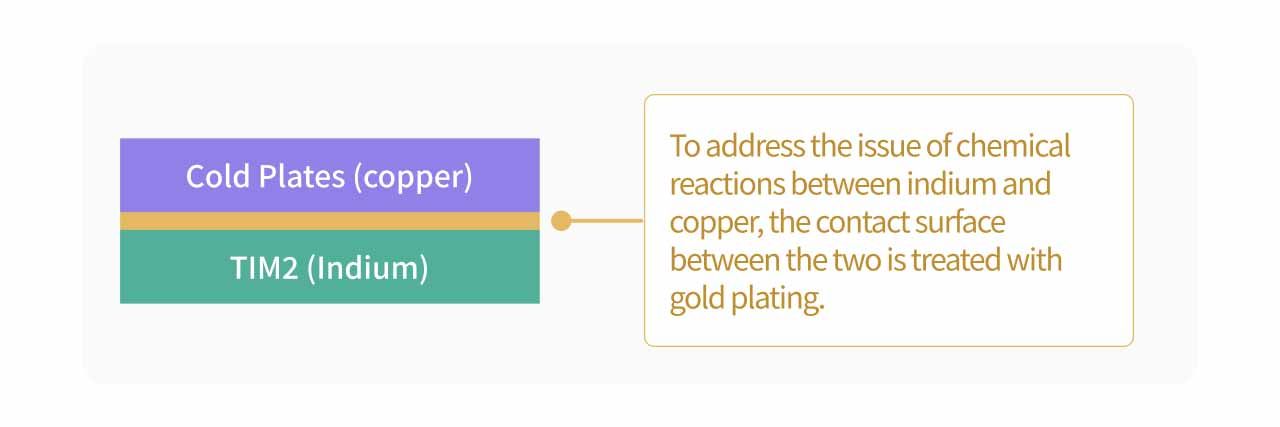
Despite the benefits of indium in improving thermal performance and interface conformity, it introduces new challenges. Indium tends to react chemically with copper, a common material in cold plates. This reaction accelerates at high temperatures, potentially forming indium–copper compounds at the interface between TIM 2 and the cold plate surface.
These compounds can cause embrittlement of the interface material, reducing contact integrity and ultimately degrading thermal conductivity.
To address this issue, the market has proposed a new solution: gold plating the contact surface between the cold plate and TIM 2. Gold is chemically stable, resistant to reactions with other metals, and has good thermal conductivity. This prevents reactions between indium and copper while maintaining interface stability. As a result, gold plating on cold plate surfaces has become a key development direction among cooling solution providers.
Opportunities for Taiwanese Companies
High Barriers to Gold Plating Processes Favor Established Taiwanese Players
Although gold-plated cold plates are seen as a key future trend in cooling technology, the core gold plating process is not easily scalable. First, the process involves highly toxic chemicals and must be applied directly to cold plate surfaces, requiring advanced process control and yield management. Some Chinese manufacturers still face gaps in yield and process stability, suggesting that demand may gradually shift toward Taiwanese companies with more mature manufacturing capabilities.
In Taiwan, electroplating processes are subject to strict environmental and emission regulations. Failure to comply can result in significant environmental impact, making licensing procedures lengthy and complex. For cold plate manufacturers, building in-house gold plating lines requires substantial time, capital investment, and strong process and quality control capabilities. Therefore, Taiwanese electroplating companies with existing expertise, environmental permits, and proven track records are well-positioned to enter this supply chain.
Superior Plating Technology (8431.TW)
Chew’s Precision Industrial Co., Ltd. (8431.TW) is one of the few Taiwanese companies with mass production capabilities in metal surface treatment and gold plating. As AI server liquid cooling continues to evolve, the company is well-positioned to enter the gold-plated cold plate supply chain, supported by three key advantages:
- Established electroplating processes, environmental permits, and mass production capabilities, enabling it to handle high-pollution, highly regulated gold plating requirements.
- Proven track record in gold plating mass production, giving it a scarcity advantage in next-generation AI liquid cooling supply chains.
- Manufacturing presence in Thailand, aligned geographically with major cold plate supplier Auras Technology Co., Ltd., providing supply chain synergy.
Looking ahead to 2026, Chew’s Precision is expected to benefit from two major growth drivers:
- NVIDIA Rubin is expected to adopt gold-plated cold plates starting in the second half of 2026, driving demand for related surface treatment processes.
- ASIC players such as Google TPU are gradually adopting similar liquid cooling architectures as NVIDIA, further increasing the penetration of gold-plated cold plates across both GPU and ASIC platforms.
Overall, while Chew’s Precision is not a traditional cooling module manufacturer, its technological, regulatory, and production barriers in gold plating position it well to enter the supply chain through critical process capabilities. As GPU and ASIC platforms advance in parallel in 2026, the company is likely to emerge as a scarce and key beneficiary within Taiwan’s gold-plated cold plate ecosystem.
You can find more articles related to cooling system as following:
2026 Outlook Series Part 3 – Key Industry: Thermal Management
