-logo-on-phone.jpg&w=3840&q=75)
Southeast Asia’s leading delivery and ride-hailing platform Grab has announced an agreement with Delivery Hero SE to acquire foodpanda’s Taiwan delivery business for $600 million in cash. The deal is expected to close in the second half of 2026, with a full migration from the foodpanda platform to the Grab app targeted for the first half of 2027. This marks the latest development after Uber’s proposed acquisition of foodpanda Taiwan was blocked by the Taiwan Fair Trade Commission, drawing significant market attention.
Overview of Grab
Founded in 2012, Grab began as a ride-hailing app for users in Malaysia. Through service diversification, it has evolved into a Southeast Asian super app, offering services across food delivery, mobility, and digital financial services in more than 900 cities across 8 countries.
Grab currently has over 50 million monthly active users and dominates delivery and ride-hailing markets across Indonesia, Malaysia, the Philippines, Singapore, Thailand, and Vietnam, with more than 50% market share. It has successfully outcompeted local Indonesian firm GoTo and global giants such as Uber.
Ranked 128th among Southeast Asia’s top 500 companies, Grab reported annual profit of $268 million and revenue of $3.4 billion last year. Through a single app, Grab integrates services such as food delivery, parcel delivery, ride-hailing, and online payments. In retail, it operates Jaya Grocer and Everrise supermarkets in Malaysia, and provides digital banking services through GXS Bank in Singapore and GXBank in Malaysia. This diversified ecosystem has strengthened user trust and steadily expanded its market share.
Deal Rationale & Process
Delivery Hero Seeks Exit Opportunities
In recent years, Delivery Hero has faced mounting investor pressure regarding capital efficiency and portfolio optimization. The market has pushed the company to exit certain overseas markets and focus on core operations. Since 2024, it has actively sought to sell its Taiwan foodpanda business, with the process accelerating in 2025.
In March 2025, its second-largest shareholder, Hong Kong-based fund Aspex, intensified pressure, warning that failure to accelerate asset disposals and strategic adjustments could lead to efforts to replace CEO Niklas Östberg. This significantly increased the urgency of asset sales. Östberg has also described the Taiwan business divestment as a “critical first step” in the group’s strategic review.
From a fundamental perspective, the sale is driven by three key factors:
1. Deleveraging Needs: Delivery Hero recently took on approximately $1.4 billion in new loans to repay convertible bonds maturing in 2026/2027. The $600 million in proceeds will be used to reduce debt, with net debt/EBITDA expected to decline from 2.7x to 2.2x. 2. Weakening Regional Growth: Asia is the only major region experiencing contraction, with GMV falling from €23.4 billion in 2025 to €20.8 billion, reflecting weaker growth and capital efficiency. 3. Long-Term Investor Pressure: Investors have consistently pushed the company to divest non-core or lower-return assets to improve shareholder value and capital allocation efficiency, making Taiwan a priority for disposal.
Previous Agreement with Uber Eats Blocked

In 2024, Uber Eats reached a deal to acquire foodpanda for $950 million. However, due to the dominant position of both platforms in Taiwan’s delivery market, the Fair Trade Commission blocked the deal, citing concerns that the combined entity would control over 90% market share.
Following this decision, Delivery Hero shifted its focus to negotiating with Grab.
In Taiwan, such mergers are reviewed by the Fair Trade Commission under the Fair Trade Act. The key criterion is whether the transaction would substantially restrict market competition, including factors such as market share, revenue thresholds, and changes in control.
On March 26 this year, both parties officially announced the $600 million all-cash agreement after nine months of negotiations.
Deal Analysis
Grab estimates the acquisition will positively contribute to its 2026 revenue target of approximately $4.04–$4.1 billion, while maintaining EBITDA guidance at $700–$720 million. Over the medium to long term, the deal is expected to contribute at least $60 million in additional EBITDA between 2027 and 2028.
However, liquidity indicators—including the cash ratio and current ratio—have shown a declining trend throughout 2025, with increasing pressure over the past four quarters. While cash reserves remain strong at approximately $3.4 billion as of Q4 2025, the $600 million purchase represents less than 20% of cash holdings, suggesting limited short-term pressure. Still, weakening liquidity could pose risks to financial flexibility.
From a profitability perspective, Grab has maintained strong revenue and EBITDA growth—up 54% and 60% respectively in Q4 and full-year 2025. However, its cash generation has weakened significantly. Operating cash flow declined 73% year-over-year in Q4 and 91% for the full year, primarily due to rapid expansion in its lending business, which increased working capital usage.
foodpanda as a Mature Asset
Unlike Grab’s earlier-stage investments in Southeast Asia, foodpanda Taiwan is a relatively mature business nearing profitability. Its competitive strength lies in broad city coverage and a loyal subscriber base. Approximately one-third of its users are PandaPro members, indicating strong customer retention and stable consumption patterns. This makes foodpanda an attractive asset even before considering integration synergies.
Delivery Hero’s Cash Recovery
Following the failed Uber deal, Delivery Hero received a $250 million breakup fee. Combined with the $600 million sale, it will recover approximately $850 million in cash.
Post-Merger Synergies
Inheriting foodpanda’s Market Share, Grab Poised for Rapid Expansion
Amid intensifying competition in Asia’s food delivery industry, growth momentum across core markets has generally slowed. Operators have long relied on promotional subsidies to capture market share, further compressing overall profit margins and pushing the industry toward scale expansion and operational efficiency as primary competitive strategies. Delivery Hero, which operates in more than 70 countries, has in recent years continuously adjusted its Asia-Pacific footprint and scaled back certain markets to improve profitability, including exiting Thailand in May last year after more than a decade of operations.
In contrast, Grab has deeply entrenched itself in the Southeast Asian market, demonstrating stronger regional operational capabilities and resource integration efficiency. By acquiring foodpanda’s Taiwan business, Grab can directly inherit an existing user base and market share, avoiding the heavy subsidies and infrastructure investments typically required during initial market entry, and rapidly establishing scale advantages.
In addition, the transaction provides a gateway for Grab to introduce its broader ecosystem—such as financial services and mobility offerings—into the Taiwan market. Although the rollout of these services may still face regulatory and policy uncertainties, as integration of the delivery business progresses, Grab is well-positioned to enhance cross-service penetration and ARPU (average revenue per user), further unlocking monetization potential within a single market.
Taiwan as a Strategic Gateway for Expansion into East Asia
This move into Taiwan marks Grab’s first expansion beyond Southeast Asia since its founding. Taiwan not only becomes its ninth operating market, but also its first outside the region, signaling the company’s official transition into a cross-regional growth phase. At the same time, Grab has indicated plans to introduce its proprietary AI product modules into Taiwan, including its in-house localized mapping technology, GrabMaps, which enhances delivery efficiency through real-time route optimization and meal preparation time predictions.
Historically, Grab’s business footprint has been concentrated in Southeast Asia. However, as regional markets gradually approach saturation, outward expansion has become a key driver for its next phase of growth. In this context, Taiwan stands out as an ideal first step due to its strong similarities with Southeast Asian markets. In terms of population density, urban pace, transportation patterns, and food culture, Taiwan closely mirrors the environments where Grab has already succeeded. Coupled with a population of 23 million and robust demand for mobility and delivery services, the market offers favorable conditions to validate and scale its business model.
From a regional strategy perspective, compared to Japan and South Korea—which differ more significantly from Southeast Asia—Taiwan occupies a middle ground between Southeast Asia and Northeast Asia in both market and cultural characteristics. This positions it as a “bridge market” and a strategic springboard for expansion into East Asia. If Grab successfully replicates and refines its business model in Taiwan, further expansion into Northeast Asia would be a highly foreseeable next step.
Key Risks
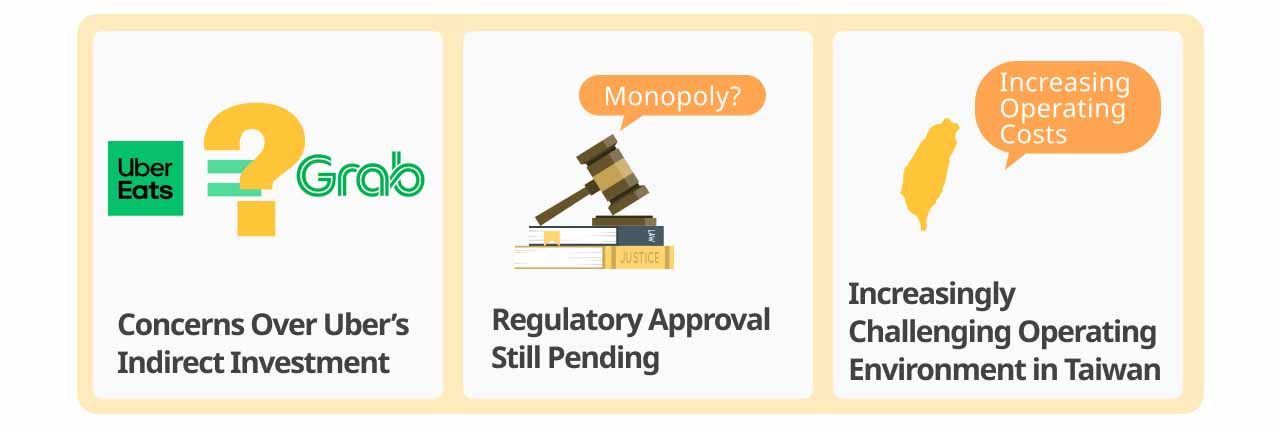
Concerns Over Uber’s Indirect Investment
The previous merger between Uber Eats and foodpanda was blocked due to antitrust concerns. However, in this transaction, Uber remains one of Grab’s largest institutional shareholders (holding approximately 13.5%), raising market concerns about a potential “indirect investment” route. In addition, some observers have pointed to possible indirect influence from Chinese capital, as Chinese ride-hailing platform Didi is also a key investor in Grab.
In response, Grab stated that although Uber holds around a 13% equity stake, its voting power is below 4%, and the stake originated from the 2018 sale of Uber’s Southeast Asia business to Grab. Uber does not participate in daily operations, and its nominated board members have recused themselves from all Taiwan-related decisions. As for Didi, its shareholding is below 5%, with voting rights under 1.4%, no board representation, and no Chinese institutional investor currently holds more than a 5% stake.
Grab further emphasized that it is headquartered in Singapore and listed on the Nasdaq. Under its dual-class share structure, co-founder and CEO Anthony Tan retains majority voting control. All strategic decisions related to the Taiwan market are independently evaluated by the Singapore-based management team, with limited influence from Uber or Didi, suggesting that market concerns may be overstated.
Regulatory Approval Still Pending
Regarding Grab’s acquisition of foodpanda Taiwan, Acting Chairperson Chen Chih-min of the Fair Trade Commission stated that the review will focus on “substantive control” as the core criterion, alongside a comprehensive analysis of the transaction’s actual impact on market competition, including the potential influence of the 13.5% shareholding. Authorities will also examine whether any “indirect investment” structure exists and carefully assess potential risks of market abuse.
As for concerns related to Didi and Chinese capital, the Fair Trade Commission noted that the source of funding is not the primary focus of its review; such matters will instead be evaluated separately by the Investment Commission.
Comparing the previously blocked Uber Eats–foodpanda merger with the current Grab acquisition reveals a key structural difference. The former would have resulted in a combined market share of around 90%, posing clear monopoly risks. In contrast, the latter represents a replacement of a market participant, with Grab taking over foodpanda’s position, leaving the overall market structure largely unchanged and maintaining a duopoly. Therefore, the antitrust concerns associated with the earlier case are not directly applicable here; overall, regulatory hurdles appear more limited and monopoly risks significantly lower.
Increasingly Challenging Operating Environment in Taiwan
Taiwan’s delivery market is characterized by a relatively limited market size and a high density of restaurants, resulting in strong substitution effects. At the same time, intense competition in ride-hailing and digital services makes it difficult for new entrants to build a large-scale, high-market-share ecosystem.
In addition, new legislation passed in January this year strengthens protections for delivery workers. While beneficial for the industry’s long-term development, it also raises operating costs, increasing labor-related and compliance expenses. As cost structures become heavier, the abundance of offline dining options and consumer convenience will continue to compress delivery service margins. Despite ongoing demand growth, overall profitability remains under downward pressure.
Under such conditions, Grab faces limited room for error during its initial market entry. Issues such as system instability or poor user experience could be quickly amplified by competitors, leading to potential market share losses. As a result, Grab is likely to rely on price subsidies in the early stages to rapidly expand its user base, while investing heavily in marketing and brand exposure to attract both consumers and merchants into its ecosystem and establish a competitive edge.
New Competitive Landscape
Shift Toward Diversified Ecosystem Competition
Grab’s advantage in Southeast Asia lies in its diversified and integrated ecosystem, which combines delivery, transportation, and a wide range of financial services. If this model is replicated in Taiwan, competition may shift away from delivery speed and pricing toward broader platform ecosystems, including service integration and deeper user engagement.
Grab’s entry signals a potential transformation in the competitive landscape. Compared to standalone delivery platforms, Grab’s integrated services span multiple daily use cases, meaning future competition will extend beyond logistics efficiency and price wars. Instead, it will center on the breadth of everyday user scenarios—such as the ability to increase user time spent on the platform and offer a wider range of services—ultimately creating stronger ecosystem advantages.
At present, aside from Line Pay, Taiwan lacks a mobile platform with service coverage as extensive as Grab’s. While such an integrated model represents a significant experiment, it also implies substantial monetization potential.
Uber’s Market Leadership May Face Real Threats
With Grab entering the Taiwan market, the long-standing duopoly could shift, posing a meaningful threat to Uber’s dominance. As Delivery Hero gradually exits the Asian market, Uber Eats has gained strong momentum in recent years, with foodpanda declining while Uber Eats has experienced rapid growth.
Now, Grab is demonstrating strong ambition in Taiwan, with a breadth of services that Uber currently cannot match. If Grab successfully implements its integrated ecosystem model, Uber’s market share could be eroded quickly, significantly challenging its leadership position.
That said, whether Grab’s operating model will succeed in Taiwan remains uncertain. If Grab fails to gain traction early and overcome Uber’s first-mover advantage, Uber could further consolidate market share and pricing power. However, given Grab’s stronger market share and operational performance across Southeast Asia compared to Uber, it is more likely that Grab will capture additional market share from Uber after entering Taiwan.
Conclusion
Grab’s entry signals that Taiwan’s food delivery market is likely to undergo significant changes in its competitive landscape. For consumers, this will bring more diverse choices and services; for existing competitor Uber, it creates tangible pressure that may force adjustments to its operating strategy in Taiwan.
From a financial perspective, the acquisition has a limited impact on Grab’s cash position. However, whether post-acquisition revenue and cash flow growth can justify the investment cost will be a key metric to watch. This is particularly important given recent signs of weakening cash generation, making profitability and cash flow recovery efficiency critical concerns for investors. Although the Fair Trade Commission’s final decision is still pending, differences in market structure compared to the previously blocked Uber deal—and Uber’s limited influence over Grab’s operations—suggest a relatively high likelihood of approval.
In the short term, intensified competition is expected to drive more discounts and promotional activities, directly benefiting consumers. Over the long term, however, competitiveness will depend on core factors such as user experience, pricing strategy, and service coverage. Going forward, key areas to monitor include whether Grab’s entry reignites price competition, whether it successfully introduces its full Southeast Asian ecosystem, and how smoothly platform migration and integration are executed, all of which will shape the market’s evolution.
