
U.S. Semiconductor Industry Overview
According to the latest survey released by World Semiconductor Trade Statistics (WSTS) in March 2026, global semiconductor sales reached $795.6 billion in 2025, marking a 26.2% year-over-year increase—one of the strongest annual growth rates in the industry’s history. Regionally, Asia Pacific and the Americas led growth in 2025, with year-over-year increases of 45.4% and 31.4%, respectively. This highlights that global investments in AI and advanced computing remain concentrated in key technology supply chains (Asia Pacific) and end markets (Americas).
While the semiconductor industry benefits from long-term growth trends, it is also inherently cyclical, fluctuating with changes in end demand, inventory adjustments, capital expenditures, product transitions, and macroeconomic conditions. However, demand from AI, cloud computing, data centers, and high-performance computing has driven the industry into a new expansion cycle. WSTS also projects that the global semiconductor market could approach $1 trillion in 2026.
Within the global semiconductor value chain, the U.S. market is primarily focused on high-value upstream segments and critical technologies, particularly IP, EDA, chip design, advanced computing platforms, and semiconductor equipment. Companies such as NVIDIA, AMD, Intel, Qualcomm, Broadcom, Synopsys, Cadence, Applied Materials, and Lam Research lead global technology standards and innovation.
In contrast, Taiwan’s semiconductor ecosystem focuses more on foundry services, packaging and testing, and manufacturing execution, with leading companies such as Taiwan Semiconductor Manufacturing Company (TSMC), MediaTek, ASE Technology Holding, and Powertech Technology.
- The U.S. semiconductor industry’s strength lies in its control over technology, architecture, platforms, and critical equipment, enabling leadership in advanced chip innovation and industry standards.
- Taiwan’s competitive edge, meanwhile, lies in large-scale production, manufacturing efficiency, and supply chain integration. Together, they form a highly complementary relationship within the global division of labor.
| Segment | Representative Companies (U.S.-listed) | Industry Overview | Revenue Model |
|---|---|---|---|
| IP / EDA | SNPS, CDNS, ARM | This segment provides core silicon intellectual property and electronic design automation tools required for chip design. IP (Intellectual Property) refers to reusable functional blocks such as CPU cores, interface IP, memory controllers, and high-speed interconnect modules, helping IC design firms reduce development time, risk, and cost. EDA (Electronic Design Automation) tools support the entire chip design process, including architecture design, circuit simulation, logic verification, physical layout, timing analysis, and sign-off. As chip complexity increases with advanced nodes, reliance on IP and EDA tools continues to grow, resulting in high technical barriers, strong customer stickiness, and stable licensing revenue. | IP: Upfront licensing fees plus royalties based on shipment volume or contract terms after mass production. EDA: Subscription models, long-term licensing agreements, and technical service revenue due to high switching costs. |
| IC Design – CPU / GPU | NVDA, AMD | CPUs and GPUs are core computing chips responsible for data processing, logic operations, and graphics computing. They are widely used in PCs, servers, data centers, AI training and inference, gaming GPUs, and edge devices. With the rise of cloud computing, high-performance computing, and generative AI, GPUs have become increasingly important for parallel and accelerated computing, while CPUs remain central to general-purpose computing and system control. The two often work together, making this sector highly competitive with strong R&D requirements, rapid product cycles, and the need for integrated hardware-software ecosystems and advanced manufacturing partnerships. | Revenue comes from chip sales to OEMs, cloud service providers, enterprises, and channel partners. High-end products typically command higher ASPs and margins. |
| IC Design – Communication Chips | QCOM | This segment focuses on wireless and wired communication technologies, including smartphone SoCs, baseband chips, Wi-Fi, Bluetooth, GPS, RF front-end, and automotive/IoT connectivity chips. Applications span smartphones, wearables, connected vehicles, and various smart devices. With the advancement of 5G, Wi-Fi 7, AI smartphones, and edge connectivity, chips must deliver higher speed, lower latency, and better power efficiency while maintaining integration and compatibility. The industry is dominated by a few players with strong standards control, patent portfolios, and customer relationships. | Revenue from chip sales to device manufacturers, module makers, automotive clients, and IoT vendors. Leading firms also generate licensing and royalty income from patents. |
| IC Design – ASIC & Networking | AVGO, MRVL | This segment serves data centers, switches, routers, optical communication, enterprise networks, and custom computing applications. ASICs are custom-designed chips optimized for performance, power, and cost, while networking chips handle high-speed data switching, packet processing, and transmission control. As AI data centers, cloud computing, and high-speed interconnect demand grow, custom accelerators, switching chips, and optical components are becoming increasingly critical. The industry features high R&D barriers, deep customization, and strong ties with cloud providers and equipment vendors. | Revenue primarily from chip sales. ASIC projects often involve co-development upfront, followed by long lifecycle shipments and strong customer stickiness. High-end networking and optical chips benefit from rising ASPs and demand. |
| IC Design – In-house Chips | AAPL | In-house chips are designed by system companies to enhance performance, power efficiency, hardware-software integration, and supply chain control. This approach allows companies to optimize chip architecture for their own products, strengthen differentiation, and reduce reliance on external suppliers. It has become a key strategy for major brands across smartphones, PCs, wearables, and future AI devices. | Not sold externally; value is reflected in hardware sales, software services, margins, and ecosystem integration. Improves BOM cost, differentiation, and user engagement. |
| Equipment | ASML, AMAT, LRCX, KLAC | The semiconductor equipment sector provides manufacturing, metrology, inspection, and testing equipment to foundries, memory makers, and packaging companies. Positioned upstream, the industry has extremely high technical barriers and customer stickiness due to deep process integration, long validation cycles, and high switching costs. The market is highly concentrated among a few leading players. | Provides critical tools for chip manufacturing rather than selling chips directly. |
| Materials | ENTG, PLAB, DD | This upstream segment supplies consumables and chemical materials used in wafer fabrication and advanced packaging. Materials must pass rigorous and lengthy qualification processes, leading to high switching costs and strong customer stickiness. The sector includes semiconductor chemicals, photoresists, lithography materials, silicon wafers, and substrate materials. | Supplies consumables tied closely to wafer output, growing alongside capacity utilization and shipment volume. |
| Foundry | GFS, TSM, TSEM | Foundries manufacture chips based on customer designs without engaging in chip design themselves. The industry is characterized by high capital intensity, strong customer stickiness, and high market concentration, with only a few globally competitive players. | Provides manufacturing capacity, yield management, advanced process technology, and stable production output. |
| IDM (Integrated Device Manufacturer) | INTC, MU, TXN | IDMs handle both chip design and manufacturing. Compared to fabless companies (design-only) and foundries (manufacturing-only), IDMs benefit from deep co-optimization between architecture and process technology, offering better control over quality, delivery, yield, and intellectual property. However, this model requires substantial capital investment and carries higher fixed costs, making profitability more sensitive to industry cycles. | Fully integrated model covering design, process development, and manufacturing within a single organization. |
| Packaging & Testing | AMKR, ASX | This downstream segment handles chip packaging and final testing after wafer fabrication. It converts dies into usable semiconductor components for applications such as smartphones, servers, automotive electronics, and AI accelerators, ensuring performance, reliability, and efficiency. Advanced packaging now plays a critical role in improving bandwidth, reducing latency, enhancing thermal performance, and enabling multi-chip integration, especially for AI GPUs, ASICs, HPC, HBM, and networking chips. | Provides packaging and testing services for IC design firms and IDMs before delivering products to system manufacturers or end brands. |
Semiconductor Industry Outlook
- Since ChatGPT sparked the global AI boom in 2023, investment has gone through a wave of infrastructure expansion, with no clear signs of slowing in the near term. As cloud service providers continue raising capital expenditures in 2026 and sovereign AI investments increase, demand for semiconductors is expected to remain strong and sustained.
- AI development is shifting from training to inference, significantly boosting demand for ASICs and GPUs. At the same time, AI is expanding from cloud to edge applications—including robotics, autonomous driving, and industrial use cases—further increasing overall computing demand and semiconductor consumption.
- On the supply side, driven by surging demand, U.S. manufacturing policies, and a memory supercycle, midstream and downstream manufacturers are increasing capital expenditures and expanding capacity. This, in turn, drives growth in equipment and facility-related orders and supports overall industry momentum.
Potential Industry Risks
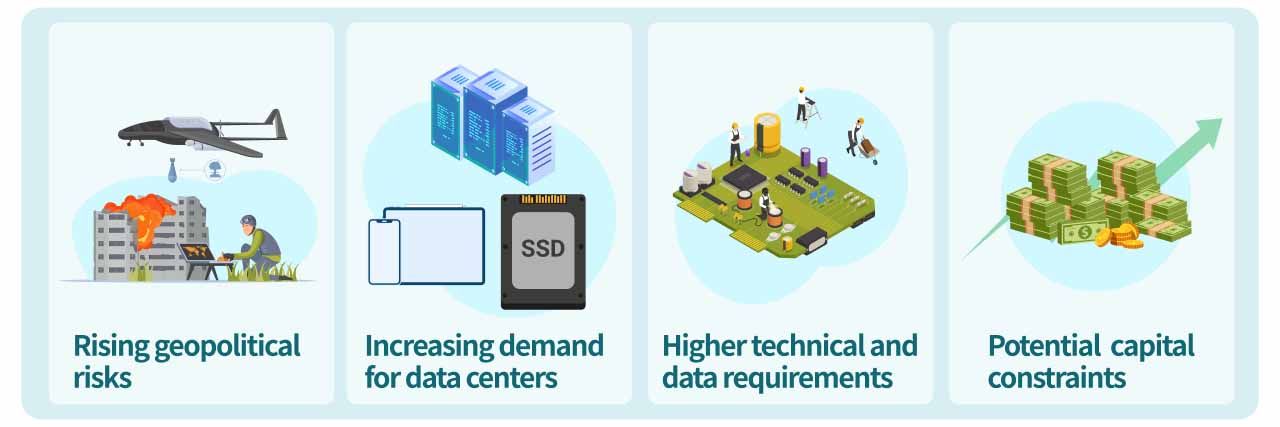
- Rising geopolitical tensions, including prolonged U.S.-Iran conflict and potential disruptions in the Strait of Hormuz, could drive oil prices sharply higher and impact the global economy. Additionally, U.S. tariff policies and advanced chip export restrictions introduce uncertainty to the semiconductor industry.
- Strong data center demand is driving rapid growth in memory demand, crowding out supply for consumer electronics. This forces downstream manufacturers to raise prices, increasing costs that are passed on to end consumers. However, higher prices may suppress demand and delay recovery in the already weak consumer electronics market.
- As semiconductor performance continues to improve, demand for advanced materials also increases, leading to structural supply tightness in substrates and upstream materials such as fiberglass cloth and copper foil. If capacity expansion lags demand growth, supply bottlenecks may emerge.
- Disruptions in private credit markets could impact AI data centers, computing infrastructure, and expansion projects that rely on external financing, potentially delaying deployments or reducing capital expenditures, and affecting order visibility across servers, networking equipment, power systems, and upstream semiconductor supply chains.
Summary
Overall, the U.S. semiconductor industry spans the full value chain—from upstream IP/EDA, IC design, equipment, and materials, to midstream foundries and IDMs, and downstream packaging and testing—forming a highly specialized and interdependent ecosystem. Benefiting from the transition of AI from training to inference, the expansion from cloud to edge applications, and continued capital investment from cloud providers and sovereign AI initiatives, the semiconductor industry is expected to maintain steady growth in 2026, driving demand for high-performance computing, memory, and advanced packaging.
However, despite the optimistic outlook, it remains important to monitor downside risks, including geopolitical tensions, raw material and key component supply constraints, slower-than-expected recovery in consumer demand, and potential financial market disruptions.
